Arts & Entertainment
Stages of a Painting: Parade Scene, Part 1
Anthony Pellegrino's photo, winner of the Painter's Eye, Camera's Lens Competition, is the inspiration for a painting.


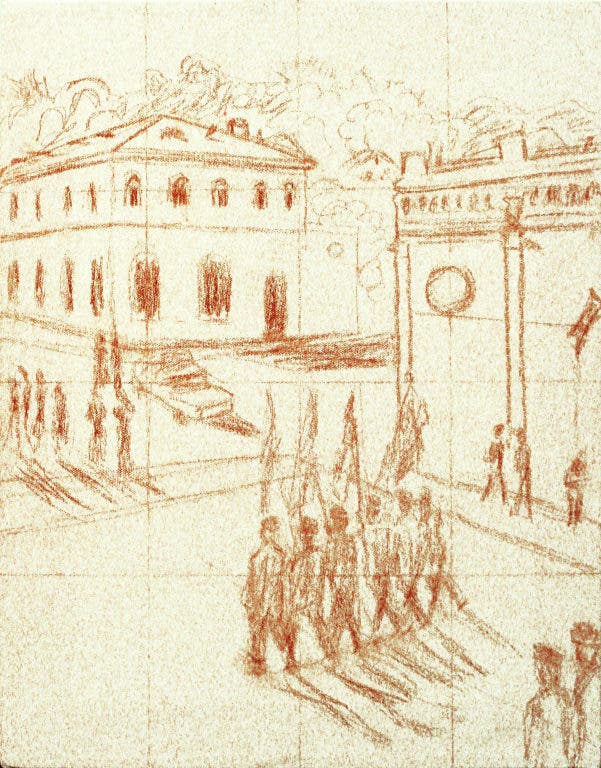
It never gets old for me. I sit down to a blank canvas and an hour or so later I have the coppery first stage of a new painting. The transformation still seems to me a miracle, like making a new living thing. Anthony Pellegrino’s fine photo of a parade at Broadway and Main Street, winner of the , is morphing into a painting.
For me, the experience of looking at the photo is very different from that of looking at the drawing. In the photo I see a complete scene with a lot of information. In the drawing I see “handwriting” and movement in the lines of the foreground objects and the squiggles that depict the background trees. The drawing somehow looks a little Van Gogh to me, although the photo doesn’t at all. How did that happen? It’s the same scene with less detail. Maybe it’s partly the way I indicated the trees, and my version of the architecture of the landmark bank building on the east side of Broadway. I am reminded of his famous 1888 painting now at the Van Gogh Museum, The Yellow House in Arles, with its vibrant and loosely painted buildings including Vincent’s own house. My finished painting will be less like a Van Gogh, because detail will bring it into the present and show my particular hand in it more. Like Vincent, though, I will be using vivid colors, because I enjoy them. The caressing nature of brushstrokes on canvas will be visible to those who are sensitive to it. Detail will be less than in the photo, but everything that is important will be clear enough. The flags will give not only great color but increased feeling as well.
Anthony’s basic composition remains the same in the drawing, but I’ve made changes to enhance it. I’ve removed the shadow at bottom left, and also the shadow that looked like it shot out from under the police car but wasn’t the car's shadow. It presumably was cast by the pole on which the traffic light sits, but it was nowhere near that and didn’t look right. Most notably, in a visual, psychological sense, it seemed to be a barrier for the approaching marchers.
Find out what's happening in Tarrytown-Sleepy Hollowfor free with the latest updates from Patch.
I’ve cropped some of the sky to make a more active composition. I’ve changed the direction of the police car a little bit, and that little bit makes an important difference. Even though when we look at it in the photo we know that it was blocking the intersection to protect the marchers, visually it looked like it was heading towards them. It broke the direction of the action in an uncomfortable way. I’ve turned it slightly counterclockwise so its direction is parallel to the march. Everything counts in a painting.
I’ve left out the truck on Broadway for now. I’ll have to go there to see what it obscured. Chances are I’ll prefer that and use it instead of the truck. As I’ve said before, I’m not impressed with the artistic qualities of motor vehicles, despite their other, rather important, uses.
Find out what's happening in Tarrytown-Sleepy Hollowfor free with the latest updates from Patch.
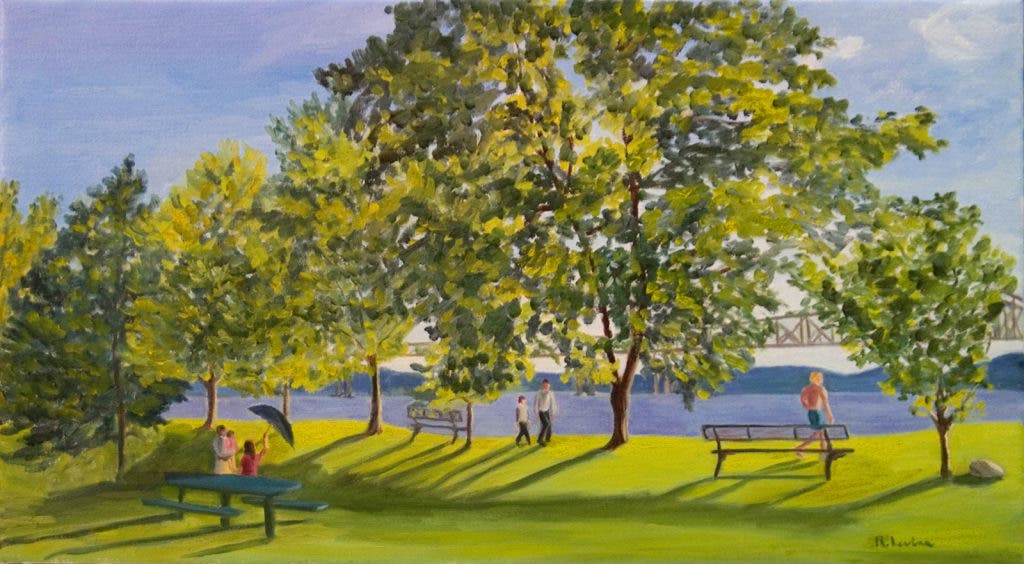
I change my own photos, too, when I select one for painting. Check out a photo I made at Pierson Park and my painting from it, Tarrytown: Late Afternoon at the River. You’re going to have to look carefully at the photo to recognize the connection, because I’ve cropped it a lot, and you’ll see that my style of painting is definitely not photorealism. Anthony’s photo won’t be changed nearly as much as I changed my own in this case.
I look at the photo and I see the march. I look at the drawing and I feel the march. I am grateful to be able to live in this scene as I work on it and as I look at my work in progress.