Community Corner
Agonizing Wait For Wife Of Boater Claimed By Lake Travis
Three weeks since man drowned, wife waits for his body to be recovered from depths of a beautiful, yet deadly, lake where death count grows.


AUSTIN, TX — It's been three weeks since Manuel Salas went into the water at Lake Travis without resurfacing as his wife watched in horror from their boat. As the days turn into weeks, with his body yet to be recovered, Roseann Salas is slowly resigning herself to the idea the reservoir amounts to her husband's watery grave.
"He was the rock of the household," Roseann said during a telephone interview with Patch on May 24 — 19 days since her husband went into the water on a sunny day on May 5, the last day she saw him alive. "I don't even have the will to live anymore," she says midway through the conversation, breaking down emotionally after meticulously recalling the moments leading up to her husband's drowning. "But I know tomorrow is another day."
It was a beautiful, sunny day when Roseann, 48, and Manuel Salas, 53, decided to hit the lake for some much-needed relaxation. It was Cinco de Mayo, a Mexican holiday of vague provenance to most Americans but effectively appropriated by marketers as a day to party. Manuel and Roseann had a different plan, taking advantage of a rare day without their kids or grandchildren around as the perfect chance to spend quiet time together, just the two of them.
Find out what's happening in Austinfor free with the latest updates from Patch.
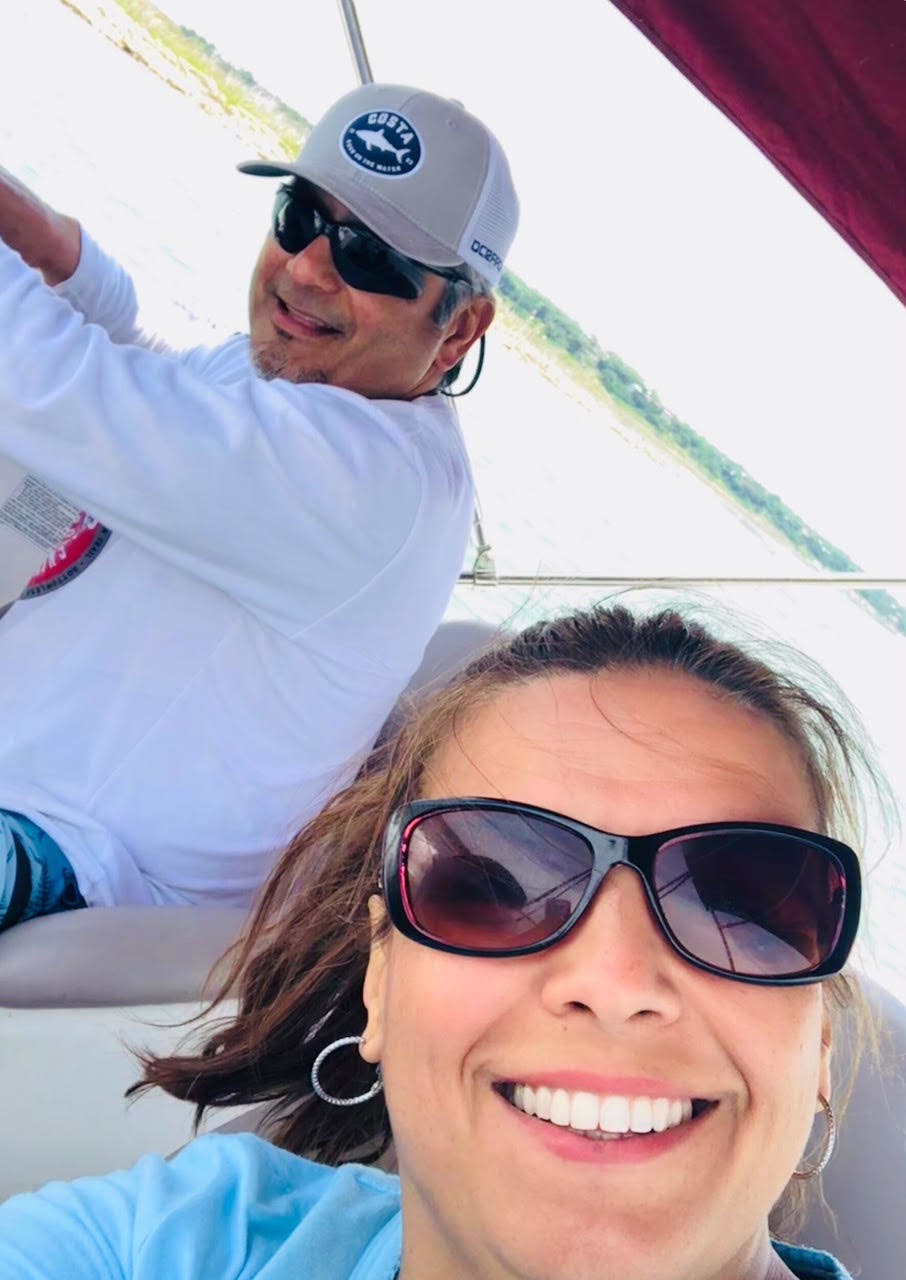
Manuel and Roseann Salas on a previous excursion at Canyon Lake
They were still in the honeymoon phase of their marriage, having gotten married in February. Co-workers at Sun Coast Resources Inc. — where he worked as a driver and she in the human resources department — the two got to know each other better last August when Hurricane Harvey slammed into the Texas Gulf Cost. As a driver for the Houston-based fuel transporter, Manuel drove his big rig across the ravaged landscape, delivering much-needed fuel to hospitals, prisons and other places where the power was knocked down by hurricane winds.
Find out what's happening in Austinfor free with the latest updates from Patch.
Roseann says that's when she got to better know the man who would become her husband as the two interacted for work purposes. Each had found love the second time around after earlier marriages had ended in divorce. Roseann has a grown, 28-year-old son and two grandchildren, while Manuel is survived by three daughters ages 28, 21 and 13.
A bond forged amid natural disaster
"Throughout that time, we had established a strong contact," she said, recalling the bond they forged as Hurricane Harvey raged. But in mid-courtship, he found himself on the road from August to January as he frantically tended to the needs of those urgently needing fuel in the hurricane's aftermath. They would see each other intermittently — "hundreds of hours on the phone and Facetime," Rosann added — until he said to her "Ro, you're coming home with me," she recalled. So in January she quit her well-paying job and sold all her belongings to be by his side.
"He swept me off my feet," she recalled. "The man sent me roses for six weeks in a row. 'I'm not going to stop until you say yes,' " she recalled him telling her after he proposed. "I've been very independent, the kind of woman who would say 'I don't need no man,' she said with a quiet laugh. "But there was something about him that made me willing to surrender, because I trusted him."
May 5 was that rarest of days when it was just the two of them with no kids or grandchildren around, no other family members needing their time — the perfect opportunity for a romantic weekend getaway. Manuel suggested a trip to Canyon Lake just outside San Antonio, deciding at the last minute on Lake Travis instead. After driving around the lake for a while, Manuel circled a sandbar and settled on a spot just off Mansfield Dam.
"That was my first time there, but he knew the lake very well," she said. "He was very familiar with the lake, but being familiar and boating are two different things," she said in retrospect.

Manuel Salas
As is often the case when tragedy strikes, Mrs. Salas said it all happened so fast. "We had just launched, just gotten in the water," she recalled. At some point, he decided to drop anchor, but the weight didn't hit bottom despite the 75-foot line he had attached to the anchor, she recalled him mentioning to her, astonished. Patch has learned the area where he tried dropping anchor has a depth of 140 feet.
So Salas started puling the anchor back up before telling his wife "I gotta go," she recalled, handing the line to her as he went into the lake to relieve his bladder. She said the two hadn't been drinking alcohol, but nature invariably calls nonetheless.
"My attention was pulling in the line," she told Patch. "It was maybe two minutes. He jumped in. I didn't know he was going to jump in; I didn't think anything of it. I heard the splash, but didn't hear him screaming or see him flailing, nothing."
Instead, she heard him tell her the boat was slowly drifting away, prompting her to gradually put the craft in reverse gear. She could still see her husband treading water, but sensed something was amiss.
"His head was above water, but I knew he was not going to make it," she said. "His mistake was jumping in without a life vest," she added, noting there were plenty of them on deck. If only he had put one on before jumping into the water, she said, her voice trailing off in envisioning what could have been.
They arrived at their selected spot at 3:05 p.m., she recalled. By 3:30 p.m., he was gone.
Given the nature of his job, Manuel had a commercial drivers's license (CDL), which imbued him with a sense of responsibility behind the wheel. That same level of responsibility was further honed after 15 years spent driving big rigs for Sun Coast Resources, she noted. "There was no drinking. He was a CDL driver, so he was very careful and safety-conscious. He bought $400 worth of life vests for everyone in the family."
The days since his disappearance have been agonizing ones for Roseann, days filled with paralyzing sadness tempered with anger. She claims it took a full 30 minutes for emergency responders to get to the site where her husband went underwater after she placed the first 911 call. She says county officials attributed the delay to having just two rescue boats covering the entire surface of the massive lake.
In an emailed response to questions from Patch, Travis County Sheriff's Office spokeswoman Kristen Dark acknowledged it took half-an-hour for a lake patrol boat to reach Salas. But she added that others responded quicker, including those in nearby vessels, in attempts to provide aid.
"It did take 30 minutes for a lake patrol boat to get to her," Dark wrote. "It was coming from Pace Bend Park. Nautical miles take longer to travel and it was a Saturday afternoon so our deputies were navigating boats, jet skis, skiers, swimmers, etc."
She added: "That being said, there were multiple emergency responders engaging the effort. There were 4 Parks units, 2 fire, several EMS and Starflight. A TCSO deputy was at Mansfield Dam Park within 6 minutes."
Flood control reservoir contains hidden dangers
Formed in 1942 by the construction of the Mansfield Dam on the city's western edge, the reservoir was built specifically to contain floodwaters in an area prone to flash flooding. Lake Travis now has the largest storage capacity of the seven reservoirs known collectively as the "Highland Lakes," stretching 65 miles upriver from the western Travis County down a serpentine path stretching into southern Burnet County to Max Starcke Dam then southwest of Marble Falls. The Padernales River, a major tributary of the Colorado River, flows into Lake Travis from the southwest.
Despite its original utilitarian use as a flood control structure, the lake is now used as a water supply source, electrical power generation and recreation. It's a bucolic lake to be sure, its beauty highly appealing to those who love the water. But it's a monster of a lake, its ever-changing water levels contingent on the volume of flood water discharge. Its topography is equally unpredictable ranging from shallow water to unimaginable depths, sometimes plunging precipitously from one step in the water to the next.
In the aftermath of heavy storms, the lake is made deceptively treacherous as levels rise and debris accumulates under the surface. Those changed dynamics were seen as early as 1938 during its construction, when a severe flood prompted the raising of the dam to add additional storage capacity for floodwaters. Added rain water also has the effect of strengthening the currents, a change in velocity that has taken many by surprise.
Many visitors to the lake don't know its hidden dangers and post-storm transformation as they engage in all manner of recreational activities — fishing, boating, swimming, scuba diving, zip lining — at a reservoir originally built for flood control. Yet Lake Travis ranks high among Texas bodies of water in terms of fatalities, clinching the top spot for deaths in 2011 and tied for second place for total deaths from 2000-2015, according to its Wikipedia entry.
Since the tragedy that visited her on May 5, Roseann has been learning more about the lake. She said her sadness is tempered with anger when she remembers the lack of warnings posted other than "no lifeguards" signs; the dearth of buoys in the area around Mansfield Dam she's since learned from officials is among the lake's danger zones; the absence of a medical helicopter on standby on lake grounds, at the ready to quickly arrive on scene and transport victims; the mere pair of patrol boats to safeguard the lake's massive surface.
" 'We only have two boats for all this area,' " the widow recalls an official telling her as she sought help for her husband. " 'There is somebody there, but on other side of the lake.' "This is our state's capital, and it's so sad we don't have the resources readily available, especially a lake that's notorious for these."
The sheriff's office spokeswoman said there are three patrol boats total. "On typical weekends, two of them are on patrol," Dark added. "On holiday weekends, all three are on duty."
As for the perceived lack of warning signs or other alerts, Dark wrote: "We are a law enforcement agency and we patrol Lake Travis in that capacity. We do not manage the lake," referring questions related to lake management to the Lower Colorado River Authority.
Lake Travis death count continues to grow
Manuel Salas is just the latest to be claimed by the lake's deceptive depths. Deaths at Lake Travis are frequent, and tragedy can be counted on especially during peak swimming season. Some have died not knowing how quickly the depths at the lake can become from one step to the next. Just days after the Manuel Salas went under, a woman in her 20s fell into Lake Travis from the upper deck of a party barge on May 19. Her body also has yet to be recovered.
All told, there have been 15 drownings in the last two years at area bodies of water, including Lake Travis — not counting Salas and the young woman who recently drowned, both still categorized as "missing," the Travis County spokeswoman told Patch in a subsequent telephone interview.
In the past few months alone, several have drowned at the man-made reservoir:
- In June 2016, the body of a man in his 30s was pulled from Lake Travis after he went missing in the Little Devils Hollow portion of the lake. The county sheriff's office had received calls about a body that was seen floating on the lake before retrieving the corpse at the Emerald Point Marina portion of the lake.
- In July 2016, a 2-year-old girl drowned after falling off a dock into Lake Travison a Saturday evening. When Travis County Sheriff's Office deputies arrived at the scene, they the child fell off a boat dock at a private residence in the 8000 block of Lakeview St.
- In August 2016, the family of Olman Ramirez took it upon themselves not to give up the search for their loved one who went missing at Lake Travis, ultimately finding his body at south marina shore. The man was reported missing early evening after he jumped into the lake to help a friend who fell from the party boat in which they were traveling on the lake's surface. Family members found the body four days later. A Travis County officials told Patch at the time that stronger-than-normal winds ahead of a line of thunderstorms may have contributed to the drowning, given its effect on the currents.
- On Jan. 19, 2017, Cody Quincy May, 31, of West Haven, Conn., drowned after trying to join his children on a raft, according to Travis County Sheriff's Office officials. Witnesses told police several of May's children were playing on a raft near the shoreline when May began walking out to the raft and suddenly stepped into deep water. He immediately began to struggle while calling for help. A nearby fisherman tried to go to his aid, but arrived too late to save him. May had moved his family to Austin just a week before his death.
- In May 2017, the body of a 21-year-old man was pulled from Lake Travis. The man had been cliff diving after arriving at the site on a party barge filled with friends.
- In June 2017, Travis County Sheriff's Office officials identified Brian Robinson, 31, of White Plains, N.Y., as the victim of a June 11 drowning. Like Olman, Robinson had been on a party barge before falling into the water. Just the day before, Lower Colorado River Authority officials had re-opened Lake Travis after shutting down access on June 6 due to altered flood-related conditions that made it too dangerous for recreational use. Water levels by then began receding after earlier heavy downpours, and stood at a level of just over 690 feet above sea level, officials said at the time.
- In July 2017, Saugata Ghosh, 34, of Austin, was rescued after a near-drowning at Lake Travis, only to later succumb to his injuries. According to witnesses, Ghosh and several friends were swimming near their party boat when he started to struggle in the water, sheriff's officials said.
After mourning in solitude, Salas rejoins family
After retreating to Elgin, where she lived with her new husband, to process her grief alone, Roseann Salas is now in Houston with family members — loved ones who would check in on her in the days after the incident at the lake, extending a familial embrace for comfort and support.
"I stayed in Elgin for two weeks by myself," she said of the days after her husband's disappearance into the lake. "That's just the way I deal with things. Yesterday, I was not having a good day, so I got in the truck and came home. My family's been calling out for me, begging me to come home."
Just as the watery territory of Lake Travis proved unfamiliar to even an experienced swimmer as her husband was, the emotions Roseann now is forced to navigate are uncharted. "I've always been in control, but now I'm finding myself in unknown territory," she said. "I can't work, I can't function."
She once got regular, unprompted updates from emergency officials appraising her of search efforts for her husband's body, she said, but now finds herself having to call for the latest news — despite what she described as palpable annoyance of officials on the other end of her regular, desperate communications seeking closure.
The spokeswoman for the sheriff's office had a different perspective on that front, even while expressing empathy with the widow's need for continual contact: "The first six days after Mr. Salas went missing, we were actively searching using sonar and divers," she wrote. "There were frequent updates because search tactics and methods were changing and she was being updated on progress. When those efforts had been exhausted, the search efforts changed as I indicated in my press release 5-11-18.
"I’m sure the frequency of calls from our agency slowed because new information won’t likely exist until he is found," Dark added. "I spoke to the detective working this case and he told me he spoke to Mrs. Salas today [May 25] and that the conversation was cordial. He told her she is welcome to call him anytime."
On road to recovery after navigating grief
Roseann doesn't know what the future holds for her now, but she does plan to warn as many people as she can about the dangers of boating, and the importance of life vests. Maybe she can form a nonprofit to promote water safety, she wondered aloud. Maybe she needs to alert other media outlets to spread the word about safety when boating, she mused.
Just talking to a reporter helped unburden her of grief, she suggested, fueling her resolve to find something positive to emerge from her inestimable loss. "Today's a really good day," she says, the tone of her voice suddenly brightening. "This is the force that's going to help me get through this. I may have not been able to save his life, but maybe I can save mine and others."
>>> Photos courtesy of Roseann Salas. Mrs. Salas said the uppermost photo was taken 15 minutes before her husband went into the water at Lake Travis and never resurfaced.
Get more local news delivered straight to your inbox. Sign up for free Patch newsletters and alerts.