Health & Fitness
Central Texas Residents Take Stand Against Teen Suicide
In observance of Suicide Prevention Month, thousands are poised to gather for walk this weekend raising awareness to mental health issues.



AUSTIN, TX — It's an act so heartbreaking and tragic as to almost render it unspeakable. But it's an important issue that must be discussed openly, or as mental health officials say: "Now’s the time to have the other “S” talk with your kids."
That "s" word is suicide, and the topic is often a harder task than the ritualistic sex talk parents inevitably have to discuss with their children. Yet grim statistics from the Centers for Disease Control and Prevention highlight the need for parents to start the conversation in the interest of mental health.
In Austin, an estimated 2,000 participants will be taking a stand against teen suicide by volunteering with NAMI Central Texas and participating in NAMIWalks Central Texas on Sept. 28 — educating parents about talking to their children while changing the conversation about suicide and mental health along the way.
Find out what's happening in Austinfor free with the latest updates from Patch.
NAMIWalks Central Texas Quick Facts
- Event date: Saturday, Sept. 28, 2019
- Route distance: 5K
- Scope: 1,870 participants among 170 teams.
- Location: The Long Center, 701 Riverside Dr.
- Event time: Walk Festival and Check-in at 7:30 a.m., start time 9 a.m.
- Contact: NAMIWalks Central Texas, P.O. Box 302398 | Austin, TX 78703. Christina Schneider, community relations coordinator, at christina@namicentraltx.org or (512) 420-9810 ext 1006.
According to the CDC, suicide rates have been on the increase in nearly every state. In Texas, one in eight high school teens reported attempted suicide in 2017 — more than double the national average — in the latest available figures. Suicide looms large among the younger set, the stats show, yielding the second-leading cause of death among those 15-34.
Find out what's happening in Austinfor free with the latest updates from Patch.
Mental illness an indiscriminate scourge
The scourge is indiscriminate, transcending demographics and income bracket. "As a parent, I almost lost my child to suicide about six years ago," Karen Ranus, executive director of NAMI Central Texas, told Patch in a recent telephone interview. "She almost died from untreated depression and anxiety. It is shame that almost killed her, a sense that she was somehow flawed."
It's that lingering stigma attached to suicide prevention that mental health officials are fighting to eradicate: "I firmly believe it is that shame that keeps us from making progress and keeps us from gaining mental health," Ranus said.
Formerly NAMI Austin after its 1984 founding, the organization Ranus heads up is a member of the largest grassroots mental health organization in the U.S., the National Alliance on Mental Illness. Its mission to change the way mental health is addressed is furthered through innovative education, support and advocacy programs offered at no cost to its clients.
Her role at the organization is informed by personal experience. In retrospect, she figured early onset of anxiety and depression was manifested within her daughter as early as 14 before she finally sought help four years later. Had the issues been addressed early, Ranus said her daughter might not have reached the Stage 4 level of illness that chipped away at her ability to cope.
"We thought things were okay," Ranus added. "I just really just recognize now, like I said, for her there was a great deal of shame. Because of that, her anxiety and depression went untreated."
Thankfully, the story has a happy ending. The once troubled young girl is now a flourishing woman in her mid 20s with myriad hopes and dreams for the future. After emerging from the darkness, the young woman six years ago accepted her mother's invitation to the NAMI Walks when she was 19 years old. Ranus recalled an interaction as the event was winding down: "I looked at her and asked if she liked it," she recalled. "She said 'I loved it.' It completely transformed my way of thinking about the walk."
Parents felt powerless after son's diagnosis
Cassandra and Rick Allen can relate to Ranus's ordeal as a parent dealing with a child in the throes of a mental health crisis. Both felt helpless when their son, Ricky, was diagnosed with schizophrenia after struggling with thoughts of suicide while cutting himself and self medicating in desperate attempts at achieving coping mechanisms.
The father recalled not understanding what his then-19-year-old son was going through, thinking he might using drugs when acting strangely at family gatherings. "There were times at the dinner table when he was really spacing out," the man recalled in an interview with Patch. "He was normally very engaged, but from his junior year we starting noticing at family dinners he would just start gazing off. We would literally have to clap our hands together in front of his eyes, and he would come to. I observed this behavior, but couldn't put my finger on it. I would think: Is he on drugs?"
Ricky's mother said her son wasn't diagnosed as an early teenager but just before turning 20. "We did not know he was self-mutilating because he was an athlete," she said. "We'd see a cut and we thought it was due to athletics or playing with the dog. That's the way I explained it away."
To this day, Rick deals with guilt over his initial reaction to the changes he saw in his son. "I was very judgmental and just ignorant of mental illness," he acknowledged. "Without empathy, it's hard to get past anything else. You're not willing to put yourself in your loved one’s shoes. You’re just angry and irritated."
In 2012 came the moment of reckoning for the Allen family, when their son attempted suicide. With the help of a campus minister from whom he sought aid, Ricky finally came clean to his family, explaining what he had long experienced but was too ashamed to talk about: Hearing voices in his head in 10th grade, seeing phantom visions the following school year.
Cassandra, had earned a master's degree in hospital administration for her career in health care, working as a lab director at the time. Yet despite her familiarity with medical settings, she and her husband both felt powerless and ill-equipped to help their son. "We didn’t have a clue how to navigate around mental illness," she said. "We were broken."
After his suicide attempt, the Allens took their son to St. David's Austin Lake hospital for medical evaluation. "Thankfully, by God's grace, we were able to catch him and took him to the emergency room," she recalled of that dark day. "The first time we took our son to that hospital and saw the people he was in there with was the hardest part of my life," she added, recalling how they would have to leave their beloved son at the facility for extended periods as part of his treatment.
In one of those visits, a nurse handed the worried mother a Post-It note with the acronym NAMI scrawled across it while urging her to reach out to the organization for resources. That casual referral would prove transformative for the family in a genuinely life-changing way, Cassandra said. Today, she and her husband are both are trained NAMI Family-to-Family teachers, helping other parents negotiate the painful journey in navigating around mental illness.
Fighting the stigma of mental illness
And Ricky? He's 28 now, enrolled at Austin Community College and thriving. He told Patch during a phone chat he's taking classes toward an associate's degree in creative writing, with graduation coming in December. "I like to play video games and do some writing because I do love to write," he said. As the chat grew deeper, he was reminded of his journey: "I'm shaking because everything is good. How in the world did I make it?" he asked rhetorically but with palpable pride in having emerged from the fog of mental illness.
But it wasn't easy, he acknowledged. "I was having major issues, hearing things and seeing things visually," he recalled. "Some days, I could not get out of bed, would skip school and avoid things that came across my life."
Candidly speaking, it was hell: "I was hearing a lot of stuff that went on inside my head and insecurities flared up. I just felt like a failure. The only thing that helped was football — that was the only thing that kept me going. It got to the point where I fully accepted myself as a failure and shouldn't exist anymore. Having that depression and hearing voices was unbearable and indescribable. It was horrible."
Exacerbating his condition was an unwillingness to tell loved ones what he was going through. "I didn't want to be considered a freak or not normal," he said. "A lot of stigma still exists. Whenever I read books about people who go through mental health problems, it was something to be feared — something scary. I was trying to make a name for myself, and didn't want to have that label."
Further adding to his sense of helplessness was a perceived lack of resources of which he could avail himself. "It was just words on billboards, nothing to give you meaningful insight to move forward and get help."
His journey would lead to NAMI (thanks again to that life-saving Post-It note alerting to NAMI), where he now serves as a volunteer advocate. In that role, Ricky acts as something of a NAMI ambassador in visiting schools, hospitals and police departments in providing insight into mental illness. He recalled the first time he had to give a presentation: "My first speech ever was inside the first hospital I was hospitalized," he said. "I was shaking; I was scared. But it was great and I got very positive feedback," the now-seasoned speaker recalled.
Indeed, NAMI has proved a healthy outlet for the thoughtful young man. But it was the power of love that put him on more stable footing. "I managed to muster up the courage to share my mom and dad, brother and sister. It was completely different than what I expected," he recalled in describing their support and empathy. "They finally accepted me for what I was."
What is wrong with my boy?
After her son Tre was diagnosed with OCD and anxiety disorder at 11 years old, Teena Hale and her family searched high and low for community resources that could help them navigate the school system and support him. It was a simple Google search that would lead her to NAMI Central Texas.
"It was out of the blue and started on a Thursday and got progressively worse," Hale vividly recalled in great detail. In Tre, the condition manifested itself with constant, repeated prayer while expressing a fear of going to sleep, she told Patch. "He had to read the Bible and ask for forgiveness. He wouldn't drink or eat, just pray. By Saturday night, we were trying to seek help for my son."
The episode was taxing on the entire family, she said, including Tre's sister who is 14 years his senior. The onset of Tre's OCD occurred as Hale was just beginning a new job, which served to stress an already taxing situation sparked by what she calls an "invisible illness." She admitted Tre to Dell Children's Medical Center, where he would receive the officials diagnosis while spending about five days hospitalized acclimating to his medication.
She had a hard time understanding her son's behavior, at one point thinking a malignancy might be affecting his actions. "What is wrong with my boy?" she remembers asking herself in desperation. "Is this a brain tumor? What is this?"
Once she linked with NAMI Central Texas, the picture got clearer, she said.
"I went through this journey of stumbling along and wanted to make sure I was educated on this," she said, adding she also hoped to help other families living with a mental health diagnosis realize they’re not alone.
About a month ago, she became a certified basics teacher at the organization that proved to be her lifeline. "I love the education they provide, the certification and the chance to educate other parents," Hale said. "I'm very new to this journey, but excited to be participating."
She plans to extend the sense of celebration this Saturday, when she'll participate in the NAMIWalks Central Texas event with her family — including Tre, now a healthy, 15-year-old.
Mom inspired by her son's brave fight
Sadly, not all stories have such happy endings. Marcia Oakes lost her 17-year-old son, Jake, to suicide two years ago. She and her husband did everything right in recognizing their son's major depression, but in the end it wasn't enough. Oakes learned of NAMI after her son's death, and wishes she had known of its wealth of resources that may have created a different outcome for Jake.
Seeking for something positive to emerge from a type of tragedy that is incomprehensible to so many, she now teaches a 6-week NAMI Basics course along with Let’s Talk courses to other Central Texas parents and teachers in an effort to prevent other teens like Jake from taking their own lives. She is also the captain of one of the top NAMIWalks teams poised to hit the streets of downtown Austin on Saturday with the company of her husband, daughter, family and friends in the name of mental health awareness in her fourth year of participation.
"My dad was a clinical psychologist, and grew up with mental health my whole life — it's not something that was foreign to me or taboo," Oakes told Patch in a note of cruel irony. But sometimes, things that work in theory are harder to achieve in practice: "When I became the mom of a teenager, it changed for me. Suddenly, I felt lost and confused. It was a very scary time."
Jake died in 2015 just shy of his 18th birthday, the mom said.
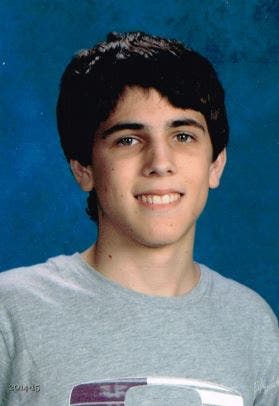
Although Jake lost his battle with depression, his bravery continues to inspire his mother to this day. Yearbook photo courtesy of Marcia Oakes.
In her grief, she gravitated to the NAMIWalks Central Texas in attempts at camaraderie and support from others who have experienced such loss. Those initial steps have turned into giant strides given her robust volunteerism. "I initially started doing the NAMI walk to support those living with mental health conditions and their caregivers, and raise some money. But that was really the extent of it."
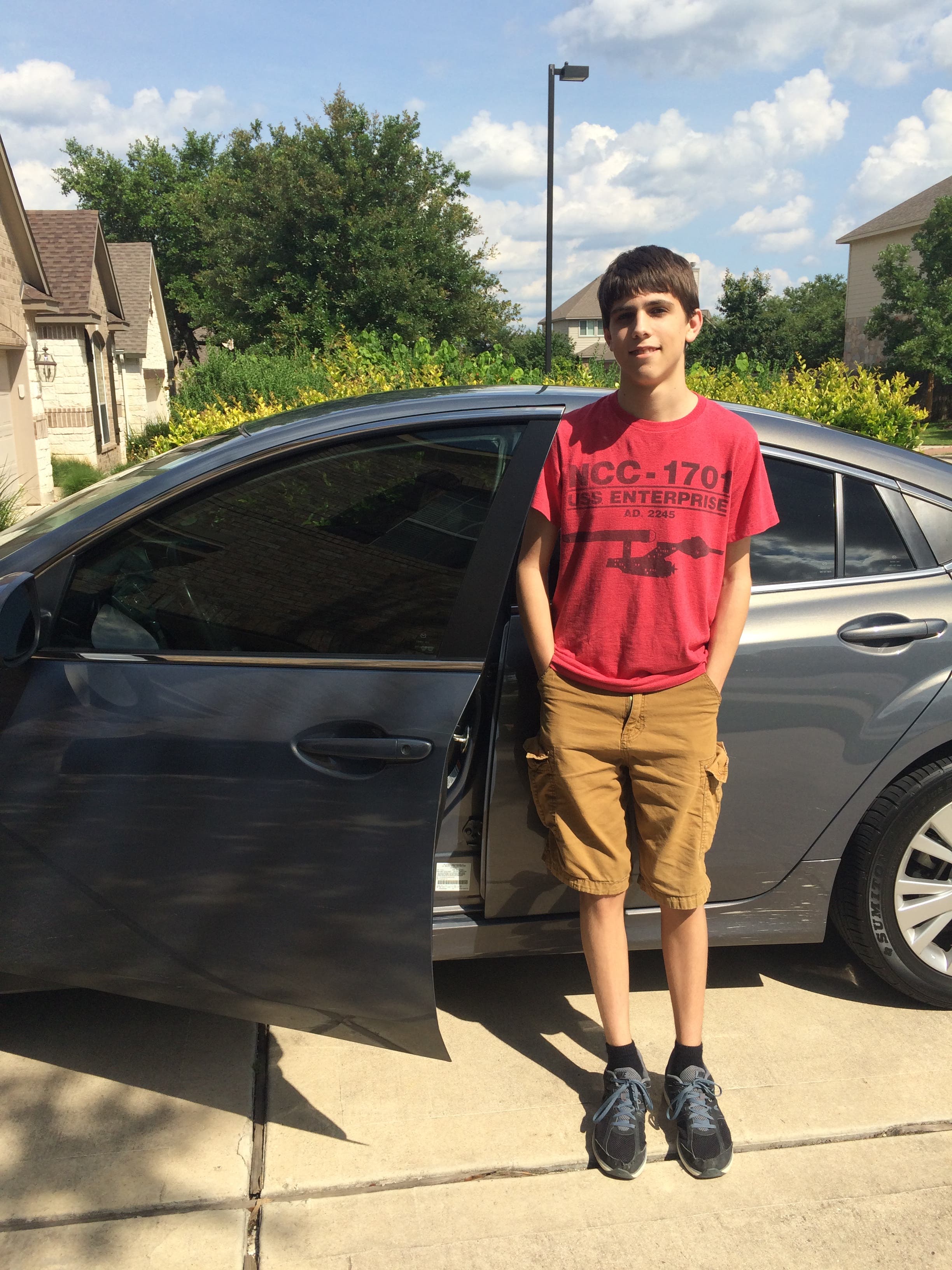
Jake's spirit figures prominently in the life of his mom, who is guided by vivid memories of the bravery he displayed in the final days of his young life. Jake is pictured here at 17 in front of his car after getting his driver's license. Photo courtesy of Marcia Oakes.
With her daughter — who also had faced mental health conditions before being successfully treated — now poised to start college, she found herself with more time on her hands to devote. And even in his physical absence, Jake looms large in inspiring her to do more. I can attest how fiercely and bravely our son fought," she said. "He was an active participant in his treatment, an his bravery to me is very inspiring. If he was that brave, i want to be that brave."
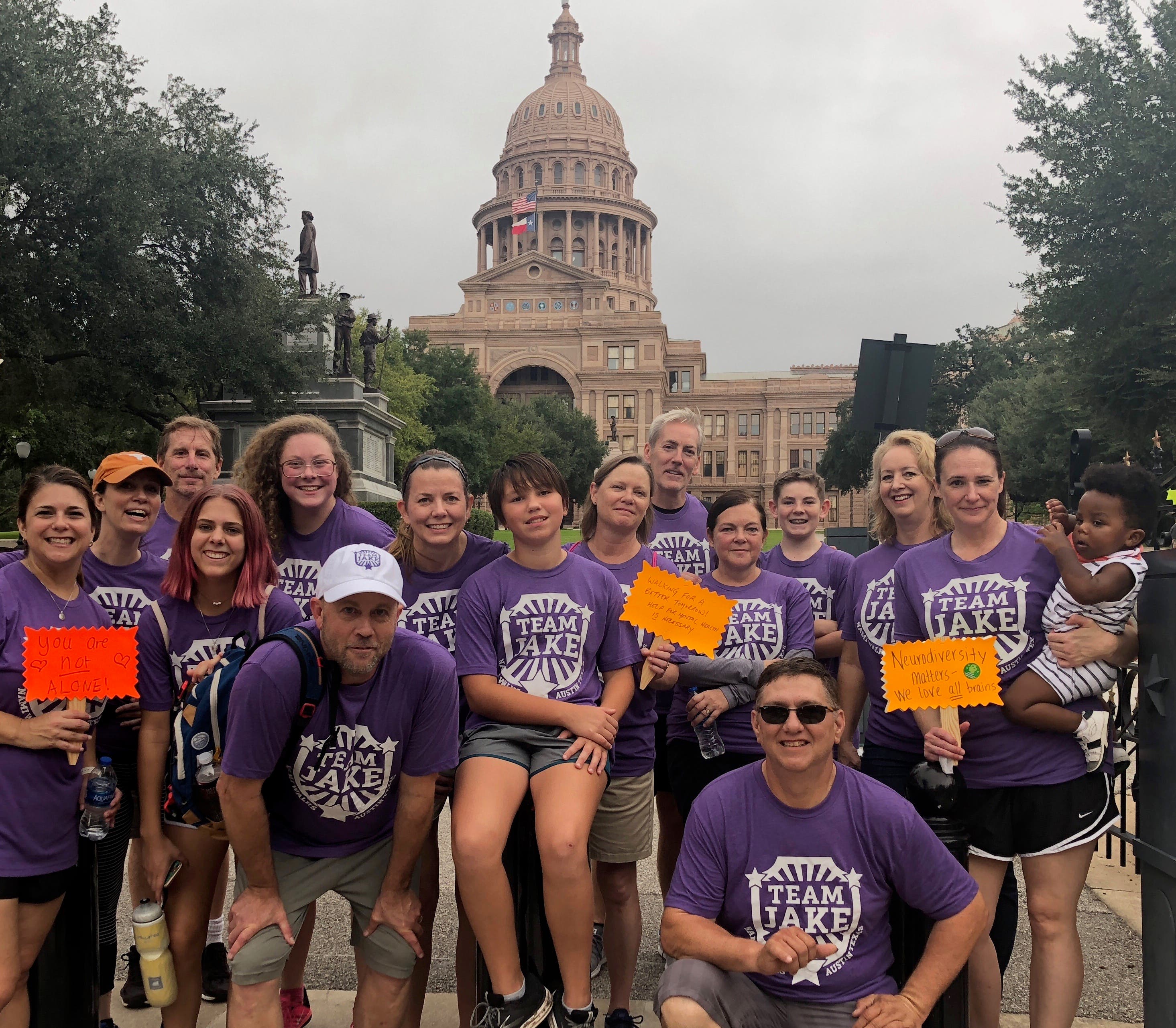
Team Jake poses in front of the state Capitol in a previous NAMI Walk. Photo courtesy of Marcia Oakes.
Ranus, the NAMI Central Texas executive director, said she wouldn't want to underestimate the value of NAMIWalks Central Texas — her organization's biggest fundraiser — in yielding a sense of solidarity in a shared cause. "There's a lot of fun activities, and it's a fun and empowering experience."
Also in abundance at the annual walk is hope. And hope springs eternal.
Get more local news delivered straight to your inbox. Sign up for free Patch newsletters and alerts.