
MAKE AMERICA HEALTHY AGAIN
Dear Mr. President,
Find out what's happening in Greater Alexandriafor free with the latest updates from Patch.
On January 1, 2011 the oldest members of the Baby Boom generation celebrated their 65th birthday. And roughly, 10,000 Baby Boomers will turn 65 today, and every day thereafter, for the next 19 years – until 2030. Dec 29, 2010, Baby Boomers Retire | Pew Research Center. www.pewresearch.org/daily-number/baby-boomers-retire/
What I find troubling about the following narrative is the assumption that most people have enough funds to actually retire. The reality is that most will depend on Social Security as their primary source of retirement income. When net worth figures were examined, the single largest asset for most retiring Americans was their primary residence. It is good to have a paid off home in retirement but no income is generated from this. Then, there are expenses associated with home ownership, such as taxes, insurance, home-maintenance, not to mention the costs of daily living: food, healthcare, and other expenses. Unfortunately, for many retirees, the new retirement plan is a form of working until you pass away.
Find out what's happening in Greater Alexandriafor free with the latest updates from Patch.
Americans do a very poor job of saving money despite being one of the wealthiest countries in the world (although wealth inequality is at record levels). This is partially due to our consumption with a driven economy. People go into mind boggling levels of debt to purchase cars for example. Many will take on subprime auto debt just to purchase a car that is out of their financial reach. Besides, retirement planning is a slow and largely boring process. There is nothing exciting about setting aside a few hundred dollars per month for 40 years. More than one-third of Americans report having less than $1,000 stashed away for retirement:
http://www.mybudget360.com/looming-retirement-crisis-baby-boomer-hit-retirement-age-per-day/
The 2016 presidential campaign slogan dominated the media and excited working class Americans: for the past year:
Make America Great Again
But Dear Mr. President, America will never be great again until it becomes healthy again. I write this because I am a baby boomer who suffered greatly with a chronic autoimmune disease (Lupus) until I changed my diet and lifestyle. And based on current American bureaucratic trends, making America healthy again cannot be accomplished without change - drastic changes in the way Americans eat. You want to take back our country; let’s take back our health at the same time.
This article is dedicated to my generation; the Baby Boom Generation. There is no doubt that baby boomers have and will make their mark on history in many ways. And as we get older we present an ever-increasing challenge for health care and the GDP.
There are some facts presented in this article that are startling, and something you should pay attention to. And as you read through this article, please keep this one fact in mind: the only control you have over health care costs is the control you have over you. The healthier you are, the less you will spend on health care. To that extent, people have the greatest control over their own health in the lifestyle habits and diet they choose.
A major shift has occurred over the past 100 years in the leading causes of death for ALL generations, especially older adults. Once the leading causes of death, Infectious disease and acute illness/injuries have been replaced by chronic, inflammatory, and degenerative illnesses. Today, two of every three older Americans have multiple chronic conditions, and the treatments for this population accounts for 66% of the country’s health care budget.
Medicare (and Social Security) are running out of money! According to Fortune Magazine, the U.S. Federal Program will exhaust reserves in 2028, earlier than expected, and Social Security and Disability trust fund reserves are estimated to run out in 2034. This is not a good prospect for baby boomers, and more importantly, catastrophic for Generation X and Millennials. Why? Because my generation, the Baby Boom Generation, is plagued with costly chronic diseases; chronic health disease that present a clear and present danger to our economy. We are keeping people alive longer with VERY expensive technology, treatments and medications.
We know it is our own fault. This will come as no great shock to you, but the Standard American Diet (SAD) is dreadfully unhealthy; it is sad. Our Society and Government have made it so easy for us to become unhealthy eaters by supplying us with fast food restaurants on every corner. We have become lazy. It’s so much easier to go to MacDonald’s for lunch than to get up 30 minutes earlier and pack a healthy salad or last night’s leftovers. The conveniences we have and enjoy today are costing us our health. For example, drive-thru fast food eateries are now more crowded than the restaurant itself. We do not have to leave the comfort of our home to go shopping! Instead, we sit on our couches, sipping coffee and eating donuts, and use our laptop computers to order online our groceries, clothing, drug store items, and Pizza delivery for dinner. Chronic disease and poor health is just as great a threat to our great nation as terrorism, violence, and drug addiction. No my friends, the U.S is not fairing very well when it comes to health improvement initiatives.
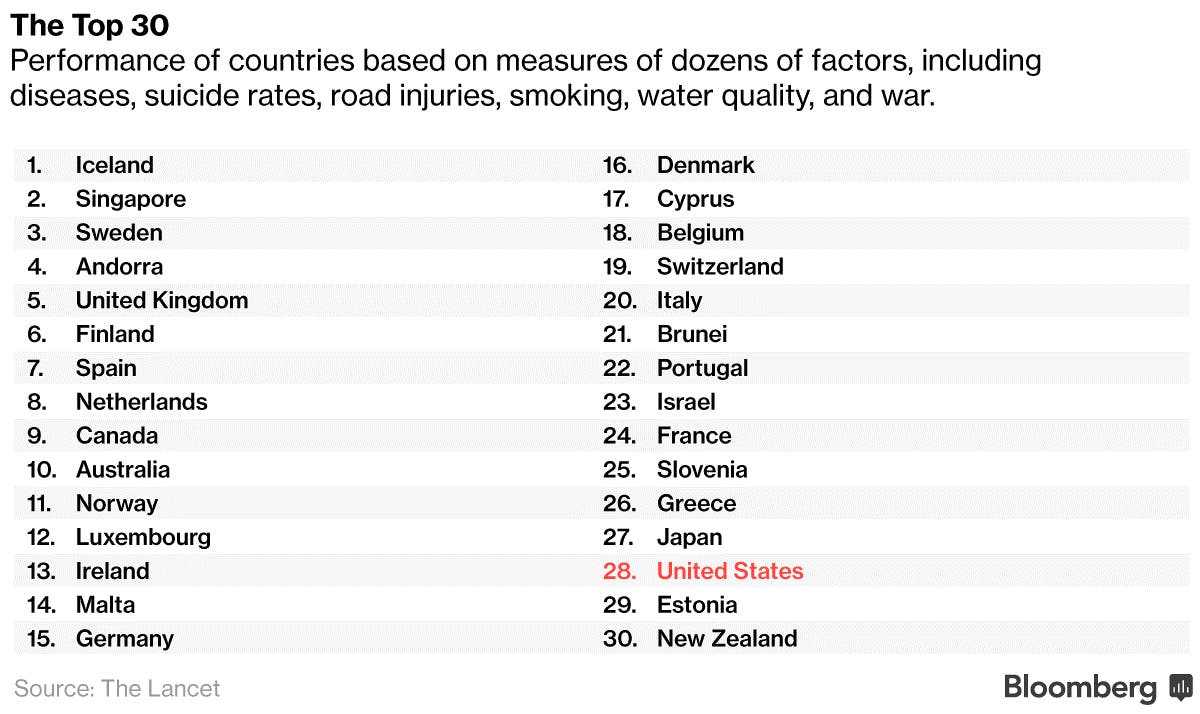
America Is Not the Greatest Country on Earth. It’s No. 28. “A massive study emerged from a decade-long collaboration focused on the worldwide distribution of disease. More than a year ago, the researchers showed how their data might help measure progress on what may be the single most ambitious undertaking humans have ever committed themselves to: survival. In doing so, they came up with some disturbing findings, including that the country with the biggest economy, not to mention, if we’re talking about health, multibillion-dollar health-food and fitness industries, ranks No. 28 overall.”[1] The Scandinavian countries of Iceland and Sweden, along with Singapore, took top ranking.
Oh, how the tables have turned. Hundreds of years ago, persons of wealth and means were overweight and obese because they could afford good food and they employed servants to do their work. The working population was generally fit, lean and strong. They worked long hours and very hard without many of the conveniences we enjoy today. There was no junk or processed foods; they relied totally on the crops they tilled each year and were lucky to afford some animal protein on occasion. People may have died younger, but they did not die from the chronic diseases that kill Americans today. Our ancestors died from the elements, such as the environmental events, infections, and untimely accidents/injuries. Diseases such as diabetes, cardiovascular disease, and cancer were low on the totem pole when compared to infectious disease epidemics, e.g. influenza, polio, malaria. The battle against epidemics was won with the introduction of antibiotics and vaccines. And yet today, America is waging another kind of war against other self-inflicted, man-made epidemics; ones caused unhealthy eating and behavioral habits, like smoking and obesity.
Americans are not aware that the cost of chronic disease is accelerating at a very rapid pace, in part, because people are living longer. People can survive a lot longer due to advances in medicine and technology and their reliance on very expensive drugs and therapies. Health care expenditures now accounts for 20% of the GDP. If this trend continues, health care expenditures could account for ± 50% of the GDP by the year 2050. And while this may not matter to baby boomers who won’t be around to experience such gross inflation, our children and grandchildren will bare the burden.
Most concerning, Baby boomers, fast approaching or currently enrolled in “Medicare,” are in for a rude awakening. The coverage we once enjoyed though employer-sponsored or private insurance plans will become a thing of the past. Services such as home health care and medical equipment are now limited. Prescription drugs, especially the newer, more expensive ones are either non-covered or so expensive that our seniors who live on limited social security incomes cannot afford them. As a health care professional directly involved in the day-to-day care of the sick and elderly, coverage is not getting better, it’s getting worse.
For those Americans who are still enchanted with Obama Care, are you aware that under the current ObamaCare system, a half-trillion dollar will be cut from Medicare over the next 10 years to pay for it? These cuts are untenable and will lead to substandard care for seniors. The cuts in Medicare Advantage will impose hefty costs on millions of Medicare beneficiaries and will fall disproportionately on the low income and minority seniors.
A Federal survey demonstrated that most Americans have serious economic worries. Forty-six percent of adults surveyed say they cannot cover an unexpected $400 medical expense; they would have borrow or sell something to do so. The majority of lower income Americans said they would not be able to cover an emergency room charge and some 38% of middle-class Americans reported they would have trouble as well. Even 19% of those making ± $100,000 a year said they could not pay the bill promptly either. Worse, many Americans are delaying or avoiding much-needed medical care because of the high cost of deductibles, co-insurance, and co-pay expenses.
According to Consumer Reports, since the year 2000, incomes have barely kept up with inflation as insurance premiums have more than doubled. The average employer family health plan that cost companies $6,438 per staffer in 2000 shot up to $16,351 by 2013.
According to the New York Times, “The last few years have seen a puzzling and welcome new trend in health care spending: Instead of going up and up, increases have slowed way down. Since health care costs are growing more slowly than they have in decades, they’re making budget forecasts look better and better. But health economist, Uwe Reinhardt, a Princeton professor has cautioned against over-interpreting the recent good news: “We don’t know what the hell is going on,” he said.”[2]
But don’t rejoice yet. I predict, based on my professional health care (oncology) experience, the decline in spending is a result of tighter control and less coverage for Medicare recipients coupled with the fact that people who have health care coverage can’t afford to use it. Many people do not experience 100% coverage until they meet their deductible and out-of-pocket expenses. Even then, they are still bound make their treatment co-pays.
Unfortunately, I’m one of them. I always think long and hard before seeing a doctor for something I suspect may resolve without medical intervention. And in time, we will start to see people presenting with illnesses that, if detected early through routine care and screenings, could have been prevented or cured more cost-effectively had their Medicare health coverage been more affordable.
[1] Roston, E. 2016, September 22. America is not the Greatest Country on Earth; it’s No. 28. Bloomberg News.
[2] Sanger-Katz, M. 2014, July 14. Expected Health Spending Declines (Again). The New York Times. Retrieved from http://www.nytimes.com/2014/07...