Neighbor News
Monarch Motivation: Raising Butterflies in Alexandria
Dive deep into the fun and rewarding benefits of a butterfly garden.

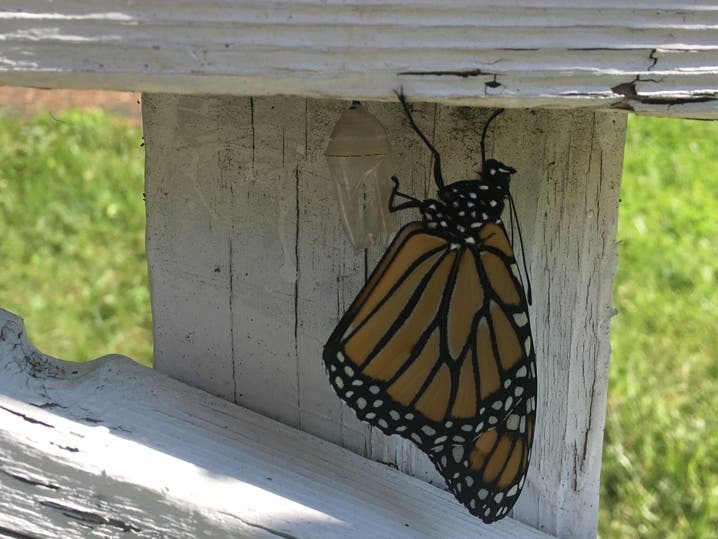
If you've been thinking about starting a monarch butterfly garden, check out this great piece by Angela Logomasini at DCRegionRealEstateNews.com:
For the past several years, I have devoted space in my garden for a monarch butterfly habitat and have raised and released butterflies at the end of each summer. I learned quickly that rearing these glorious creatures is not for the faint of heart; it’s work and sometimes heartbreaking as caterpillars frequently fall victim to pests, disease, or injury. But when you get to see one of your butterflies open its wings and fly off into the blue sky, it’s like getting a glimpse of heaven, making it worth all the effort.
If you are thinking about starting a garden for monarch butterflies or are just curious about the process, read on. Here I share my experiences and offer some tips based on what I’ve learned.
Find out what's happening in Greater Alexandriafor free with the latest updates from Patch.
Among some of nature’s most amazing creatures, monarch butterflies breed throughout the United States and Canada, and then the last generation of each season migrates to Mexico and southern California where it hibernates in forests until spring. When the weather warms up, they migrate back to breeding territories. Of course, it’s a little more complex than this, and you can certainly delve deeper elsewhere if you’d like.
Milkweed is a Must
Find out what's happening in Greater Alexandriafor free with the latest updates from Patch.
The cornerstone of a butterfly garden is the milkweed plant, which is the only food the monarch caterpillars eat. The butterflies lay their eggs on the leaves, and tiny caterpillars then emerge and feed on the plants until they are about an inch and a half long and a bit plump.
Once mature, the butterfly caterpillars produce a string-like fiber that adheres to a fence post, twig, or other fixed object, from which they then hang upside down in the shape akin to the letter J. After a few days they molt, forming a casing called a chrysalis, which is similar to, but different from, the cocoons formed by moths.The butterfly develops inside the chrysalis for a couple of weeks before emerging and unfolding its amazing wings. It then will hang upside down for a while as its soft floppy wings fill with a fluid that eventually hardens in an hour or two, making it possible for the butterfly to eventually fly. But if the butterfly wings don’t hang straight, they can dry deformed, and the butterfly is doomed. Accordingly, it’s essential to their survival that they hang undisturbed until their wings are ready for flight.
Continue reading here.
Angela Logomasini and her husband Christopher Prawdzik are licensed Realtors® with Samson Properties in Alexandria. Operating as D.C. Region Real Estate, they serve the Virginia, Washington, D.C., and Maryland real estate market and offer comprehensive real estate services, including 4½% full-service listings.