Politics & Government
Letter: Unions Urge Governor To Sign Tysons Casino Bill
In a letter to Gov. Abigail Spanberger, a coalition of unions outline the reasons why they support the Tysons casino legislation.

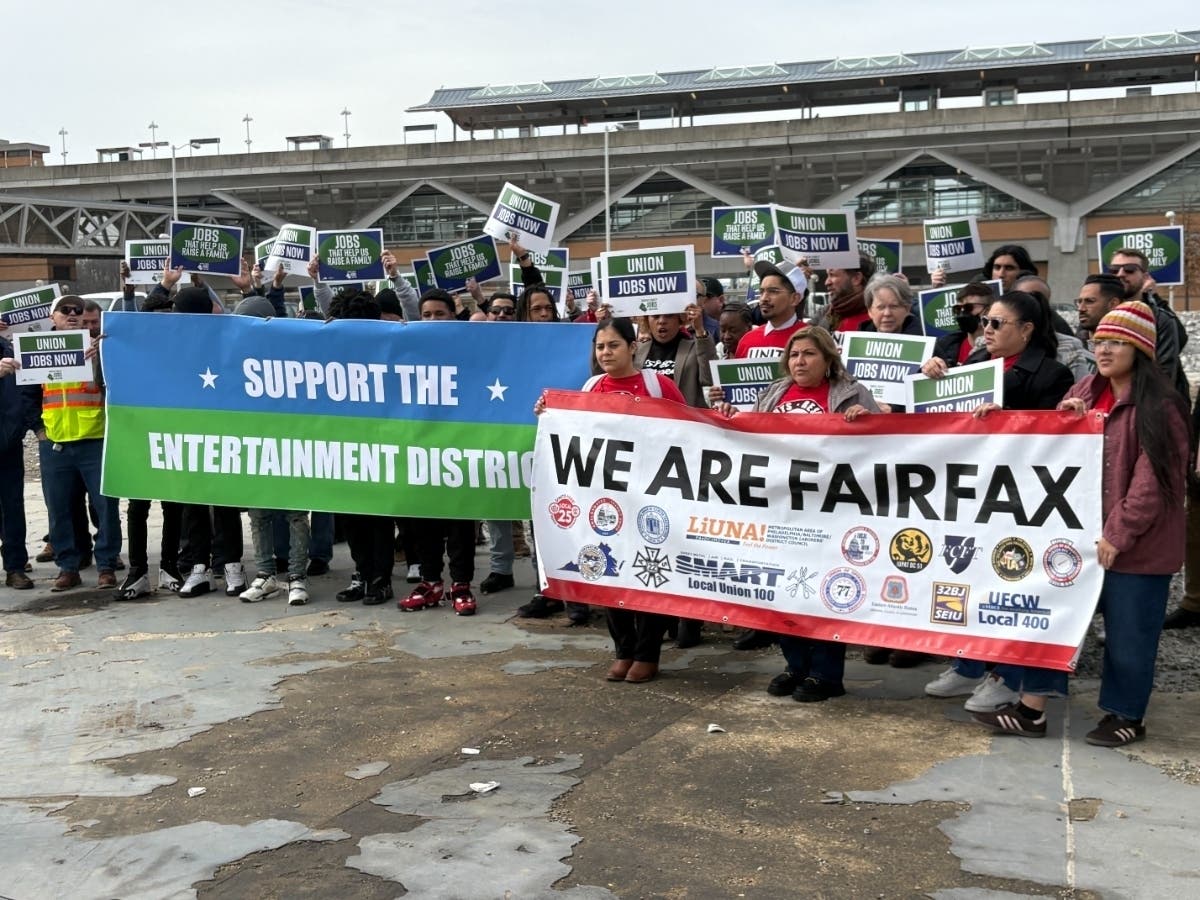
TYSONS, VA On March 19, a coalition of labor unions from Northern Virginia sent the following letter to Gov. Abigail Spanberger (D), asking her to sign Senate Bill 756. If the governor signs the bill, it would pave the way for a casino and entertainment district to be built in Tysons near the Spring Hill Metro station.
Dear Governor Spanberger:
We, the undersigned labor organizations representing tens of thousands of working men and women in Fairfax County and the surrounding Northern Virginia region, write to urge you to sign Senate Bill 756, which would authorize casino gaming in Fairfax County. We believe this legislation represents one of the most significant economic development and affordability opportunities before working families in our community in a generation.
Find out what's happening in McLeanfor free with the latest updates from Patch.
I. Fairfax County's Cost of Living and Tax Burden Are Driving Working Families Away
Fairfax County has long been Virginia's economic engine, but that engine is sputtering under a cost of living that has become unaffordable for working families. With more than 1.15 million residents, Fairfax County is larger than eight U.S. states and yet it lacks even a single convention-class facility capable of hosting a major conference, trade show, or large-scale public event. That absence is not merely an inconvenience; it is a structural gap in the county's economic infrastructure that costs the regional economy hundreds of millions in convention and event revenue that flows instead to Washington, D.C., and other jurisdictions. A casino resort development, as contemplated by SB 756, would fill this gap with a large-scale mixed-use facility embedded in a transit-oriented, Silver Line corridor site.
The tax burden on Fairfax County homeowners and renters compounds the problem. Fairfax County has the highest property tax rate in Northern Virginia of $1.1225 per $100 of assessed value while facing a $150 million deficit. Loudoun County's $0.0805 rate is approximately 30% lower than Fairfax County while facing a $250 million surplus. This disparity is not explained by superior services—it reflects the structural reality that Fairfax County's residential property base must shoulder an enormous and growing share of the public cost of running the largest local government in the Commonwealth. Working families who do not work in tech, federal contracting, or law are increasingly unable to bear that load.
Find out what's happening in McLeanfor free with the latest updates from Patch.
The consequences are now quantifiable and alarming. New population estimates from the University of Virginia's Weldon Cooper Center show that from 2020 to 2025, Fairfax County saw 38,495 more people move out than move in—an out-migration figure nearly 32 times larger than the net out-migration from all of rural Virginia combined. Our members are among those being displaced. They are the hotel workers, the building tradespeople, the culinary professionals, the retail clerks, and the transportation workers who commute longer and longer distances because they can no longer afford to live in the community where they work. Fairfax County desperately needs new revenue sources that reduce the burden on residential property taxpayers, and SB 756 provides exactly that.
II. Casino Gaming Will Generate Substantial New Revenue and Reduce Tax Burdens
An independent market analysis commissioned for JLARC by The Hartmann Group projects that a Fairfax County casino would generate between $418 million and $682 million in annual gaming revenue in its first year of permanent operation, depending on the scale of development. Critically, approximately 90 percent of that revenue represents net new money entering Virginia's economy—primarily by repatriating the estimated $800 million to $1 billion that Northern Virginia residents currently spend annually at casinos in Maryland and West Virginia.
It is important to note that the Hartmann Group's projections are deliberately conservative. The analysis models a Fairfax casino generating approximately 70 percent of MGM National Harbor's current annual revenue as its base-case assumption—a significant underestimate in the judgment of many gaming industry analysts. MGM National Harbor currently generates approximately $850 million per year in gaming revenue, and it does so from a site in Prince George's County, Maryland that is less conveniently located for the majority of Northern Virginia's population than any site along the Tysons/Silver Line corridor. A casino embedded in Tysons—one of the most densely developed, transit-accessible, and affluent commercial corridors on the East Coast, with direct Metro access and proximity to millions of Northern Virginia residents—would benefit from structural advantages that National Harbor does not enjoy.
Most informed gaming industry observers believe a well-capitalized, well-located Tysons casino would meet or exceed MGM National Harbor's current revenue, not generate 70 percent of it. If that assessment is correct, the revenue projections, the school construction fund contributions, and the local tax benefits described throughout this letter should be understood as floors, not ceilings.
The fiscal impact for Fairfax County alone would be transformative. In addition to local casino tax revenues estimated at $27 to $49 million annually, the county would receive substantial real estate tax revenue, projected meals and hotel tax receipts, and ancillary economic activity from an integrated resort development. Based on a $1 billion casino project, total Fairfax County tax revenues including casino taxes, real estate taxes, meals taxes, hotel taxes, and admissions taxes could approach $146 million annually. Every penny of real estate tax reduction in Fairfax is worth approximately $30 million. Casino revenues of this magnitude could meaningfully lower the property tax rate, providing direct relief to every homeowner and renter in the county.
The state also benefits substantially. The net increase to Virginia state tax revenue, after accounting for any in-state competitive impacts on existing gaming facilities, is estimated at $55.6 million under a $300 million development scenario and $110.4 million under a $750 million integrated resort scenario. Under SB 756, the majority of that state revenue flows directly to the School Construction Fund—an investment with profound statewide significance, as described below.
III. SB 756 Repatriates Hundreds of Millions of Virginia Dollars Currently Flowing to Maryland and West Virginia
Every year, Northern Virginia's residents send an estimated $800 million to $1 billion in gaming revenue across state lines to Maryland and West Virginia. This is not an abstraction. These are Virginia tax dollars, Virginia paychecks, and Virginia consumer spending that leave the Commonwealth and are taxed by other states, used to fund their schools and public services, and captured by out-of-state corporations. The primary beneficiary is MGM National Harbor, which—as noted above—is the highest-grossing commercial casino in the United States outside of Nevada. MGM's extraordinary success is built, in significant part, on Virginia residents who have no in-state alternative.
The Hartmann Group's independent analysis, prepared for JLARC, estimates that in year one of permanent operation, 38 to 40 percent of a Fairfax County casino's projected revenue would represent direct repatriation of Virginia resident gaming spend currently flowing to out-of-state operators. That translates to between $158 million and $270 million annually—money that would stay in Virginia, be taxed in Virginia, and fund Virginia's schools, services, and communities rather than Maryland's. An additional 13 to 20 percent of projected revenue represents newly induced market demand from Virginia residents who currently do not patronize any casino because the nearest option requires a significant out-of-county drive. Combined, more than 90 percent of projected Fairfax casino revenue represents money that either returns to Virginia or enters Virginia's economy for the first time.
This repatriation dynamic means that the Fairfax casino is not primarily a question of gambling policy—it is a question of economic sovereignty. Virginia has permitted a structural subsidy of Maryland's and West Virginia's gaming industries for years, at the direct expense of Virginia taxpayers, Virginia workers, and Virginia schoolchildren. Every year we delay authorizing a Fairfax County casino is another year that hundreds of millions of dollars that should fund Virginia roads, schools, and services instead fund Maryland's. Governor Spanberger, SB 756 ends that arrangement. We urge you to sign it.
IV. Virginia's School Construction Crisis Demands the Revenue SB 756 Would Generate
Virginia faces a well-documented, severe, and growing crisis in public school infrastructure. The 2025 Public Education Infrastructure Profile published by the 21st Century School Fund found that Virginia's 2,153 public school buildings have a current replacement value of $97 billion and that Virginia school districts fall short of capital investment standards by $2.62 billion every single year. Over the decade from FY2014 to FY2023, Virginia's local school districts bore 82.4 percent of all school construction and capital outlay costs with local funds—compared to a national average of just 21 percent borne by the state. Virginia ranked among the worst states in the country for state support of school construction, contributing only about 9 percent of capital costs over that period.
The result is a staggering maintenance and capital investment backlog: Virginia schools are underfunded for basic maintenance and operations by $877 per student, totaling $1.11 billion per year statewide. Nearly 1,000 school buildings across the Commonwealth are at least 50 years old, with replacement costs exceeding $25 billion. These are not abstract figures. They represent crumbling HVAC systems, leaking roofs, classrooms without adequate broadband, buildings that are not ADA-compliant, and schools that are overcrowded because construction dollars were never available. The children attending those schools are disproportionately in lower-income communities and rural localities where the local property tax base is inadequate to fill the gap the state has left unfunded for generations.
Signing SB 756 is a direct and immediate investment in those children. The four existing Virginia casinos—in Bristol, Danville, Portsmouth, and Norfolk—have already demonstrated the model: under current law, 98 percent of state casino gaming revenues flow to the School Construction Fund. A Fairfax County casino would dramatically expand that funding stream.
Under SB 756's tiered tax structure, net state tax revenue from a Fairfax casino is projected at $55.6 million annually under a $300 million development scenario and $110.4 million annually under a $750 million integrated resort scenario in year one of permanent operations—with revenue ramping at 4 percent in year two and 3 percent per year through stabilization in 2035. Applying that growth trajectory, a $300 million Fairfax casino would generate approximately $620 million in cumulative net state tax revenue over its first decade of operation. A $750 million integrated resort would generate approximately $1.23 billion in cumulative net state tax revenue over the same period. That is $620 million to $1.23 billion flowing into Virginia's School Construction Fund over ten years on top of revenues already flowing from Bristol, Danville, Portsmouth, and Norfolk.
And as noted above, those projections rest on a conservative assumption that the Fairfax casino would generate only about 70 percent of MGM National Harbor's current revenue. If the Tysons project performs at or above National Harbor's level—as many industry analysts expect—the school construction benefit to the Commonwealth over a decade would be substantially higher.
Fairfax County itself stands to benefit directly and substantially. Under SB 756, local casino tax revenue flows unrestricted to Fairfax County at rates of 6 percent on the first $200 million of adjusted gross receipts, 7 percent on receipts between $200 million and $400 million, and 8 percent above $400 million. In year one, that translates to an estimated $27.4 million to $48.6 million annually in direct local tax revenue to Fairfax County government—unrestricted funds that the Board of Supervisors can deploy for schools, transportation, public safety, or direct tax relief. Over a decade, applying the same revenue ramp, Fairfax County would receive an estimated $305 million to $541 million in cumulative local casino tax revenue. That is before accounting for real estate taxes, meals taxes, hotel taxes, and admissions taxes from the development, which could push total decade-long Fairfax County revenues well above $1 billion.
Governor Spanberger, the math is straightforward: SB 756 generates between $620 million and $1.23 billion for Virginia's school children over the next decade, and between $305 million and $541 million in additional unrestricted local revenue for Fairfax County without raising a single tax on Virginia families. It is one of the most powerful school construction and local fiscal relief tools available to you at this moment. We urge you to use it.
V. Casino Gaming Creates Good-Paying Jobs for Non-College-Educated Workers
Perhaps no aspect of SB 756 matters more to our membership than its job creation potential. The casino and integrated resort industry is one of the most reliable generators of quality, union-accessible employment for workers without four-year college degrees. These are the workers who have been most squeezed by Fairfax County's cost-of-living crisis—the workers who clean hotel rooms, serve food, mix concrete, hang drywall, run electrical, and staff the front desks.
A large-scale casino resort in Fairfax County would be expected to directly employ thousands of full-time workers across gaming operations, food and beverage, hotel, security, facilities and maintenance, transportation, convention services, and retail. Construction of the facility would generate thousands of additional construction trades jobs. These positions carry health benefits, retirement contributions, and wages that—when organized—sustain middle-class families. They are precisely the kinds of jobs that Fairfax County's economy, which has become increasingly concentrated in government contracting and technology, has failed to generate for workers without college degrees. We are committed to working with the county, the preferred operator, and the General Assembly to ensure that these are quality jobs with fair wages, safe working conditions, and the right to organize.
VI. Fairfax County's Commercial Real Estate Market Urgently Needs Catalytic Development
The out-migration of Fairfax County residents is matched by a parallel crisis in the county's commercial real estate market. Post-pandemic remote work patterns have left significant office vacancies across Tysons, Reston, and other commercial corridors. Federal workforce contractions driven by recent downsizing further threaten commercial activity throughout the region. Northern Virginia and Hampton Roads have lost more jobs than any other major metro area with over one million people.
SB 756 requires that the Fairfax casino site be within one-quarter mile of an existing Silver Line Metro station, part of a coordinated mixed-use development of not less than 1.5 million square feet, and within two miles of an enclosed regional mall. This is not a standalone gambling hall—it is a catalyst for transformative mixed-use development that will absorb commercial vacancy, activate underutilized transit-oriented land, and provide Fairfax County with the large-scale convention and event infrastructure it currently lacks entirely. The construction and operation of such a facility would generate sustained economic activity for years, with a real estate assessed value potentially approaching the $1.2 billion assessed value of MGM National Harbor in Prince George's County.
Conclusion
This legislation was supported by a large bipartisan coalition of state senators and delegates:
- A majority of the Senators who represent Fairfax County;
- A majority of the Northern Virginia Senate Delegation;
- 33 Democratic State Delegates including 11 Northern Virginia State Delegates; and
- The Northern Virginia Chamber of Commerce; and
- The undersigned labor unions.
Fairfax County has not landed a major economic development project in a decade and once the advocates for this project have been given an opportunity to explain the revenues, jobs, quality of life improvements and other benefits this entertainment project could bring to the County, it will be supported by people of Fairfax County. SB 756 directly addresses Fairfax County's most pressing challenges: unsustainable tax burdens, population out-migration, a shortage of convention and event infrastructure, a hollowing-out of the commercial real estate market, and a shortage of quality jobs accessible to workers without college degrees. It also delivers sustained new revenue to Virginia's School Construction Fund at a time when that fund's need has never been greater.
We respectfully urge you to sign SB 756 into law and give Fairfax County's workers, families, and children the economic opportunity and investment they deserve.
Respectfully submitted by,
Virginia Diamond President Northern Virginia Labor Federation, AFL-CIO
Member Organizations: IBEW Local 26, Fairfax County Federation of Teachers, LiUNA! District Council, EAS Carpenters, Virginia Building Trades Council, UA Mid-Atlantic Pipe Trades Council, SMART Local 200, UFCW Local 400, SEIU 32BJ, Unite Here Local 25, IUEC Local 10, Operating Engineers Locals 77 & 99, IATSE Local 22, ATU Local 689, Painters District Council 51.
Read Patch's reporting on Comstock Companies' plan to build a casino in Tysons at Silver Line Casino.
Get more local news delivered straight to your inbox. Sign up for free Patch newsletters and alerts.