Community Corner
When E-Bikes Meet the Law: CA’s Fight Over Safety, Speed, And Accountability
Mounting accidents involving young riders are at the center of a widening debate over safety, responsibility, and e-bike laws.


A California summer afternoon turned tragic last year when an 11-year-old boy carrying his little sister on an e-bike collided with an SUV exiting a parking lot, setting off a chain of events that ended with a 4-year-old bystander dead and a complex legal question: who bears responsibility when children operate motorized bikes in public spaces?
Authorities say the crash prompted the 19-year-old SUV driver to accelerate across the street and jump a curb, killing 4-year-old Ayden Fang.
Prosecutors in San Mateo County declined to file criminal charges. But Fang's parents filed a sweeping civil lawsuit that names the driver, the 11-year-old rider, both sets of parents, and the city itself. They argue the 11-year-old rider was too young to safely operate the vehicle—a claim that could help define how courts assign liability in future crashes involving minors.
Find out what's happening in San Franciscofor free with the latest updates from Patch.
RELATED: Boy, 14, On E-Motorcycle Hits Man, 81, And Flees Scene In Orange County
The case unfolding in Burlingame reflects a rapidly growing issue across California and the nation: e-bike riding is surging among children and teenagers, and so are injuries. This spring, cities across the Golden State are cracking down, and police are pulling over children heading to and from school on e-bikes.
Find out what's happening in San Franciscofor free with the latest updates from Patch.
The surge in e-bikes has been dramatic. The U.S. imported an estimated 1.7 million e-bikes in 2024, fueled by rising gas prices, pandemic-era lifestyle shifts, and rapid advances in lithium-ion battery technology. Expanded infrastructure also played a role. PeopleForBikes reports the country now has more than 4,400 miles of protected bike lanes, a massive increase that has connected neighborhoods to schools, jobs, and transit.
However, safety measures have not kept pace with e-bikes, which can reach speeds of 20 miles per hour or more—and even faster when modified. They often carry no minimum age requirement.
How Did This Happen?
Emergency rooms across California report a sharp rise in injuries tied to electric bikes and scooters. A study published in JAMA Network Open found that e-bike injuries doubled each year from 2017 to 2022, while e-scooter injuries rose by roughly 45 percent annually.
A pediatric study from Rady Children's Health Orange County found e-bike injuries became the leading cause of trauma visits to the hospital by 2025, soaring from just one case in 2021 to 201 cases. Researchers tied higher speeds to more severe injuries, including head trauma and internal organ damage.
Doctors say the injuries increasingly resemble those from motorcycle crashes. "We're treating neurological and orthopedic injuries much closer to motorcycle accidents than traditional bicycle injuries," said Russell Rodriguez, an emergency physician with John Muir Health, where trauma teams reported treating twice as many e-bike and e-scooter injuries in 2025 compared to the previous year.
National data underscores the trend. The American College of Surgeons estimates more than 20,000 e-bike riders are injured annually, with roughly 3,000 hospitalized.
Part of the danger lies in the machines themselves. Class 2 e-bikes can be modified to exceed speed limits, while Class 3 e-bikes can travel at speeds well over limits. Speed, combined with inexperienced riders, creates conditions where crashes resemble motor vehicle collisions. Walnut Creek Mayor Kevin Wilk said e-bikes have become the town's number one public safety complaint.
A Wave Of Enforcement
The core urgency for the Bay Area's Santa Rosa Police Department agency is balancing public safety, rider behavior, and evolving laws, Sgt. Patricia Seffens said. "High-speed or modified bikes, inexperienced riders, and inappropriate e-bikes for the age and/or experience level of the rider, creates significant safety risks."
Law enforcement and researchers alike caution that rising injury numbers mirror the explosion in ridership. Still, confusion between legal e-bikes and higher-powered "e-motos" continues to complicate enforcement and policy. That confusion has triggered a wave of legislation.
Not all accidents or scofflaws involve children or teens. On Wednesday a 61-year-old Petaluma man traveling on the wrong side of a sidewalk on an electric scooter without a helmet collided with a pedestrian. However, accidents are more common among youth. And a study by the Mineta Institute reported that existing evidence points to a wide variety of people using electric bicycles for transportation, including children, older adults, and people with disabilities. The study's authors also noted that electric bicycle patients 65-years and older had both the highest hospitalization rate and highest head injury rate.
In Marin County, officials documented a 110 percent increase in bike-related 911 calls among school-aged youth. E-bike crash rates for riders ages 10 to 15 were five times higher than those of any other group.
In Orange County, police are pulling over children on e-bikes outside middle schools. At Bell Intermediate School in Garden Grove, police parked outside the school during morning and afternoon bell before spring break, pulling over students failing to halt at stop signs or carrying passengers on their handlebars.
Staff at the school's front office warned parents to make sure their kids obey the law.
Some parents took to social media to complain about aggressive enforcement while others celebrated the crackdown.
"The government has nothing better to do than pull kids over impound bikes, issue fee fees, penalties just another way for them to get in our pockets," Nextdoor poster Kyle Smith, of Fullerton, complained. "Kids can't even be kids anymore."
"Unfortunately e-bike and e-scooter riders have no regard for laws," countered Florence Rini, of Garden Grove. "Possibly because they do not realize they are a MOTORIZED VEHICLE. They are NOT Pedestrians. Educate your kids and adults about e-bikes & scooters laws because they apply to all who operate them."
For his part, 15-year old Dylan Berger said he sees many of his peers in Alameda skip helmets, ignore hand signals, and modify bikes for clout, often without parental oversight.
His perspective shifted with age and after a past accident made him realize how much can go wrong. Ideally, he believes e-bike riders should take safety classes, though he doubts most teens would.
He rides his Eunorau Flash daily, traveling between school, errands, and friends while sharing the road with cars. His bike tops out at 28 mph, or 35 if unlocked, but in Alameda, where most streets are 25 mph, he says there’s no need to go faster.
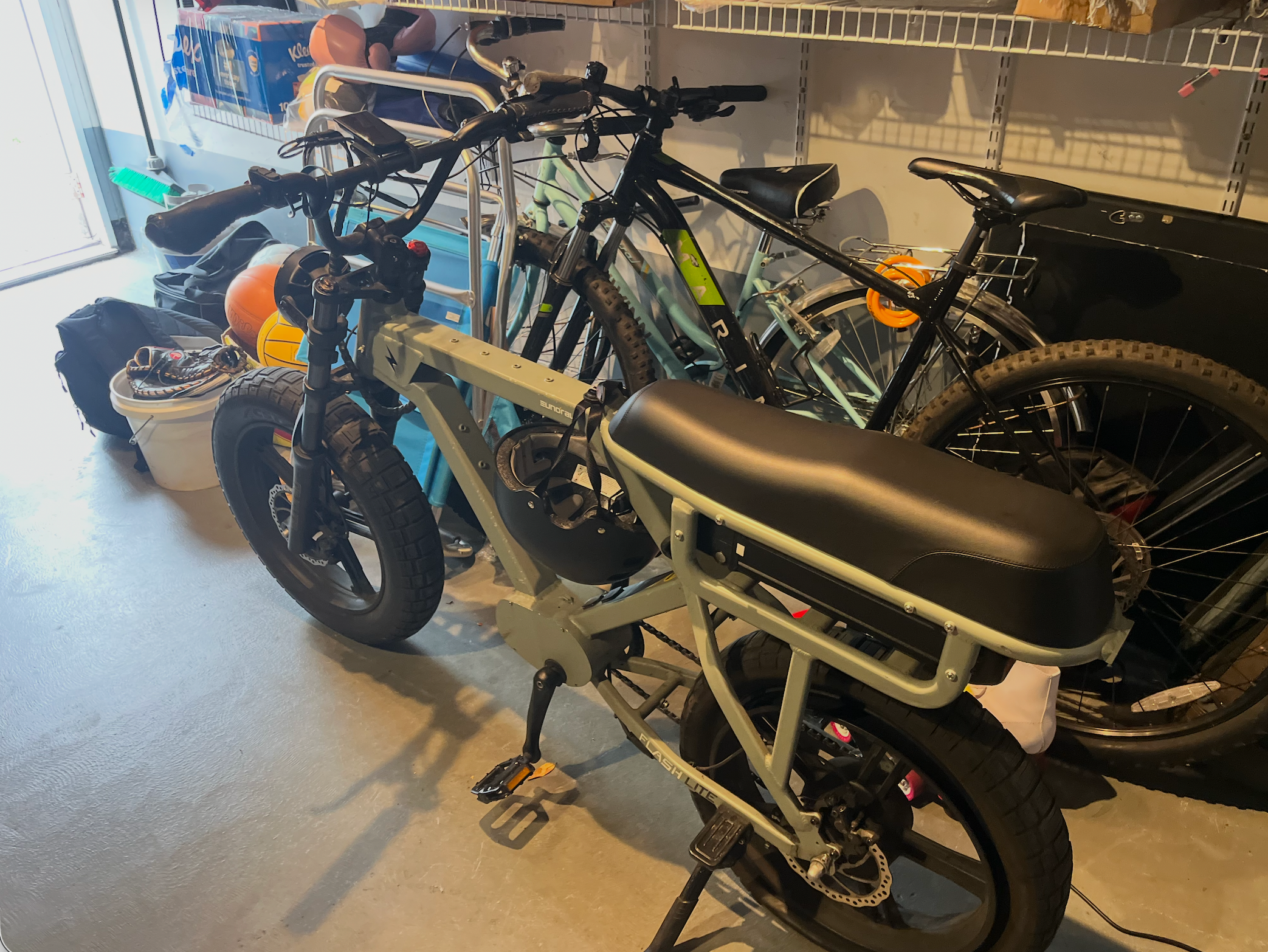
That mindset sets him apart. While he rides for practicality, others chase thrills—speeding into the 40s, doing wheelies, and sometimes crashing.
He had his own scare near the Crab Cove Visitor Center when someone stepped into his path, forcing him to swerve while carrying a friend. He wasn’t badly hurt, but friends in a separate incident suffered serious injuries, including a broken leg and a concussion.
Still, he’s seeing change. As he and his friends get older, the urge to push limits is fading. “We’ve all matured,” he said. “Not everything has to be to the max level.”
San Mateo County lawmaker Diane Papan has proposed reclassifying higher-powered bikes as motor vehicles requiring licenses.
Southern California Sen. Catherine Blakespear has introduced SB 1167, backed by the California Bicycle Coalition and PeopleForBikes, to crack down on deceptive marketing of electric motorcycles as e-bikes.
In Northern California, Assemblywoman Rebecca Bauer-Kahan, whose district runs from Lamorinda to the Tri-Valley region, introduced a separate bill that would require Class 2 and Class 3 e-bikes to be registered with the Department of Motor Vehicles and display license plates—marking a significant shift in how California will regulate electric bicycles.
The proposal also requires riders to carry proof of ownership tied to a bike's serial number and allows law enforcement to issue fines or impound bikes that do not comply.
Bauer-Kahan said the goal is straightforward: improve accountability and curb dangerous riding as e-bike injuries rise. "It's frightening," Bauer-Kahan said, describing her own experiences and reports from her constituents of riders doing wheelies in traffic and weaving through streets.
She said police departments across her district have struggled to respond when riders break the law and then flee. Officers often face a difficult choice: pursue and risk escalating danger, or let riders go. "They're trying to get their arms around the problem," she said.
A central issue, she argues, is anonymity. Without identifying markers, riders can evade accountability.
"Putting a plate on the back of a bike changes behavior," Bauer-Kahan said. "And where it doesn't, it gives police a way to hold people accountable."
Under California law, devices exceeding 20 mph are not permitted for riders under 16. But Walnut Creek Police Chief Ryan Hibbs said enforcement remains difficult without clear identification requirements. "Without registration or license plates, it is nearly impossible to identify riders who operate outside safe boundaries," he said.
Still, the cycling advocates and lobbyists have pushed back hard against the bill.
Groups like the California Bicycle Coalition and Bike East Bay argue the bill targets the wrong problem. They say legal e-bikes are already clearly defined under California law—limited to 750 watts and categorized into three classes with speed caps designed to integrate them safely into bike lanes and trails.
The real issue, advocates say, is the growing presence of high-powered electric devices—often marketed as e-bikes—that exceed those limits and behave more like motorcycles.
Rather than adding new requirements for lawful riders, advocates are pushing for stronger enforcement of existing laws and crackdowns on misleading marketing.
Bauer-Kahan said the opposition surprised her, particularly given her work on bike infrastructure and Safe Routes to School programs. "They don't want barriers to riding, and that makes sense," she said. "But this is not in place of infrastructure—it's in addition to it."
She emphasized that the registration program would be low-cost—likely under $10—and modeled on existing requirements for off-road vehicles. "This is about enforcement," she said. "Right now, it's the Wild West."
"Parents don't always know what they're buying," she added. "Kids are borrowing bikes from friends. The lines aren't clear."
The measure is scheduled to be heard in the Assembly Transportation Committee later this month.
Opposition
The debate over AB 1942 is unfolding alongside a broader legislative push that could reshape how e-bikes are defined in California, which is generating the opposition against the bill.
Taken together, biking advocates weighing in on legislation, like Oakland-based Bike East Bay and CalBike, appear to see the measures as a shift toward treating some e-bikes less like bicycles and more like regulated electric vehicles.
The worry behind that move is restrictions on e-bike access to bike lanes and trails, as well as equipment, licensing, and insurance requirements. In particular, the concern is that bikes would start to be classed as motor vehicles.
The opposition reflects common talking points, mainly that Bauer-Kahan's proposal in particular misses the root causes of bike-related crashes, which advocacy groups say stem largely from unsafe street design and high car traffic rather than from legal e-bike use. And they contend that most safety concerns stem from illegal or modified high-speed "e-motos," not from standard Class 2 and Class 3 e-bikes used by commuters and families.
Andrew Wright with CalBike said parents have been buying bikes not suited to youth, e-motos instead of bikes. He said the responsibility is with the seller. Prohibitions already exit that prohibit children from riding modified Class 2 bikes and all Class 3. There is an enforcement gap, Wright said.
Bike East Bay advocacy director Robert Prinz said the Mineta study also showed major gaps in the data. So, when asked about the opposition to registration, he said, it’s hard to come to a conclusion about the problem. "In absense of the data it’s hard to say what the problem is," he said, adding that he suspected Class 2 and 3 bikes were involved.
Advocacy groups like CalBike also argue that adding registration and license plate requirements would discourage low-emission transportation that supports California's climate goals, while potentially reintroducing tools that could enable biased enforcement.
Prinz advocated involving schools in compliance but more specifically holding manufacturers and distributors accountable. "Otherwise it's like whack-a-mole," he said.
Filling the Gap
Cities across California are expanding safety campaigns and infrastructure amid injuries that drive urgency for action. In the meantime, responsibility is falling not just on riders, but on families.
The Riverside County District Attorney's Office is reviewing whether parents and guardians can face criminal liability in crashes involving minors. Officials say at least 36 juvenile-related e-bike incidents involving 45 youths occurred in 2025 alone.
Parents could be charged with child endangerment if they provide an inappropriate e-bike, fail to ensure safe use, or neglect required safety measures—potentially facing up to six years in prison. "E-bikes are not toys. Legally, they are motorized vehicles," prosecutors warned.
In March a Benicia couple was charged with child abuse after an unlicensed minor related to the couple crashed into a car and suffered injuries, the Contra Costa County District DA said.
Steven Leroy Crews and Jeanna Marie Gabellini, both 58 of Benicia, were arraigned on one count of misdemeanor child abuse. The DA alleges that the couple “willfully and unlawfully permitted a child to be injured or placed in a situation where the child’s health is endangered.”
In Riverside County, prosecutors warned parents they could face legal consequences if their children e-bike outside the law.
"Under California Penal Code 273a(a), a parent can be held criminally liable for child endangerment if they provide a minor with an inappropriate e-bike, fail to properly educate them on safe operation, and do not ensure they use required safety equipment — actions that place the child or others at risk of death or great bodily injury," the Riverside District Attorney's office warned. "A felony conviction under this statute carries a maximum sentence of six years in state prison."
In Petaluma, officials are also placing the responsibility on parents. Petaluma police are stepping up enforcement of California's e-bike laws, warning that parents and guardians can now be held legally and financially responsible for juveniles riding motorized bikes illegally. This move follows a string of recent incidents involving teens and tweens downtown.
As the Burlingame lawsuit moves forward, it may become a defining case—testing how far accountability extends when children, rapidly evolving technology, and public streets collide.
RELATED:
Adults May Pay The Price For Kids' E-Bike Offenses
E-Bike Restrictions Planned For Unincorporated Murrieta, Temecula
MORE CALIFORNIA NEWS:
- Boy, 14, On E-Motorcycle Hits Man, 81, And Flees Scene
- CA Nurse Served 15 Shots On Cruise Ship Awarded $300K By Jury
- Death Of Carlsbad Woman In Remote Big Sur Area Under Investigation
- D4vd Arrested In Murder Of CA Teen Found In Towed Tesla: Police
- Following Public Outcry, Philz Coffee Pride Flags Are Staying Up
- Infant Diagnosed With Measles As CA Cases Continue To Spike
- Chain-Saw Wielding Driver Sets Off Traffic Snarl
- Guy Fieri Backlash, Apology After Viral Tate Brothers Handshake
- Could Kamala Harris Become CA's Next Governor? New Poll Shows Shift After Swalwell's Exit
- CA Housing Market Shows Shift Toward Buyers
Get more local news delivered straight to your inbox. Sign up for free Patch newsletters and alerts.