Profs and Pints DC presents: “George Washington and the Civil War,” on how all sides of a nation-dividing conflict enlisted a long-dead founding father, with Anne Sarah Rubin, a professor of history at the University of Maryland, Baltimore County who specializes in the study of nationalism and memory during the American Civil War.
George Washington died in December 1799, more than sixty years before the American Civil War began. Yet in 1860 he seemed to be everywhere, embraced by abolitionists and slaveholders, Unionists and Confederates alike as a mythical symbol of their own righteousness. All drew on the image and iconography of George Washington and the American Revolution to claim legitimacy for their respective sides.
Gain insight into how our nation’s history and memory has long been weaponized to support disparate causes with Anne Sarah Rubin, an author of two books on the Civil War who has given great talks in Baltimore on the war’s impact on that city.
Dr. Rubin will describe how memories—both actual and cultural—of Washington and the revolution diverged in ways that reflected divisions over slavery. Slaveholders and abolitionists each laid claim to the parts of the past that they could use and discarded the rest.
The memory of the Founders and the Revolution was malleable. Homages to their wisdom and the republican experiment they created could be read as conservative. Calls for greater equality could be read in the Revolution’s spirit. Washington was portrayed as a benevolent master in one popular engraving and as an emancipator in another.
Each side used images, songs, and stories to make their case. When the war broke out, Confederates eagerly seized upon popular songs like “Yankee Doodle” and “The Star-Spangled Banner” and rewrote them to serve their own ends, calling Union soldiers “Hessians” or “Tories” and praising the Stars and Bars as the better flag.
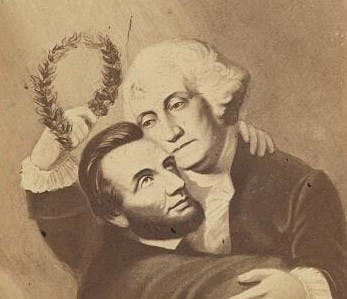
With the end of the war and the assassination of Abraham Lincoln, Northerners united the two presidents in death, even proposing that Lincoln be buried at Mount Vernon. That presidential home itself became a symbol of sectional reconciliation. (Advance tickets: $13.50 plus sales tax and processing fees. Doors: $17, or $15 with student ID. Listed time is for doors. The talk begins 30 minutes later.)
Image: A Stephen James Ferris print published in 1865 after Lincoln’s assassination (Library of Congress).