Crime & Safety
BioLab Explosion: New Details Show Faulty Sprinklers Triggered Fires At GA Warehouse
An explosion at a GA manufacturing facility resulted in about $50.5 million in property damage and the shelter in place of 90,000 people.

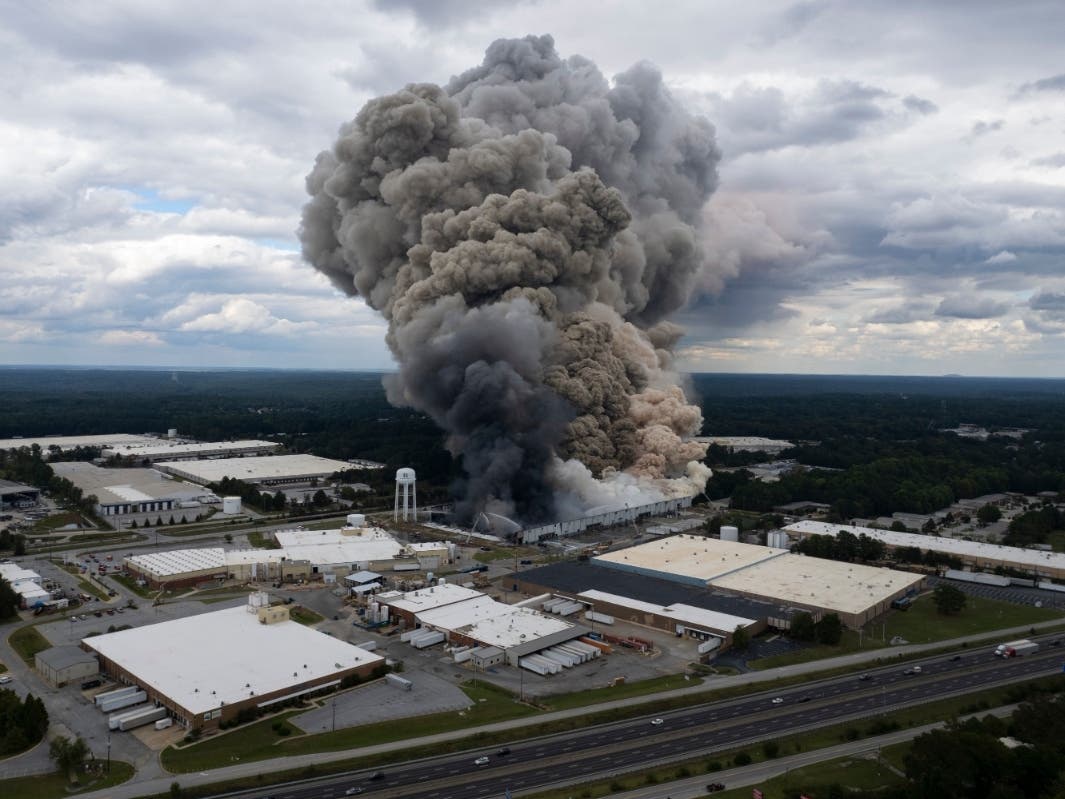
CONYERS, GA — Officials have released new details into an explosion at a manufacturing facility that was caused by a failing sprinkler system, impacting thousands in metro Atlanta.
The U.S. Chemical Safety and Hazard Investigation Board on Tuesday released its final report into the September 2024 explosion and fire at BioLab, a Conyers-based facility that makes products used in swimming pool and spa water care.
Patch has obtained and reviewed the 148-page report, which shows a failed sprinkler system that watered chemicals is to blame for the explosion that caused a massive overcast of smoke in Rockdale County.
Find out what's happening in Conyersfor free with the latest updates from Patch.
The fire sparked around 5:30 a.m., Sept. 29, 2024, before reigniting around noon, setting free "harmful irritant chlorine" into the air and causing a stir in Rockdale and neighboring counties, the Occupational Safety and Health Administration said in the past.
About 17,000 people in the surrounding area had to be evacuated, and 90,000 people in metro Atlanta were ordered to shelter in place due to the toxic smoke.
Find out what's happening in Conyersfor free with the latest updates from Patch.
The CSB's preliminary probe in November 2024 indicated the fire and smoke were a reaction to heat-generated materials that were being stored in a warehouse. The materials deteriorated, released toxic vapors and erupted fires.
RELATED: BioLab Cited $60K After Blaze Erupts At GA Facility
The CSB on Tuesday said no one was injured in the fires; however, the warehouse was destroyed. Property damage totaled about $50.5 million.
In April 2025, OSHA cited BioLab for six violations, four of which were considered serious. OSHA proposed the manufacturer pay $61,473 in penalties.
The emergency response to the explosion lasted for 17 days, and schools closed for nearly two weeks.
KIK Custom Products, the operator of BioLab, relocated its operations to BioLab's Ontario, California-based facility, as well as third-party manufacturing facilities and warehouses, according to the CSB. Ultimately, KIK listed the Conyers property for sale on Jan. 27, and as of June, it remained listed.
Here's How It Happened
A chemical reaction due to a faulty sprinkler system was the root cause of several fires, off-gassing, excessive heat development and chlorine-filled toxic smoke, according to the CSB's report. The plume of smoke also contained hydrogen chloride, bromine and other substances.
Water from the sprinkler system came into contact with chlorinated isocyanurates, which are chemicals used in the treatment of pools and spas, that had been stored in the warehouse.
RELATED: Chlorine-Filled Air Triggers Local Emergency, Impacts 3rd GA County
The reaction occurred in BioLab's Plant 12 storage warehouse and led to heat generation, triggering other sprinklers in the warehouse, according to the CSB.
Additional chlorinated isocyanurates, cyanuric acid, aluminum sulfate and sodium bromide then became wet, spawning more chemical reaction.
This led to more significant heat, product decomposition, toxic vapors, plumes of smoke and fires at the facility, the CSB said.
The initial fire and off-gassing occurred in an outside area where chlorinated isocyanurates were being stored.
Product stacking made it difficult for staff to access the impacted area, the CSB said.
Faulty Sprinkler Heads
National Fire Protection Association Class 1 and Class 2 oxidizers were being housed in Plant 12. They were trichloroisocyanuric acid (TCCA), sodium dichloroisocyanurate (NaDCC) (anhydrous and dihydrate) and Bromochloro5,5-dimethylimidazolidine-2,4-dione (BCDMH).
At the time of the explosion, the CSB said BioLab's facility was storing nearly 14 million pounds of TCCA, NaDCC, NaDCC dihydrate and BCDMH combined formulations - twice the amount initially reported to local officials. TCCA and NaDCC are used to disinfect swimming pools.
RELATED: BioLab Blaze: Immense GA Fire Due To Stored Chemicals, Officals Say
Corrugated cardboard, plastic bottles, containers and labeling supplies were also being stored at the warehouse.
Plant 12's sprinkler system had been leaking and corroding since 2019, shortly after BioLab began housing chlorinated isocyanurates, the CSB said.
The unit was not air conditioned, and the "ventilation was insufficient to effectively manage humidity (moisture) levels inside the building in light of the large quantities of oxidizer chemicals in the building," the CSB said.
Inspection reports from 2021 and 2022 showed "hundreds of 'deficiencies'" due to corroded or rusty sprinkler heads in the warehouse's "Powder Storage," or "bunker," the CSB said. This area is where most of the chlorinated isocyanurates were stored.
Though BioLab replaced the sprinkler heads inside and outside the bunker, officials say a December 2023 inspection turned up shortfalls in the sprinkler heads outside the bunker where additional chlorinated isocyanurates were stored during an increase in production.
The agency wrote:
"Overall, 1,124 sprinkler heads outside the bunker were visually observed to be corroded during the December 2023 annual sprinkler inspection. Although Bio-Lab Conyers had replaced the corrosion-prone brass-finish sprinkler heads in the bunker with the corrosion-resistant heads, it did not do so outside the bunker. Instead, Bio-Lab chose to replace corroded/leaking brass-finish sprinkler heads outside the bunker with similar brass-finish sprinkler heads, even though Bio-Lab Conyers had begun to store significant amounts of chlorinated isocyanurates outside the bunker. The corrosion damage to the sprinkler system components at the Plant 12 storage warehouse resulted in a high number of abnormal events recorded by the building’s fire protection alarm monitoring system."
Furthermore, the fire protection system was considered abnormal at least 9.6 percent of the time between Jan. 1, 2023 and Sept. 29, 2024, according to the report.
"Before the Conyers incident in September 2024, KIK did not effectively institutionalize lessons learned from prior incidents, observations and sprinkler system component failures to prevent similar failures across its organization. Although these events highlighted vulnerabilities related to corrosion, KIK did not provide adequate organizational oversight to ensure that corrective actions were systematically evaluated at Bio-Lab Conyers and implemented across all locations with similar conditions," the CSB wrote.
"As a result, safeguards to prevent or mitigate the corrosion of sprinkler system components were not consistently applied across the organization. This lack of organizational learning and the failure to integrate knowledge gained from past experiences into company-wide practices likely allowed known deficiencies to persist, increasing the risk of recurring incidents involving similar failure mechanisms."
The Conyers facility had been operating since 1973 and has gone through multiple owners, the CSB said in the past.
Get more local news delivered straight to your inbox. Sign up for free Patch newsletters and alerts.