Schools
Panel Discussion Sheds Light on Women's Rights in the Arab World
Panel discussion at FDU highlighted the gains and struggles of women in the Arab world
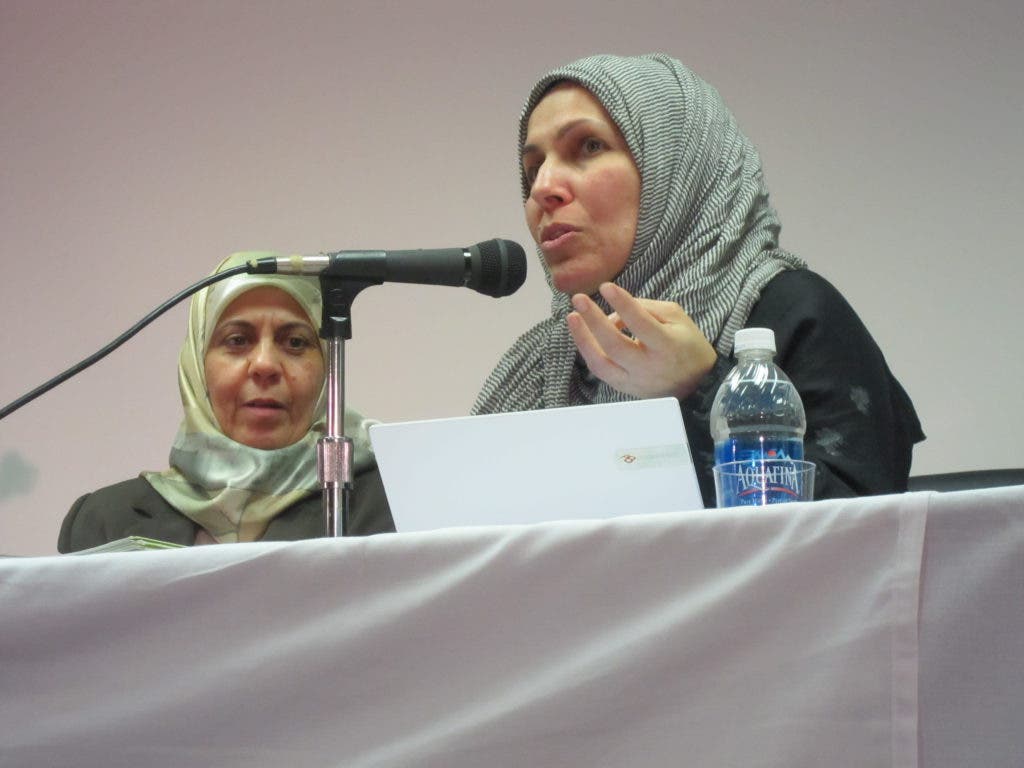

A panel discussion Thursday evening on women’s rights in the Arab world drew a crowd of about 100 people to the Rutherford Room at Student Union. The event featured two members of the Bahrain Women Association (BWA): Saba Al-Asfoor and Wajeeha Al-Baharna.
Members of the BWA are in New York for the Commission on the Status of Women at the United Nations.
The moderator for the event was Ethne Swartz, associate professor of entrepreneurship, who shared some quick facts about Bahrain, such as that it’s a small country between Saudi Arabia, Iran and Iraq and that it’s about four times the size of Washington, D.C., with a population of 1.3 million and a literacy rate of nearly 100 percent.
Find out what's happening in Teaneckfor free with the latest updates from Patch.
“The Bahrain Women Association has been in existence for 10 years,” Swartz said. “They’re not the only women’s organization in the country, but they are one of the most vibrant. They focus a great deal on children, especially the exploitation of children who may be vulnerable in society.”
WOMEN AND EDUCATION
Find out what's happening in Teaneckfor free with the latest updates from Patch.
Al-Asfoor introduced herself first, telling the audience that she’s a civil engineer with a master’s degree in engineering management. She is also the president of the BWA.
“I’m sure you are hearing a lot about what is going on in the Middle East – the protests and the demonstrations,” she said. “It started through the young generation. We now know how powerful the young generation is. We used to underestimate your abilities. You proved us wrong. You have secured the future and you know how to do it yourself without any guidance.”
Al-Asfoor said there are a lot of stereotypes in Arab countries about a woman’s role in society.
“When we ask people how they see women, they will tell you she is a wife or a daughter or an entertainer or a cook or whatever. All the answers are about her roles and duties,” Al-Asfoor said. “Nobody will say she is a human. And that is not only in Bahrain, this is everywhere. I try this everywhere and get the same answers.”
Al-Asfoor said education is improving for women in the Arab world, with many women earning high academic scores and obtaining degrees in higher education inside and outside of Bahrain. But in some Arab countries, like Morocco and Yemen, she said the rate of uneducated women can be as high as 60 to 65 percent.
Poor economic conditions also hold women back academically because any money and resources will be used to educate male family members because of the stereotype that the woman ultimately will be in the house all day, so she doesn’t need an education. Also there are fewer job opportunities for women.
“They think she will get married and have children and will be excusing herself from the job to do other household duties,” Al-Asfoor said. “There is this perspective that women won’t be committed to their job compared to men.”
CHALLENGES FROM LONG-HELD CUSTOMS
Al-Baharna is an activist in the Middle East in the field of human rights and women rights and is a BWA founder. She discussed some challenges facing women in the Arab world: government policies, inherited social customs and norms and misinterpretations of Holy Scriptures.
“In all Arab countries we have an article which is similar in every constitution that stipulates that people are equal in human dignity, and citizens shall be equal in public rights and duties before the law without discrimination as to race, gender, language, religion or belief,” she said. “Regardless, women face legal forms of discrimination that are systematic and pervade every aspect of life.”
One example of this discrimination is in the form of nationality. Al-Baharna said a woman from Bahrain who marries a non-Bahraini man cannot give her nationality to her children or spouse. So, they cannot enjoy rights such as health-care services, political participation, higher education and housing facilities.
She also said gender inequality is evident in family law, in which the man is considered the head of the household.
“Under this law in all Arab countries, a husband can divorce his wife at any time without a stated reason, but a wife seeking divorce must meet very special and onerous conditions,” Al-Baharna said. “There are also many consequences after divorce like custody, alimony, housing, and it’s all in favor of the father or the husband.”
There also is no specific legislation criminalizing domestic violence or spousal rape.
“I would like to emphasize that Islam has nothing to do with these practices,” Al-Baharna said. “We have three pillars for any married life: respect, love and mercy. But these are not applicable in many cases.”
QUESTIONS FROM THE CROWD
After both women spoke, a microphone was passed around for anyone who wanted to ask questions. Some wanted to know more details about life in Bahrain, such as jobs available to women and why women wear the hijab, or the headscarf.
“The hijab is a self decision,” Al-Asfoor said. “It’s not compulsory anywhere in the Arab world. It is a tradition in Saudi Arabia for example. It is not by law, but it is a tradition. If a woman is not wearing a hijab outside on the road, she looks odd. And they try to avoid that. It is a decision; it is not compulsory. And she is free to work anywhere. In some countries, a man’s permission is required, but most of them, as long as she is educated and she has a degree, she can work where she likes without any permission from anyone.”
Another person asked if the demonstrations in the Middle East will lead to advancements for women.
“These changes will lead to more democratic reforms, and this will allow women to have more chances and to achieve more equality between men and women in regards to her rights and roles in society,” Al-Baharna.
A majority of those in attendance for the panel discussion were FDU students, which was the goal of Jason Scorza, vice provost for Global Learning at FDU.
“We’ve been having events like this for more than a decade,” Scorza said. “We feel it’s really important that students be exposed to current conditions in world events. Ultimately, we hope students develop an awareness of themselves as global citizens, and part of that is being well-informed.”
Scorza said that the Middle East in recent weeks has seen social activism used by citizens “agitating for their rights” and that groups such as the BWA are a big part of the positive social change seen in their country.
“This change doesn’t happen on its own,” he said. “It happens because of dedicated individuals.”
FDU student Syuveybe Beytulova said the panel discussion offered attendees more insight into the many roles women play in different Arab societies. She said it also was good to hear about the other societal issues that activists are trying to reform.
“I think the event offered a great opportunity to learn more about Arab culture and the role women try to play in society,” she said. “A lot of people get confused. They believe the situation is so bad, but there is a lot of important stuff happening.”