Community Corner
Police, Residents Talk Bail Reform, Bias, Tasers, Facts At Forum
"We don't want your kind in here." Racism, ICE, stop and frisk, bail reform addressed at forum to create dialogue between police and public.


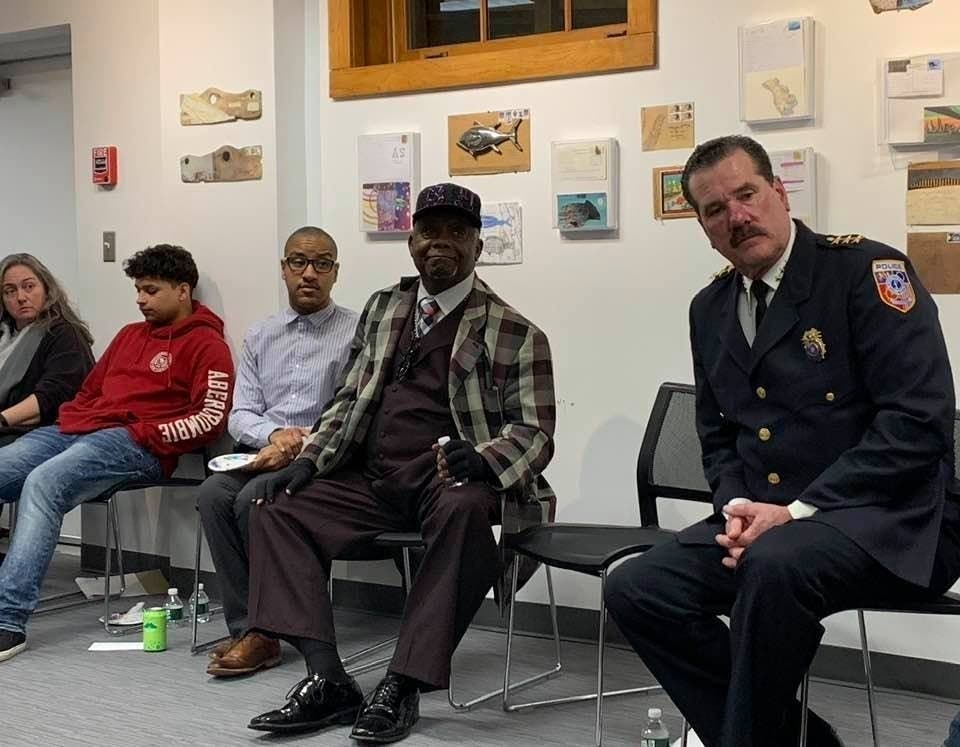


GREENPORT, NY — In a nation divided by hate crimes and escalating fears and distrust, Southold Town has once again taken aim at the issues with an eye toward fostering communication between police and all members of the community.
The Southold Town Anti-Bias Task Force hosted "Synergy 2020" on Wednesday at Floyd Memorial Library in Greenport, with members of the ABTF, Southold Town Police Chief Martin Flatley, Greenport Village Trustee Mary Bess Phillips, and Dr. James Banks, chair of the Southampton Town Anti-Bias Task Force and Suffolk County Community College's coordinator of multicultural affairs, among others, in attendance.
"Synergy," the ABTF said, is a "series of respectful and open conversations between the Southold Town Police Department and all members of the community." Past "Synergy" events have been held in Peconic, Greenport, and Mattituck, with the community bringing concerns on a wide range of topics, including enhanced communication and trust with police, fears among immigrants, how to create a bridge to the Latino community, school issues, and how to combat racism and discrimination.
Find out what's happening in North Forkfor free with the latest updates from Patch.
Chris North of the Southold ABTF kicked off the discussion."We're here to talk about fear," he said.
Southold ABTF co-chair Val Shelby said no one should be afraid to express their concerns. "We're all one big, happy family — and we are here to discuss whatever is on your minds and hearts," she said.
Find out what's happening in North Forkfor free with the latest updates from Patch.
Greenport resident Theresa Pringle asked if the ABTF had dealt with any specific issues of bias this year. Loretta Hatzel-Geraci said there are issues that arise but during the past year, the focus has been on education and informational initiatives and forums.
Shelby added that the Synergy event was not meant to put the police chief on the "hot seat," but instead, was a chance to open up dialogue between law enforcement and the public. Flatley, in turn, said he enjoys the yearly event and the enhanced communication.
Shelby then asked what young people should do if they felt as though they were being followed by police for no reason. Flatley said everyone has a cell phone now; the individual should call 911 or police headquarters to see if there was an explanation for why the officer was in the area; sometimes, he said, that officer might be out looking for a suspect.
Hatzel-Geraci said she's heard from some that if a teen got on the phone the officer might not "take it very well."
Taser talk
Teen librarian Tracey Moloney reported that one teen had told her that he was "walking in town when a police officer stopped him. He said, 'I'm going to call my mom,' because he's a minor and the police officer said, 'You can't do that' and if he did, he would be tased."
"That does not seem like a normal response," Flatley said. "No police officer is going to tase someone for reaching for their phone."
Shelby asked if Southold police had tasers.
"We do, but there are strict guidelines to use them. They're a tool to use if a person is out of control or poses a threat and we don't want to use a gun, but the person needs to be arrested. We want to incapacitate them long enough to put handcuffs on them without resistance," Flatley said. "If we use tasers five times a year, it's a lot."
One woman asked if a person reaching into pocket their phone might be perceived as a threat.
ABTF member Susan Dingle asked what happened after the teen was stopped and asked to call his mom; Flatley said he was not aware of the incident but Moloney said the teen's parents did discuss the issue at the police station.
When asked if a young person who is a minor could call their parent, Flatley said yes, although he hoped not every person would want to call their parent if a police officer was just talking to them, unless they were definitely being questioned.
One teen at the event said, as a resident of Greenport, "not a lot of people are strapped," or carry guns. However, a teen added, another incident involved a van that stopped while the kids were wrestling in the village; an individual who got out of the van and told them to stop was wearing a uniform and was "strapped," he said. Flatley said the town does not have that type of van but suggested the vehicle might have belonged to the county or state.
Stop and frisk
The issue of "stop and frisk" was then raised.
"We don’t randomly follow people till they do something wrong and then stop them. At the very least there needs to be a reasonable suspicious to take it a step further, to put your hands on someone and frisk them," Flatley said. While the NYPD was doing stop and frisk "aggressively" under former New York City Mayor Michael Bloomberg, he said, "Police procedures have moved on."
When asked if there would be an incident report for the teen stopped, Flatley said anyone who went to the police could lodge a civilian complaint and a report would be generated.
And, as for the incident when the teens suspected the man in the van had a gun, Flatley said anyone with fears about a gun should call police and not handle it themselves; a list is maintained of who has a permit in town to carry a concealed weapon, he said.
Flatley added that since Greenport Village is one square mile in diameter, there are "a lot of people coming in and out," with police foot presence, K-9 units, highway patrol officers, Suffolk County Police and New York State Police and the reason why the officer was on the street might involve a simple and easy explanation.
Shelby asked if a body cam would have recorded the issue with the teen; Flatley said there are car video cameras in police vehicles facing into the back, but no body cams.
Phillips said Greenport is a "crossroads" with many restaurants, the North Ferry, and a visible police foot patrol presence, especially during the heavily trafficked summer months. Greenport always has two cars, even in the busy summer months, Flatley said.
When asked about the size of the Southold Police Department, Flatley said there are 52 to 60 police officers, with 6 females and one in the Police Academy, two Spanish speaking officers and two black officers.
"We are always striving to have a police department represent the community we serve all the time," Flatley said. The challenge arises in that the department must rely on Suffolk County's civil service exams to find applicants and new recruits; to that end, a civil service exam seminar was recently held in Peconic.
Hatzel-Geraci said the goal is to encourage young people to apply for those civil service jobs and to become interested in criminal justice.
The department also has a language line to translate 100 different languages and work is ongoing to install a mobile line into police cars, Flatley said.
Youth events
When asked about training to work with youth, Flatley said officers are taught in the police academy and added there are many community events where police and young people are able to interact, such as the DARE program, Pizza with a Police Officer at the library, Boy Scout and Girl Scout meetings and other events, including last year's Funfest at Mitchell Park, where kids were able to meet law enforcement officers and try out equipment.
Officers are also trained on how to work with individuals who are autistic or who have other behavioral disorders, Flatley said.
ICE fears
Another woman asked how much Southold Police interacted with U.S. Immigration and Customs Enforcement, or ICE. Flatley said ICE often does sweeps and does not notify local police. "They don't call us or ask us for help. Most of their work is done in isolated way," he said. A person stopped, for an example, a broken taillight would not be arrested because of their immigration status; ICE sweeps mainly target criminals wanted on felony charges, such as gang members, he said.
"There is some fear in the community," that police might be seeking to arrest undocumented individuals, one woman said.
"We have never gone and knocked on any doors," Flatley said.
The discussion then turned to marijuana — where the laws "are changing very rapidly," the police chief said —and drug recognition for drivers impaired by other substances such as opioids; all officers have Narcan training, Flatley said.
Bail reform
Bail reform, Flatley said, "is a real volatile issue;" as it stands, the only individuals arrested now held for cash bail involve violent offenders, those charged with DWI, or some charged in domestic incidents, he said. While he said he realizes the goal was, in a system that's overcrowded, to keep individuals from sitting in jail: "If a person poses a threat I think the judge should have discretion."
Both Flatley and Banks said they believe the bail reform legislation will be tweaked; some offenders benefit from the programs they avail themselves of while incarcerated, Flatley said.
"We don't want your kind in here"
Banks said it was beneficial that East End and Suffolk County Police train together on issues including implicit bias.
On the issue of bias, Pringle said last summer, a man came up to her and told her he'd gone into a restaurant in Greenport for something to eat. He was told, she said, "We don't want your kind in here." She asked what a person should do, if they are refused services due to their race or religion.
Flatley said a police report should be filed. "They can't refuse you," he said. "Places are privately owned but when they are open to the public, they can't pick and choose."
Banks said business owners should be trained in customer service with a focus on such issues. On the issue of bias training, Banks added: "You can do all the training in the world but bias is inside of us. Implicit bias means you are not conscious of it. This needs to be an ongoing process, to look inside yourself."
Green Light Law
The group also discussed the Green Light law, enacted in December, that allows immigrants who are in the country unlawfully to apply for driver's licenses in New York State.
Flatley said the issue is not affording those individuals drivers' licenses but the fact that the DMV is not allowed to share information, making it "difficult for border control;" police cannot get information from the DMV without a subpoena, he said.
Hate crimes in houses of worship
Next, Flatley addressed security in houses of worship on the North Fork after a rash of hate crimes and said he has spoken with some churches and synagogues, with a training scheduled for May 3.
Flatley and the ABTF said anyone with questions or concerns should always reach out to keep the lines of communication open.
Coming together to speak freely about questions and concerns is critical, Southold Town Supervisor Scott Russell, who was unable to attend Wednesday' session, has said.
"Communication is one of the best ways we can address what seems to be a growing chasm nationally between law enforcement and communities. Distrust and misunderstanding, whether valid or not, exists. By bringing varying segments of the community and law enforcement together, we can improve our understanding of the differing perspectives that we all have," he said. "Communication removes walls. Perhaps initiatives like these, not just in Southold but in communities everywhere, can build bridges over that chasm."
Get more local news delivered straight to your inbox. Sign up for free Patch newsletters and alerts.