Politics & Government
Some East End Supes Blast Bellone's Water Quality Plan: 'This is Not Ready for Prime Time'
Some supervisors feel the "shallow effort" leaves many questions unanswered and say they won't support the plan, others laud the effort.


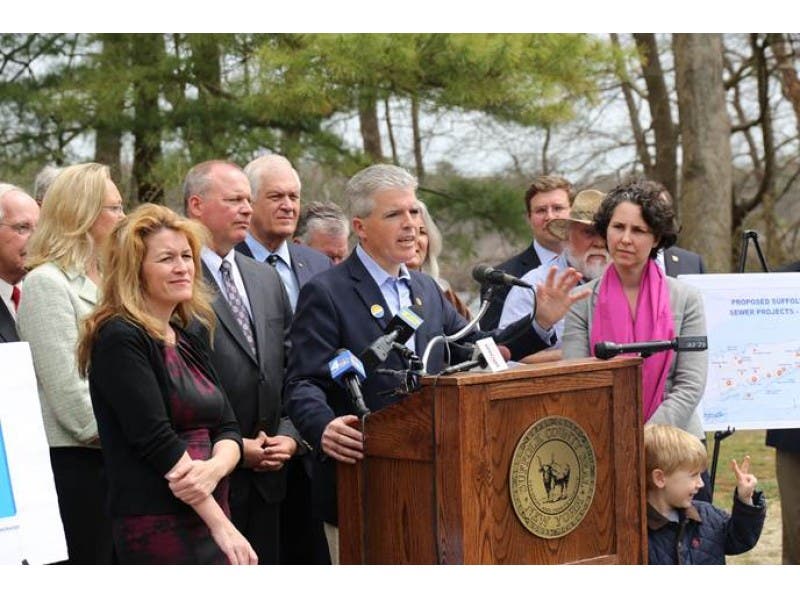
SOUTHAMPTON, NY - A proposal by Suffolk County Executive Steve Bellone that would ask residents to vote in a public referendum in November on whether to establish a dedicated funding source to pay for clean water infrastructure and alternative wastewater treatment systems won't have the support of some East End town supervisors.
Other supervisors, however, stand largely in support of Bellone's proposal, although they say details need to be ironed out.
Southold Town Supervisor Scott Russell said while he believes the idea of creating a new revenue stream is a good one and necessary to successfully address water quality, the plan as it stands falls short.
Find out what's happening in Southamptonfor free with the latest updates from Patch.
"This proposal is ill-thought out , hastily rushed and, frankly, a shallow effort designed more about raising political profiles then groundwater. The specifics have not been enumerated and there has been no discussion about other options," Russell said.
And Russell said, the fact that East End representatives weren't even included in the discussion prior to the county executive's press conference "speaks volumes about why we should be concerned. The needs of the East End are fundamentally different then the western part of the county and I have a real concern that those needs will be eclipsed by those of the west."
Find out what's happening in Southamptonfor free with the latest updates from Patch.
Russell said while the idea might be the way to go, there is no way for East End elected officials to know for sure, as they've not been given the chance to weigh in. "There is no information readily available so that we can learn more. Most questions that have been asked get the same insufficient answer: 'We haven't worked that out yet'."
He added, "Ultimately, this is a 'tax'.They can call it a surcharge all they want but that is not fooling anyone."
Riverhead Town Supervisor Sean Walter was similarly concerned. While he said he agreed that water quality issues need to be addressed, "I think the plan has serious flaws. It's a good first attempt first, and something has to get done. I'm happy he started the conversation but the conversation can't start and stop with the county executive."
To that end, Walter said he's been less than pleased with the county's ability to provide Riverhead with its share of sewer stabilization funds, which are garnered from a quarter percent sales tax gathered countywide. Those funds are disbursed in county sewer districts if the district's rate rises above three percent.
"They're not treating Riverhead the same way," he said; the town's rate went up three percent and the town needs $560,000 to stabilize the sewer district. But, while the town applied for the funding, "They haven't given it to us. If we can't trust them to do the right thing with the sewer stabilization fund I'm not sure how to trust them to do theright thing with the water fund," Walter said.
Walter said he supports the county executive's efforts but said there are problems. "There are a lot of unanswered questions. I look forward to working with the county executive to answer the questions. But this is not ready for prime time. And it should not be on the ballot in November."
Walter said he will "never support" the referendum. "This is not something that should be rushed."
Meanwhile, in Southampton, Supervisor Jay Schneiderman said something needs to be done. "We live on an island that sits atop an aquifer. Every day, we impact the water beneath us and around us."
There's a responsibility to future generations to protect drinking water and ensure East End bays support marine life, Schneiderman said.
"Changing course is never easy but it must be done," he said, adding that he applauds Bellone's "bold action" on water quality and for "including the voters in choosing a better course for Suffolk's future."
He added he's glad the public can weigh in. "If the public didn't have a choice here, I would not support it," he said.
Schneiderman added that he was notified by Bellone before the press event and he asked questions to ensure the East End would receive "its fair share. There are still details that need to be worked out before this thing is finalized and put on the ballot," he said.
East Hampton Town Supervisor Larry Cantwell said addressing nitrogen pollution in bays and groundwater is critically important. "We're developing a plan for referendum in November using a portion of Community Preservation Funds to help fund replacement" of aging septic systems, he said. "I want to suport the county's efforts to make surface water and groundwater protection a priortiy."
While he says there are still details to be worked out and questions to be answered, "I want to encourage the county to move forward with the funding vehicle as long as it will help to provide funds for East Hampton's program."
Cantwell said he met with Bellone before the press event but said Bellone did not contact all East End leaders, "which is something they should have done."
In the end, though, he says a vehicle for raising funding for water protection is critically needed in order to seriously try to solve the problem."
Bellone did not immediately respond to a request for comment regarding the town supervisors' thoughts Friday. Shelter Island Supervisor Jim Dougherty did not return a call for comment.
Specifics of the plan
Earlier this week, Bellone held a press conference to announce the fund, which would be created to fight back against the escalating nitrogen pollution crisis affecting drinking and surface waters, he said.
Taxpayers would fund the initiative, if approved, paying $1 per 1,000 gallons, or approximately $75 per year — a step that Bellone said would generate $75 million annually.
The majority of Suffolk County’s wastewater treatment relies on more than 360,000 individual cesspools and septic systems; Suffolk County has more unsewered homes than the entire state of New Jersey, Bellone said.
In western Suffolk, the funding would be used for sewering, and on the East End, the monies would be used to help residents install alternative wastewater treatment systems, he said.
"This is an important day for Suffolk County," Bellone said. "What we have seen over the past decade is the decimation of our surface waters."
Latest statistics indicate that the "overwhelming cause of that nitrogen pollution" is the 360,000 homes still relying upon cesspools and outdated systems.
The escalating crisis has let to red and brown tides and last year's "unprecedented fish kills," Bellone said. "We know what the problem is — and largely, we know what the solution is. Water quality infrastructure."
New York State Governor Andrew Cuomo has demonstrated "great leadership", allocating $83 million in Suffolk County alone to fund sewerage around four main river corridors. In addition, the Center for Clean Water Technology was created at Stony Brook University, he said. The Long Island Nitrogen Action Plan is also ongoing, Bellone said.
"What we are talking about here today is the ability to act, to implement solutions to this problem," Belllone said.
The water quality crisis has developed over decades, with a failure to implement the infrastructure that could have prevented the outcome, despite the fact that today's concerns were predicted, the county executive said. "The question is now are we going to turn the tide and reverse decades of decline — and make progress every single year on this issue?"
The referendum in November will be attached to the water bill, which is appropriate, Bellone said. As it stands, the Suffolk County Water Authority is pulling water out of the ground and providing the resource to residents; the goal is to make an investment now not only to protect groundwater but to avoid having to treat the water supply later.
"Every water body in the region is impaired," Bellone said, and the plan will affect the future of the entire region.
Currently, he added, the question is in the hands of politicians. "Personally, I will be much more comfortable when we get it into the hands of the people."
Mark Herbst, executive director of the Long Island Contractors' Assocation, spoke to the economic benefits of creating new infrastructure and alternative systems, including job creation.
Bellone added that water quality underpins the tourism industry and clean water is critically important.
Dick Amper, executive director of the Long Island Pine Barrens Society, applauded the plan. "This is absolutely critical."
Two thirds of the nitrogen in the waterways today originates in those 360,000 homes, he said. "It's time for action."
The cost to homeowners, at $75, he said, is less than the cost of a meal out to celebrate at a local restaurant, he said. "You can't buy a bottle of water for less than a buck." The total cost averages out to 20 cents a day, he said.
He added that Suffolk County is charging less for its water than 97 percent of water purveyors in the United States. The increase, he said, "is a drop in the bucket. It's a painless, almost unnoticeable cost."
Amper said he had confidence in voters to continue a long legacy of preserving land and water quality on Long Island.
All Suffolk County water districts and smaller districts would pay the fee, Bellone said; both commercial and residential customers would pay. The fee might even encourage water conservation, he said.
Those who do not tap into public water currently would still pay, but Bellone said discussions are ongoing with New York State to work out those details.
There is no sunset date for the $1 surcharge, he said; it's a recurring fee.
In order to get the referendum on the ballot, state authorization is needed, Bellone said, with the measure passed in both the Senate and Assembly.
As for alternative wastewater treatment systems being tested across Suffolk County in pilot programs, Bellone said they are close to approval. The goal is to amend Suffolk County's sanitary code for as of right approval, rather than the current approval before a board of review. The new systems could be available after the pilot programs have been tested for six months, with a timeline of late summer and early fall expected for approval of the new systems.
Suffolk County Legislator Bridget Fleming said there is a nitrogen pollution crisis in Suffolk County and applauded Bellone for his "bold" steps to spotlight the issue.
She pointed out that it's not a countywide sewer tax — but instead, a user fee. "If you conserve water, you pay less."
She added, "I support a bulletproof lockbox that will ensure that the resources generated by this fund are used only for water quality improvements, and to ensure that equal attention is given to improvements to non-sewered on site systems."
Suffolk County Legislator Al Krupski said he got short notice about Bellone's plan. "I was notified on Friday," only two days before an article in the media on Sunday, he said. "You can judge for yourself whether that was ample notification or not."
Krupski believes the issue of local waterways needs to be addressed. But, he said, "The devil's in the details and there needs to be a lot more clarification about private wells, ag use, and how the money is going to be spent. We need to firm that up."
The subject was a "hot topic" at a recent East End Mayors & Supervisors Association meeting, Krupsk said.
It's critical to know whether the East End will gets its fair share, Krupski said. "We've had a very bad example with the hotel motel tax, of collecting it and spending it who knows where, a lot on the western end of Suffolk. We really need to make sure it's going to be a fair distribution of collection and spending."
Krupski said he was briefed by Bellone, and he made his points very clear. "We'l see where it goes from here."
Get more local news delivered straight to your inbox. Sign up for free Patch newsletters and alerts.