Politics & Government
State Budget Extends Virginia Higher Education Displacement Commission Funding For 2 Years
The additional funding comes as the commission broadens its research on the impacts of university-led displacement of Black communities.
July 6, 2026
Funding approved by Virginia lawmakers in the new state budget paves the way for two more years of work by a commission studying Black communities’ past displacement by Virginia colleges and universities and potential forms of redress.
Find out what's happening in Across Virginiafor free with the latest updates from Patch.
While final figures have not been determined, the commission — the only of its kind in the state — could receive more than $300,000 over the biennium. That would mark the commission’s largest funding allocation to date.
Across Virginia, public colleges and universities expanded into historically Black neighborhoods through urban renewal, eminent domain, property seizures and other land acquisition efforts. Families in Newport News, Norfolk, Richmond, Charlottesville, Farmville, Lexington among other localities were displaced.
Find out what's happening in Across Virginiafor free with the latest updates from Patch.
Lawmakers initially allocated roughly $28,000 when the commission was created in 2024. The following year, they approved an additional $200,000. The latest funding would come from unspent money remaining after the Virginia Commission to Study Slavery concluded its work in 2024.

Delores McQuinn, D-Richmond, chair of the commission, speaks during a public listening session focused on the displacement of Black communities by Virginia’s public colleges and universities. (Photo by Marcus Ingram/Virginia Mercury)
Commission Chair Del. Delores McQuinn, D-Richmond, previously said additional funding would allow the uprooted commission to complete a broader scope of work.
At the commission’s most recent general body meeting in May, she said the group’s work should transcend research and engage affected communities to ultimately produce recommendations for remedies.
“I am confident that we want to understand what went on, and then further down the road, what are the recommendations in terms of bringing about repair to some of the families that have been hurt.“
In the last year, the commission’s work has evolved to actively documenting university land acquisition, as well as gathering testimony from affected communities.
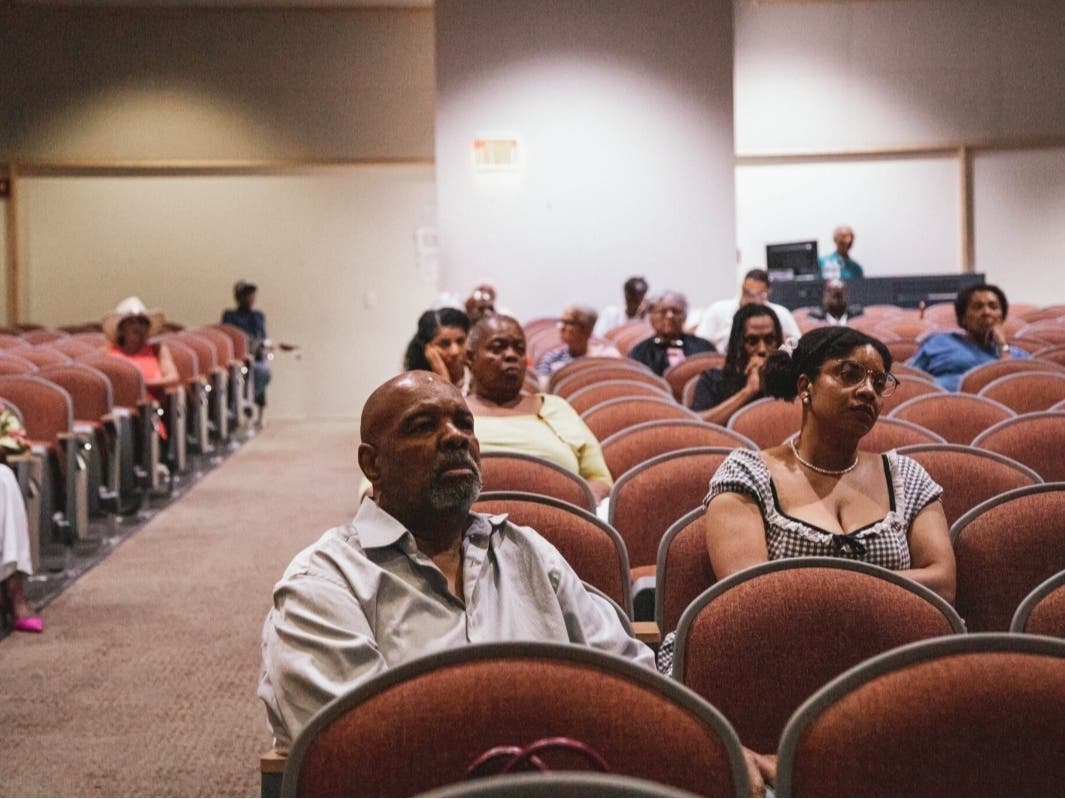
The commission contracted historian and scholar Cleve Tinsley in January to direct the project and build a research team. In June, it held its first public listening session in Richmond, where descendants and other attendees shared firsthand accounts of displacement and ideas on how to make things right.

Loretta Tillman speaks about the displacement of the Carver community during the commission’s
June public listening session. (Photo by Marcus Ingram/Virginia Mercury)
Loretta Tillman, a longtime Richmond resident, grew up in the city’s once-thriving Carver neighborhood, which was affected by the expansion of Virginia Commonwealth University’s campus. Speaking as a guest panelist, she said addressing displacement requires a holistic approach.
“It’s all connected. These people lived together, they went to church together, went to school together, and then all their stuff is just gone.”
She warned that without efforts to preserve what remains of those communities, the pattern of loss will continue.
“It’ll keep going, and then we’ll look up, and all we’ll have is stepping stones if we’re lucky.”
Teresa Guynn Hendrick, whose family remains in one of the five remaining homes in a Black community displaced by Christopher Newport University in Newport News, described the isolation that followed the loss of her community.
“It’s very sad for me to know today that my neighbors that were there in the community, which were over 100 and some homes on Prince Drew Road, are no longer there. We are trying to hold on to our property at this point in time, although the college is all surrounding us.”
Attendees at the listening session also called for financial repair, including compensation for lost property and real estate taxes, free tuition, and public commemoration of displaced families, businesses, churches and institutions.
The commission’s initial round of listening sessions is focused on four communities affected by the expansion of Virginia Commonwealth University, Christopher Newport University, University of Virginia and Longwood University.
Tinsley told commissioners in May that his team is documenting these stories at listening sessions in an effort to examine both how displacement occurred — including through eminent domain, urban renewal, development pressures and purchases through university foundations — and its lasting economic consequences.
“Our task is to pursue a final report that is three-pronged; it not only engages in an interpretation of the historical moral harm, it also assesses what kind of economic impact has been affected by that,” Tinsley said.
A similar local effort underway in Newport News also expanded its public outreach this spring, holding four listening sessions with descendants, former residents and community members.
The task force, which is studying the displacement of Black families by Christopher Newport University, plans to use feedback from their listening sessions to develop recommendations for the city, university and state that could also provide a framework for repair.
Its final report is still expected this year, though it may arrive later than planned. Task force member Joni Ivey, who also serves on the state commission, told commissioners in May that testimony gathered during the sessions had extended the group’s original timeline.
The state commission has likewise indicated it needs additional time to complete its work.
During a June update, Tinsley told commissioners his team would require at least two more years to conduct a “robust” examination of the institutions being surveyed by the state, including connecting with affected families.
McQuinn also underscored the importance of community engagement, saying the commission’s work must ensure affected residents remain actively involved.
“One of the things that we want to make sure of is that the community is engaged. (If) we do all this work and the community is not aware, then it is another piece of paper that’s put on a shelf and left there,” she said.
This story was originally published by the Virginia Mercury. For more stories from the Virginia Mercury, visit Virginia Mercury.com.