Politics & Government
380+ Trees Lost If Fairfax City Adopts John Mason Trail Plan
Fairfax City's plan to connect Pickett Road and Main Street with a scenic trail would mean removing at least 380 trees.


Correction (Sept. 16, 10:15 a.m.): This story was corrected to more accurately reflect the attribution of the document provided by the spokesman for the City of Fairfax.
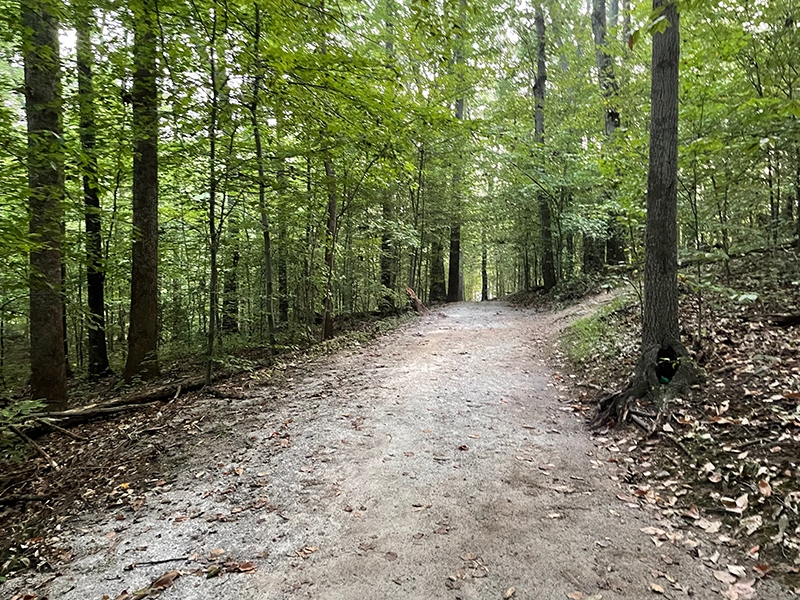
FAIRFAX CITY, VA — Local environmentalists have been voicing their opposition to a proposed project the Fairfax City is considering to clear 380 or more trees from the heavily wooded area to the north and west of the Pickett Road tank farm in order to build a bike path.
As it is currently planned, the John Mason Trail project, which is part of the city's Two-Year Transportation Program, would create a "scenic off-road shortcut" from Pickett Road to Main Street, according to the city. The trail would begin north of Colonial Avenue, head west and south around the tank farm, and connect with Main Street east of Lyndhurst Drive.
Find out what's happening in Fairfax Cityfor free with the latest updates from Patch.
"I don't think people realize that doing this kind of construction project will really damage the forest ecosystem," said Judy Fraser, who is a member of the city's Environmental Sustainability Committee. "It was not just a matter of, 'Well, we're just going to put a path through the woods.' It's that these woods are vulnerable. It's a small patch. It's narrow, incredibly healthy for all of that. But it is vulnerable to any kind of incursion like that."
The Fairfax City Council will be discussing the John Mason Trail during its Tuesday night work session and will vote on whether to endorse the project at its Sept. 28 meeting.
Find out what's happening in Fairfax Cityfor free with the latest updates from Patch.
In preparation of its proposal, the city conducted a tree inventory of the trail path, identifying a total of 1,647 trees. City staff estimated in its report that 25 percent (411 trees) would need to be cleared to make way for the path.
Matthew Kaiser, spokesman for the City of Fairfax, provided Patch with a document containing answers to questions the city has received about the John Mason Trail project.
"Preliminary modeling suggests that approximately 380 trees may be removed. A total of 1,402 trees exist on the property today," the document says. "The design is preliminary, wetland delineation is not complete, storm water compliance facilities have not been designed or sized, etc., so there will be fluctuation in the number of trees removed/preserved as the project advances. Also, this preliminary number is conservative since it assumes a 10-foot offset from construction limits everywhere and we may be able to reduce the offset and accordingly reduce the tree impact."
Friends of Accotink Creek, a local nonprofit that primarily focuses on watershed issues, has come out in opposition of the trail.
"The main problem affecting our streams in this area is erosion from paved surfaces," said Philip Latasa, a long-time volunteer with the group. "Every proposal replacing natural surface in a wooded area with pavement is detrimental to the health of the creek, because it causes an increase in stormwater runoff, which increases the volume of water going into the streams and every time it rains on paved surfaces, which overwhelms the stream. It ruins the stream bank and increases the sediment."
The current plan shows only a portion of the trail surface being paved.
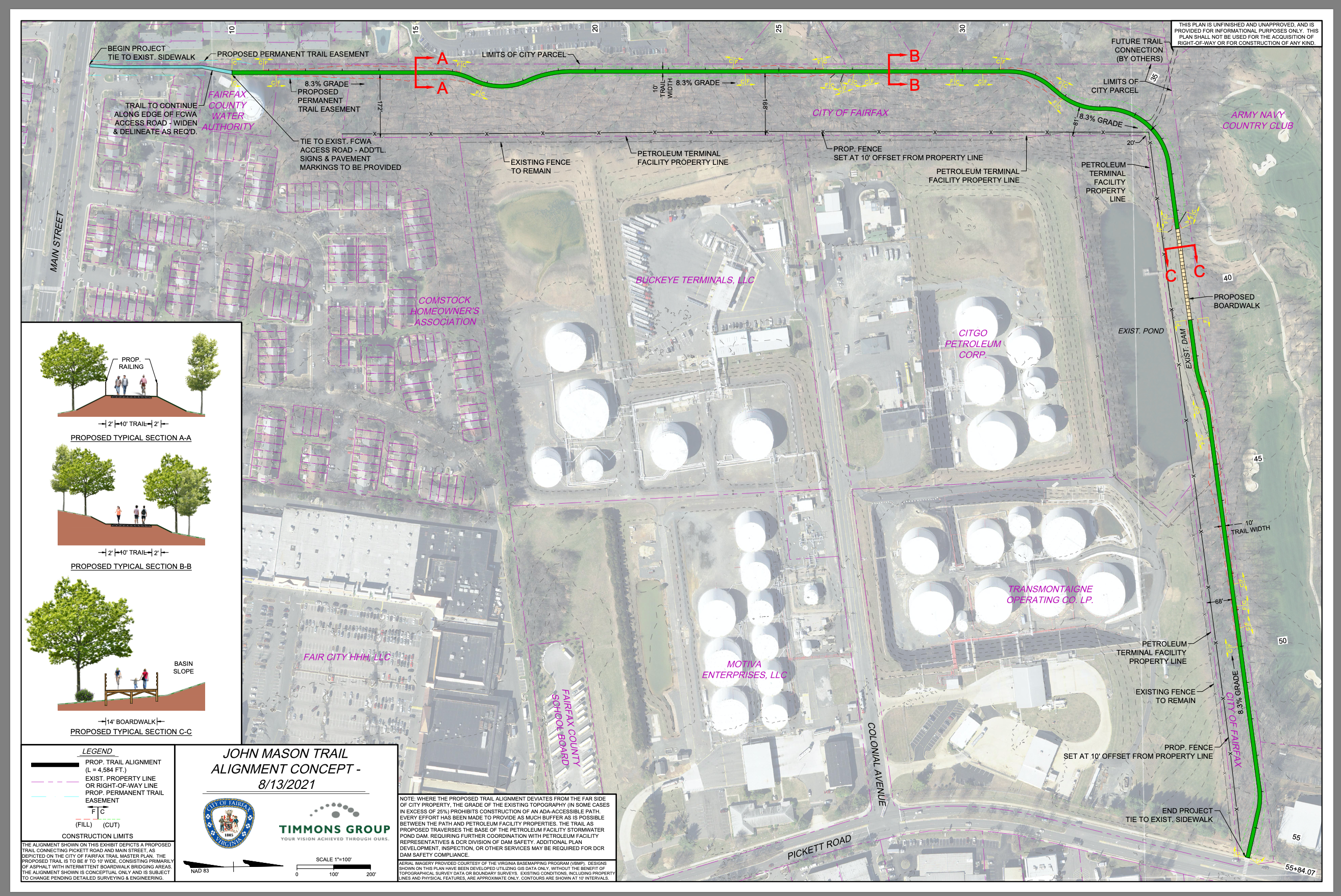
The price tag for installing the trail would be approximately $7.6 million, according to the staff report. To finance it, the city would submit a proposal to the Northern Virginia Transportation Authority (NVTA) in order to receive 70 percent regional funding. If NVTA accepts the proposal, the funding would be available in Fiscal Year 2027 with construction taking place in FY2029/30.
At that point, the city would solicit input on trail alignment from key stake owners, including the tank farm operators, utility companies and adjacent property owners. The city would also need to obtain easements from the Comstock Homeowner’s Association and Fairfax Water Authority.
In a letter to the mayor and city council, Katy Johnson, who sat in on last year's Bike Fairfax City workshop, said building the John Mason Trail was unnecessary. Those looking to avoid the busy Main Street and Pickett Road intersection can already take the back parking lot at Fair City Mall.
"The cyclists can then carry on their journey to Main Street via Bradwater Street," Johnson wrote. "The proposed John Mason Trail runs parallel to Estel Road, which is already a designated bike route listed on Fairfax County trail maps, making the proposed trail redundant and unnecessary."
The city document gives a couple of reasons why the alternate routes via neighborhood streets and the mall parking lot are not as desirable as a new trail:
"While Estel Road and other roads are available for bikers and walkers, providing an off-road trail system is a safer and more enjoyable experience. ... Both suggestions are on private property and are dependent on future plans for the redevelopment of Fair City Mall."
At the Bike Fairfax City workshop, Johnson said she was introduced to the concept of "Neighborways," in which mature forests could be preserved by encouraging the use of bike lanes in neighborhoods rather than building new paths.
"The proposed John Mason Trail will destroy 100+ year old trees, some nearly 5-feet wide in diameter," she wrote in her letter. "These historic trees and their benefits are irreplaceable in yours, mine or even our children's lifetime. Small replacement trees will in no way be able to replace the value of these massive forest trees. Any amount of mature tree loss is too much, but 400+ mature trees, is a devastating loss. Couple this with the trees to be lost for the George Snyder Trail, along with all of the private development happening throughout the city, and we are on an irreversible path to becoming a heat island."
Fraser has been a member of ESC since it was first formed in 2009. The goal at that time was for the committee to help the city be more more attentive to the environment and create more sustainable practices. It was because of her history with the committee that people began coming to her and asking about the tapes they were seeing tied around some of the trees in the city.
Unfortunately, Fraser couldn't answer their questions, because the city never brought the project to the ESC for discussion or to solicit feedback.
"It's an interesting process for these transportation projects," she said. "I would say the city has tried to do some outreach and have time for public comment. I think it's a work in progress. I don't think anybody really understands what the impact of this trail would have. Everybody's in favor of trails. Great. I like walking on a trail and all that. It's really diving into the details and saying what actually is going to be the result of this trail? What what are the down-the-road impacts of it? That's just not in the process at all."
Latasa also said the city hasn't demonstrated a real need to build the trail.
"They don't have any data or studies to show that the trail is going to benefit the environment in any way whatsoever," he said. "They don't have any studies or data showing that it's going to get any usage whatsoever. They don't have any studies or data to show that the current use of the footpaths that are in there will be driven away by the addition of the asphalt."
Without evidence that supported the need for the trail, the project's not worth sacrificing the tree canopy for, according to Latasa.
"People who are citizens of the City of Fairfax should contact the mayor and city council and let them know that it is time for Tree City USA Fairfax, which is a designation is has, to persevere its trees and give priority to trees over asphalt," he said.
Get more local news delivered straight to your inbox. Sign up for free Patch newsletters and alerts.