Community Corner
Dozens Of Confederate Symbols Removed From Virginia In 2020
A Southern Poverty Law Center report shows Virginia led the nation in the removal of Confederate monuments and symbols in 2020.


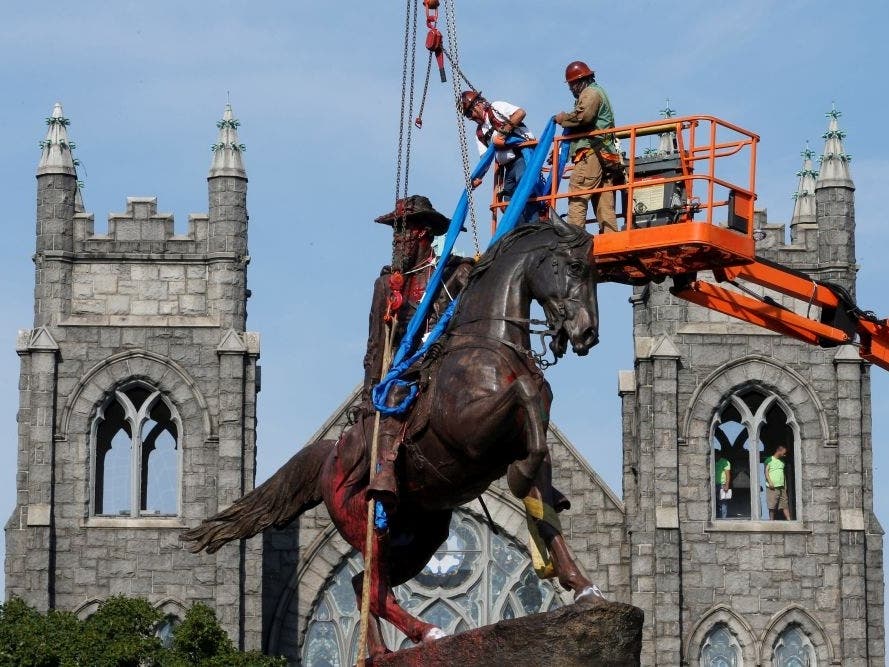
VIRGINIA — More Confederate monuments were removed in 2020 across the United States than during the five previous years combined, the Southern Poverty Law Center said in its most recent “Whose Heritage?” report that tracks public displays related to the Confederacy.
Ninety-four of the 168 Confederate symbols removed or renamed nationwide in 2020 were monuments, the report found. Fifty-eight were removed from 2015 to 2019.
More Confederate monuments and symbols were removed in Virginia in 2020 than any other state, according to the Law Center.
Find out what's happening in Fairfax Cityfor free with the latest updates from Patch.
State specific info on which monuments were removed, in which month and with any additional local background information you can find. Find the full list here.
Lecia Brooks, chief of staff for the Law Center, called 2020 a “transformative” year in the movement to remove Confederate symbols nationally.
Find out what's happening in Fairfax Cityfor free with the latest updates from Patch.
“Over the course of seven months, more symbols of hate were removed from public property than in the preceding four years combined,” Brooks said in a statement.
The Law Center began tracking the movement to take the monuments down in 2015, when a white supremacist entered a South Carolina church and killed nine Black parishioners.
Virginia by far saw the most Confederate symbols removed in 2020 with 71, the Law Center’s report found. The states with the next highest number are North Carolina with 24, and Alabama and Texas, both with 12.
Brooks praised Virginia, which changed its preservation law and, according to Brooks, “led by example” by removing so many Confederate symbols in 2020. Preservation laws in several other Southern states — including Alabama, Georgia and North Carolina — still exist and prohibit individual communities from removing certain displays.
Among the most notable Confederate symbols removed in Virginia in 2020 were:
- Jefferson Davis Monument on Monument Avenue in Richmond, June
- J.E.B. Stuart Monument on Monument Avenue in Richmond, July
- Silent Sentinel statue of a Confederate soldier in Leesburg, July
- Robert E. Lee High School in Springfield renamed John R. Lewis High School, July
- Captain John Quincy Marr Monument, Fairfax, November
The movement to remove these symbols from public spaces became part of the national reckoning on racial injustice following the killing last May of George Floyd, a Black man who died after a white Minneapolis police officer pressed his knee into Floyd’s neck for several minutes.
All but one of the 168 symbols that were removed last year came after Floyd’s death. The symbol that was removed before May 30 was Virginia’s decision to replace Lee-Jackson Day with Election Day in April.
The movement in Virginia to end the celebration of the Confederacy is continuing in 2021. On Thursday, the Virginia Senate passed a bill that calls for the removal of the name of Jefferson Davis from any section of Route 1 named after the president of the Confederacy.
Fairfax City and surrounding Fairfax County remain in the middle of a community conversation about racial and social equity, systemic racism, symbolism and identity. The Loudoun County Board of Supervisors has directed staff to develop an inventory list and a timeline reviewing the Confederate and segregationist symbols in the county. A report is expected in June.
The Southern Poverty Law Center considers public Confederate symbols as any government buildings, monuments and statues, plaques, markers, schools, parks, counties, cities, military property and streets or highways named after anyone associated with the Confederacy.
The organization said 2,100 Confederate symbols remain in the country into 2021. Monuments account for 704 of the symbols, the Law Center said.
“These dehumanizing symbols of pain and oppression continue to serve as backdrops to important government buildings, halls of justice, public parks and U.S. military properties,” Brooks said.
The Associated Press contributed reporting.
Get more local news delivered straight to your inbox. Sign up for free Patch newsletters and alerts.