Neighbor News
Storm Drain Marking in Medford on Friday
On Fri 8/22 and Tues 8/25 incoming Tufts freshman will be marking stormdrains in Medford with labels that read "No Dumping. Drains to River"

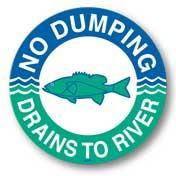
On Friday August 22, and Tuesday August 26, incoming Tufts freshman will be working with the Medford Office of Energy and Environment and the Mystic River Watershed Association (MyRWA), on a storm drain marking program. Students will be cleaning the curbs and affixing plastic storm drain medallions that read “No Dumping. Drains to River.” Students will be wearing safety vests and the City asks that motorists keep an eye out for the students and use caution when driving or parking near the projects. Volunteer groups will spread out on roads near the Mystic River and Medford and West Medford Squares.
Storm drain marking is an effective way of raising awareness about the harms of storm water runoff. Many people are not aware that most storm drains are connected to pipes that flow directly into rivers and other waterways, frequently without any filtering or screening of materials. In Medford, most storm drains empty directly into the Mystic and Malden rivers. The goal of this project is to raise awareness in Medford about the effects of runoff on our rivers and to reduce the amount of pollution entering storm drains and ultimately getting into our rivers. Storm water runoff is a leading cause of pollution in water ways and this project will ultimately improve the water quality of the Mystic and Malden Rivers.
The Tufts FOCUS students will work in teams along with members of the Office of Energy and the Environment to install brightly colored storm drain marker medallions to the curbs next to storm drains. The medallions will be affixed to the curb with adhesive and are expected to remain in place for many years, as opposed to painted stencils which need to be repainted frequently, sometimes as often as once a year.
Find out what's happening in Medfordfor free with the latest updates from Patch.
The project is a pilot to help design a community service opportunity for Medford groups. The Office of Energy and Environment hopes to determine how hard it is to attach the medallions, how long it takes and how much expertise is needed. The students will provide feedback to the City on putting together a community program to have community groups install more medallions. At this time the city has ordered enough medallions to label 25% of the storm drains in Medford. Once they know how many medallions can be installed in two hours, they will have an idea of how long it will take to install the current stock and how many community groups will be able to participate in this service activity. They anticipate that this will be an opportunity for adult, high school and middle school groups looking to give back to the city.
Many people are unaware that dumping items down storm drains brings pollution directly to Medford’s waterways. Unlike water that is used in your home, water that goes down a storm drain does not get treated at a sanitation facility. On its own, storm water is not a problem. However as rain and melted snow run down the streets into storm drains, a great deal of debris is picked up along the way. That means that all of the pollution that is picked up by rain such as litter, chemicals, oil, and pet waste, flows directly to the Mystic River, Malden River, the Mystic Lakes, and other water ways in Medford. In urban areas, such as Medford, there is an increased amount of runoff. Porous surfaces such as forests and wetlands trap storm water before it enters storm drains. However, in urban areas there is an increased amount of impervious surfaces (roads, buildings, parking lots etc.) that does not allow water to drain through it. Because of this, storm water rushes down the streets in unnaturally large amounts and brings with it a great deal of pollution from the street.
Find out what's happening in Medfordfor free with the latest updates from Patch.
You can help prevent pollution in rivers by clearing debris off of the edges of your streets, picking up trash, reducing the amount of chemicals you use on your lawn and not letting vehicle fluids or soap run down your driveway to the street.