Politics & Government
New Hampshire's 2020 Primary: Sleepier Than Elections Of The Past
Nationalization, fewer journalists, too many candidates, Trump 24/7 have some worried about the first-in-the-nation presidential contest.


CONCORD, NH — In a little more than two months, voters will go to the polls to cast ballots for candidates running in New Hampshire's first-in-the-nation presidential primary. Fifty candidates, one of the largest fields of contenders in the history of the contest, plunked down $1,000 to gain ballot access, attempting to become the leader of the free world.
As in past years, there are established candidates with professional resumes and a record of accomplishments and doe-eyed dreamers who cling to the ethos that anyone can grow up to be president of the United States.
But if you haven't been paying close attention, you might not know a primary is taking place. So far, the 2020 election cycle has been a seemingly sleepy affair, and observers wonder if this is just a sign of the times or if interest is waning in the cherished small-state retail politicking that has picked American presidents for nearly seven decades.
Find out what's happening in Concordfor free with the latest updates from Patch.
The beauty of New Hampshire, and the Iowa Caucus as well, has always been that voters, for the most part, can have interactive processes with the candidates if they want them. This is something that doesn’t occur as a presidential race moves onto larger states and becomes about raising gobs of money and gathering delegates to nominating conventions. Here, voters get up close and personal, and often ask deep, meaningful questions.
And even if you don't get to meet the candidates more than once, the news coverage has historically been strong: both fluffy and hard-hitting. And now, with video and social media embeds, readers and viewers get all kinds of story angles. It can sometimes get silly, too, like learning what songs the candidates listen to when they workout or how they eat their pizza. The joke — I don't know if I'm voting for X candidate; I've only met them three times — is true, or at least used to be.
Find out what's happening in Concordfor free with the latest updates from Patch.
The primary has also offered the opportunity for fresh-faced political activists to labor intensively next to seasoned activists and sometime dreamers, learning about the tricks of the trade – all while rubbing elbows with regular folks in factories and millyards, and at cocktail parties and coffee klatches. They also get a chance to spend time with the candidates themselves. This experience isn't replicated on the presidential level anywhere else beyond the inner circles of the candidates.
Admittedly, changes began occurring a while ago.
After the attacks on Sept. 11, 2001, some intimacy was lost. This was mostly prompted by necessity, due to the large crowds attracted to the campaign of then-Gov. Howard Dean of Vermont in 2003. Not since Jimmy Carter in 1975 had a presidential candidate shot out of obscurity like a rocket. Dean bypassed small public events, and the campaign began renting out large halls such as the Palace Theatre in Manchester – while other candidates that cycle, such as then-U.S. Rep. Dick Gephardt of Missouri, were instead discussing the problems with NAFTA to a handful of voters, small business owners and reporters in a downtown shoe shop.
Dean challenged the rules and began filling stadiums in places such as Idaho, where primary candidates rarely if ever campaigned before.
Many of the Democrats that cycle still held small events in living rooms. But they also tried to outperform each other in larger halls attempting to "keep up with the Joneses" of the then-Dean juggernaut. That juggernaut later collapsed as Dean and Gephardt torpedoed each other to the death match that was Iowa in 2004, while then-Sens. John Kerry and John Edwards slipped past both of them. Dean's fate was sealed with the repeated tape loop of his jovial and excited caucus night scream before thousands of his supporters – not one of the mainstream media's finest moments.
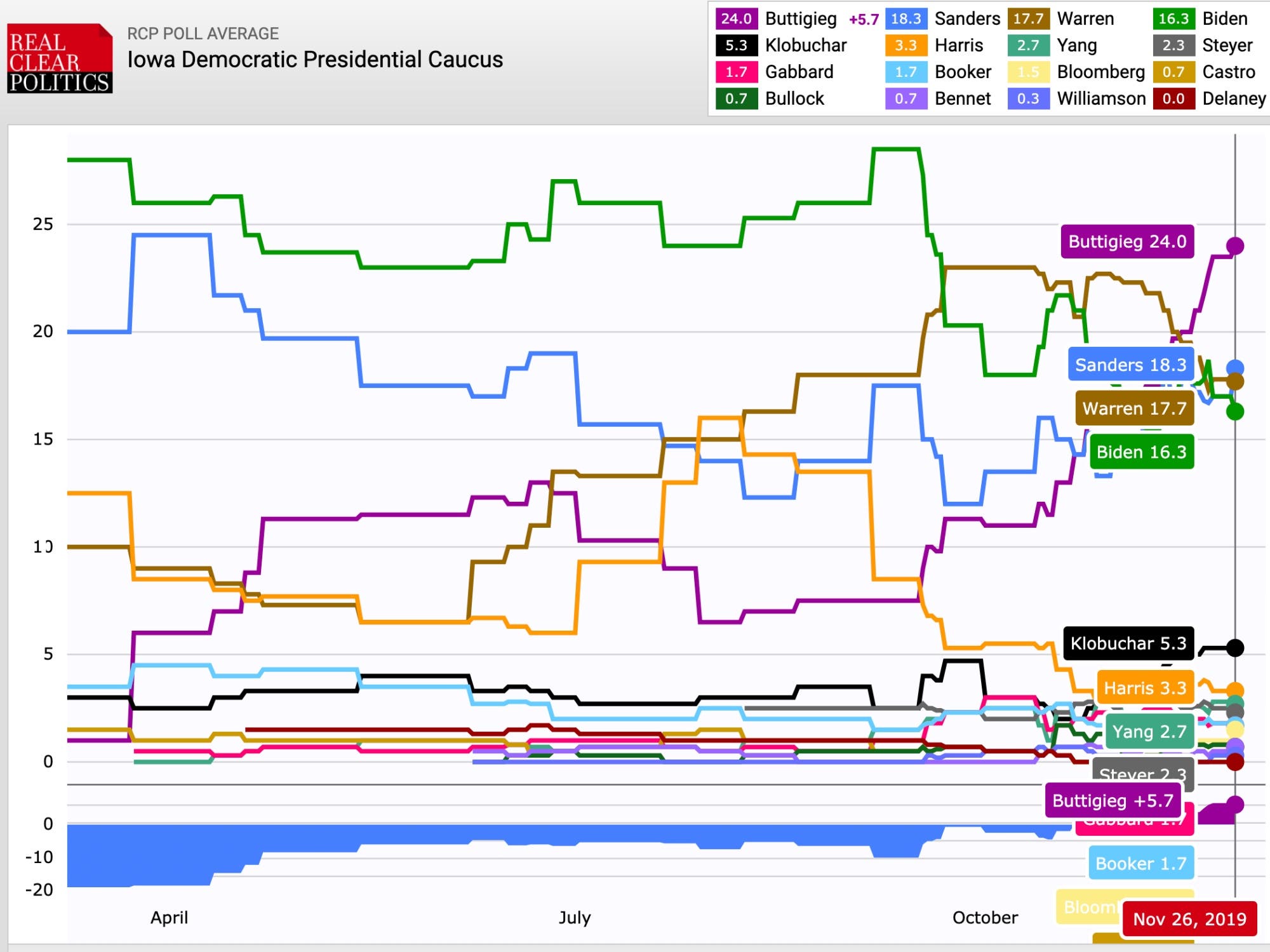
Real Clear Politics Iowa Caucus tracking polls
For 2020, even those running Hail Mary challenges against a populist president during a historically good economy are actually trying to compete for the hearts and minds of voters in intimate settings. But others, such billionaire former Republican turned indie turned Democrat Michael Bloomberg, are attempting to bypass the primary entirely, jumping into the nomination process in the longest of long shots. He is hoping he can win in a crowded field by spending millions of dollars in advertising to influence Super Tuesday states – a strategy that has never catapulted anyone to the White House before. Ask Jerry Brown, who jumped in late in 1976 in a failed attempt to derail Carter; or Rudy Giuliani, who never caught on in the early states so he put all his eggs in the big state baskets, spending millions on ads, and quit after finishing third in the Florida primary in late January 2008.
Other candidates this cycle have packed up their tents and gone elsewhere.
U.S. Sen. Kamala Harris (D-CA) had been heralded as an early favorite because of her political resume and her status as a favorite daughter of the largest state in the union which votes earlier in the process than past years. But Harris recently closed down her Granite State operation to focus all of her organizing energy on Iowa. She has promised to return, but her campaign was in a near-collapse before a former staffer laid into the campaign in a resignation letter that was shared by thousands on Twitter and in the New York Times.
No candidate has ever successfully become president after abandoning New Hampshire during the middle of the process.
Former HUD Secretary Julian Castro, a third-tier candidate at best, and the only Latino in the race, criticized the process and the state for not being diverse enough. His comments stunned many Granite Staters so much so that he was attacked by many members of his own party. His comments ignored the fact that, four cycles ago, the Democratic National Committee moved the South Carolina Primary and the Nevada Caucus forward in the calendar, to third and fourth, in an effort to give more diverse states a greater role in the early contests.
As with abandoning the state, chastising its voters has never been a one-way ticket to 1600 Pennsylvania Ave. either.
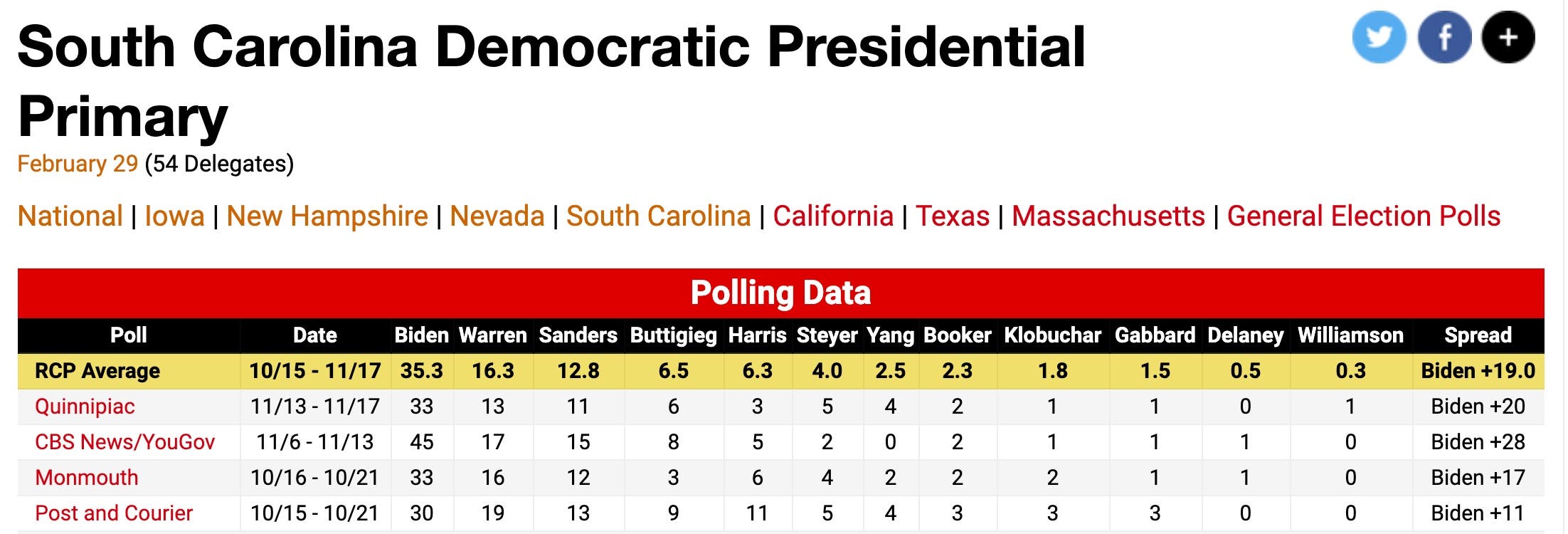
South Carolina polling data from Real Clear Politics
Since 2004, there has been a mix of the closeness of intimate political environments and larger crowd settings. Before winning the Republican nomination, Donald Trump held a few small events in 2015 and then, shifted to larger venues due to the swelling crowds attending his events. So, shifts are not unusual.
But in 2020, political watchers in New Hampshire are noticing the changes more than before.
Yeah, The Primary Is Different Now
If you've noticed that too many candidates are running but offering fewer visits, along with not-as-intimate settings and a disinterested electorate, and you are concerned, you're not alone.
Wayne Lesperance, the vice president of academic affairs at New England College, and Dean Spiliotes, a civic scholar of Southern New Hampshire University, have been first-in-the-nation primary watchers for many years. When asked if the contest seemed to take on a sleepier tone this cycle, they agreed.
"It's not just you," Lesperance said. "NH's FITN primary is facing a very different kind of challenge these days. And, in many ways, it's much more dangerous than the challenges of other states trying to leapfrog ahead of us."
Lesperance pointed to "the nationalization of the primary process," such as the early criteria of strong support via fundraising contributions as well as decent polling numbers as requirements for the rather large field of Democrats to gain access to millions of people watching the first debates – none of which have been held in any of the four early primary states, something that has never happened before. While their audiences have been waning, from a combined television and streaming audience of 24.3 million and 27.1 million on the first two June debates to a combined audience of just 7.9 million at the Atlanta event in November, candidates were "pressed to focus" on debates and "less on early states" and "more on high-profile opportunities" of the television and computer screens, Lesperance stated.
"That nationalized approach runs counter to what we treasure in New Hampshire – grassroots and shoe leather politicking," he said. "I think it is intentional as a means of wrapping up the nomination quickly. Parties want to win. They want as much time, money and focus on the actual race as possible. That’s not consistent with a prolonged, serious nominating process."
Spiliotes also pointed to the nationalization of the process via technology and social media as a change. When a candidate holds a retail event, he added, it's still local – but it is increasingly being interpreted through a national lens because of the national interest of the nomination process. He added while candidates are still engaged in retail politics, "all of the President Trump storylines are really crowding out typical media coverage." This makes it feel as if some candidates were flying under the radar, sans the debates, which were "a rare exception," he said.
"All of this makes it feel like NH is part of a larger national story, rather than driving the narrative, itself," Spiliotes said.
The "nature of politics," and the general tone of the process, Lesperance added, have left more and more people on the sidelines, not wanting to be involved – and "not nearly enough has been written about this" aspect of the 2020 race.
"Apathy is on the rise among all groups except the base for either party," he said. "And as both sides tack more to the base, those individuals in the middle are increasingly left without a home and choose to sit out and wait."
Both Lesperance and Spiliotes pointed to the number of candidates running, too, which made it difficult to cover them all fairly or for them to get exposure. Spiliotes said the large field "has been largely static – with the same five candidates on top for months now," who have had "significant movement, and we’ve been talking about it for a while," he added.
"We see some choosing to spend more time in South Carolina earlier on because of demographic affinity and because there are candidates here from neighboring states," Lesperance added.
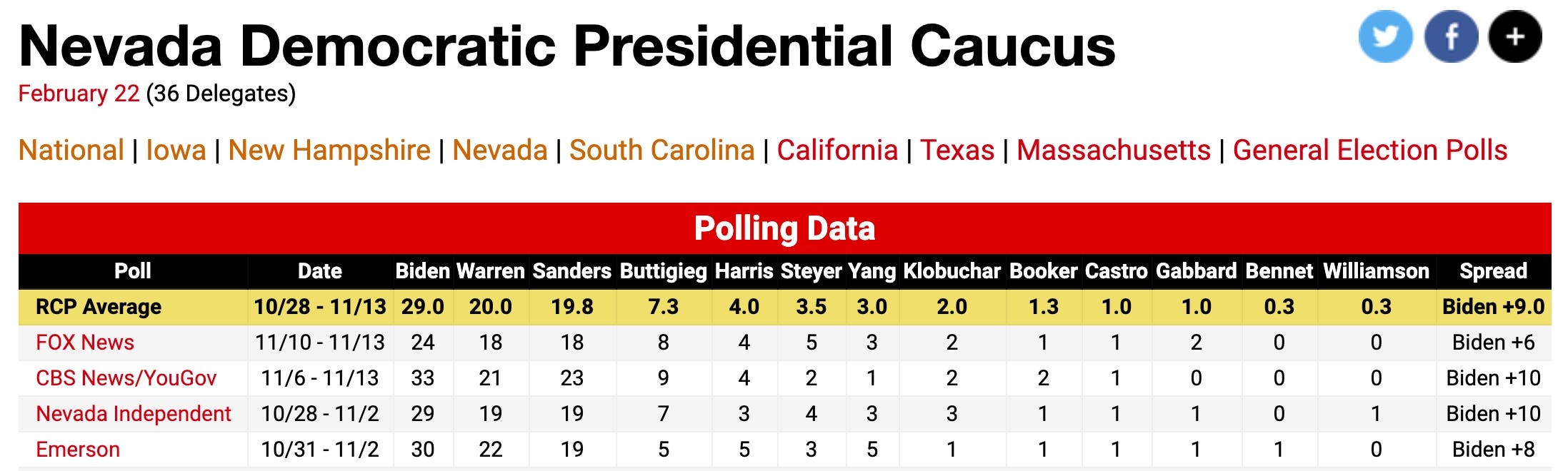
Nevada Caucus tracking polls by Real Clear Politics
John Weber, the battleground press secretary for the Democratic National Committee, however, challenged the notion that the process has been nationalized. He said threshold polling has been focused on early states such as New Hampshire, which requires a political presence in those states. The early state polling, Weber said, provided an "additional pathway" for candidates to qualify for debates through strong performances in fewer early state polls.
"The DNC recognizes the critical role the early states play in the primary nominating process," Weber said. "That's why early state polls have been used in our debate qualifying criteria since the beginning of this process – and been given equal weight to national polls. It's why we've announced we're holding debates in early states."
The View From The Upper Valley
Former state Representative and state Senator and current DNC member Peter Burling has been hosting candidates in the Upper Valley for decades. His home in Cornish is a must have meet-and-greet opportunity for any Democrat running. Burling, too, has seen changes, and most of his ire is placed on "the slow death of small paper journalism" which is now beginning to "show up on the ground" of political reporting.
"There are simply not enough reporters wandering the state of NH to keep up with all that is going on," he added. "Like it or not (and I don't) social media, particularly Facebook, has moved to displace political reporting, and at the same time fill the vacancy left by that displacement. Anyone with a good iPhone can record stills and video of any candidate, and then edit the recorded material into a passable report on what has been seen and heard."
Burling really noticed the change in political coverage this summer. He and his wife, Jean, hosted Castro, who drew about 125 people. Minnesota's U.S. Sen. Amy Klobuchar, who he is supporting, drew around 100. South Bend Indiana Mayor Pete Buttigieg, drew 550 – the most of any candidate he has hosted. The most before, he noted, was then-Vice President Al Gore in 1999, who drew about 350, including members of the press and Secret Service agents.
While there were journalists at this year's events, the "quality of the moments was not reflected in the coverage," especially, he noted, at the Buttigieg event which he called "amazing, simply extraordinary, but it wasn't covered the way it should have been. Too bad." Burling said the state needed more quality political journalists "but there is no current economic model robust enough to support excellent political reporting on a broader scale."
Burling also said "the continuing Trump circus" was playing a role in the lack of coverage of his future potential opponents. He called it "the never-ending whirl of confusion and distress coming out of the administration that simply blocks out everything else." While the Democrats had a quality field, they were not generating the interest one would expect or, frankly, need, to get elected.
"Another part is the fact that a couple of frontrunners are widely perceived as being past their 'sell by' dates," Burling added. "They simply aren't generating the kind of excitement that one might expect at this point. They may soon, I don't know, but right now it looks like Warren and Mayor Pete are the top tier folks really enjoying some interest. And that's good for them, but I wish some others, including Amy, my candidate, were standing in the spotlight. There are so many capable people running at this point."
Journalists And Bloggers Agree, Too
The nature of the news business has also changed from the days when a primary watcher or voter could bump into a candidate at Concord's storied Highway Hotel, lost in a fire years ago, pony up to the bar at the Wayfarer Inn and have a beer with Jack Germond, or even shake Al Gore's hand at the corner of North Main Street and Loudon Road in Concord, doing a sign wave. Political campaigns and the newsgathering process itself can be romanticized by journalists and the public alike even though millions and millions of Americans simply don't care about politics or the news while others are obsessed by it.
Covering the primary, however, is fun, quite charming, and fascinating, too; it is Norman Rockwellesque, actually. Sure, it can be silly at times. Reporters often hang onto every word of the candidates, many who have little-to-no chance of ever winning, breathlessly waiting for that nugget, spat or tart point that can often define a nanosecond of a moment in time for that presidential cycle (preserved now on Twitter using the hashtag FITN or, ideally, #FITN2020 this year, since there are enough characters on the social media platform now to add the year to presidential hashtags).
Not unlike the political side of the spectrum, for decades, young writers and editors have cut their teeth on primary coverage alongside seasoned scribes (although, not so much, anymore). It was as good a gig as any to get in the media business – which might be why the primary is beloved by so many and they are worried when they see massive changes that challenge its importance and validity.
When the larger television networks began hiring one-person shop embeds following the candidates around, it gave others around the nation the chance to experience the process, first-hand, too. But along with fewer political journalists and less coverage, there are noticeably fewer embeds this cycle, too.
Nancy West, the publisher of InDepthNH.org and a former reporter with the New Hampshire Union Leader, suggested there might be press and public fatigue with so many candidates expected to attend so many political stops during a longer and longer period of time. Each presidential campaign essentially begins the day after the previous election, depending on who wins (or at least after the Christmas holiday week after a president election). But West also agreed with Burling – there are too few journalists in New Hampshire to cover the candidates and she has the numbers to prove it.
According to the New Hampshire Department of Employment Security, "newspaper publishing jobs" dropped from 2,201 in 2001 to 896 in 2018. Those figures, West added, were not just reporters, columnists, and editors; they are sales people, designers, and photographers, too. But "it gives you a clue at the reduced resources to cover all these campaign stops," West stated. While there have been some new media outlets in the state like Patch, which opened 12 sites in 2011, West's own site, which just turned 4 last month, and the New Boston Beacon, which began publishing a monthly newspaper last year, the number of newspaper publishing establishments dropped from 77 in 2003 to 36 in 2018, according to state officials.
"I think staffing has been an ongoing issue even with major news outlets," West said. "It seems like the primary started too early and for the most part the candidates give similar speeches. It does look to me like the regional and local papers (worked) hard this year to cover candidates in their backyards. NHPR does something in depth with every candidate and, of course, WMUR."
InDepthNH has covered some stuff but also passed on a lot because there are so many other stories to cover, she said. Site contributor Susan Dromey Heeter started a new column this year, "Decoding the Vibe," to "try and get a sense of who the candidates are and how they interact with the crowds and they have been fun and more meaningful than a stump speech," West said.
Carol Robidoux, who was hired to start and write for the Nashua Patch site in 2011, has been publishing an online news site in the state's largest city, Manchester Ink Link, for around four years, too. Savvier use of social media by campaigns, she said, is bypassing the press and "bringing the candidates' messages directly to the people – not the least of which is POTUS." Mix in "a bit of skepticism by media and the public around legitimacy of the election process," and there is sense of "malaise about U.S. election process and its legitimacy," she said.
A former Union Leader journalist, too, Robidoux said the sheer number of candidates for the Democrats, not unlike the numbers the Republicans had in 2016, watered down the ability of even the best-staffed media outlets to focus on the "emergent Maverick – like Ron Paul or Bernie." In 2016, U.S. Sen. Bernie Sanders, I-VT, brought in "a sense of disruption" to the race in the same way then-U.S. Rep. Ron Paul, R-TX, did in 2012, she said. The large field for 2020 also made it hard to provide insightful coverage that generates public excitement.
"For me, 2012 felt like a real boots-on-the- ground campaign year in terms of the media going all out to be there for the kind of retail politics NH is known for," Robidoux said. "Patch had a lot to do with that – it forced legacy outlets to keep up and I think it was a transformative cycle."
One of the positive things about the 2004 campaign was the explosive emergence of blogging as a form of alternative journalism by citizens who sometimes break news and even offer multiple formats to their readers although, admittedly, the sites are motivated by personal and political beliefs. Blogs were around before 2004 and political activism online dates back to the early 1990s when America Online chat groups boomed in popularity. But during and after the 2004 cycle, bloggers began to go around many established media outlets, doing deep dives into issues while also performing cheerleading on the side.
Some of those blogs on the left, like Blue Hampshire, have since died off, unfortunately. But one blog site on the right which has expanded exponentially since its start in 2006 is GraniteGrok.com. "Groksters," as they are nicknamed, offer a lot of commentary – too much to process some days. The site has surpassed, in audience, based on Alexa rankings, most of the state's traditional media websites. And both Skip Murphy, a co-founder and owner of the site, as well as Steve MacDonald, a blogger and editor, have noticed some changes with the primary, too.
"I think the national media is so obsessed with the next breathy revelation from House Democrats on how they can get President Trump out of office it is sucking all the air out of the Democrat Primary," MacDonald said. "Not just in Iowa and New Hampshire, but nationwide."
Murphy is seeing "lots of excitement and a lot of enthusiasm" for Trump's reelection at the ground level, "a heightened enthusiasm that I haven't seen or felt since the TEA Party days (except they weren't GOP, they were TEA Party)." Journalists though, he said, while covering the events, "don't seem to be all that thrilled in do so … while a bit more than at 'yeah, it's the job' level, it's nowhere near the Obama level when they were all but falling all over themselves."
But Murphy was also critical of the process and the folklore of the primary as "a distortion in the local political scene," especially with Republicans, with the state party taking "its eyes off the local ball" and becoming more focused on the money that comes with the national campaigns and obsessing about the "DC Brass Ring." Murphy stated some Democrats might be facing some of the same issues – worrying about the stature of the primary with a national role while making sure the money still flowed to the state. If Bloomberg pulls off a win, bypassing New Hampshire, "the fame and the donations will dry up in a heartbeat," he said.
Murphy also pointed to Castro's comment about the state's lack of diversity and how most Democrats pounced on the criticism calling it not relevant and a sign of a weak campaign by Castro – not a non-diverse state that couldn't handle the responsibility, as it always has, of picking presidents.
"That confirms Dems only see skin deep stereotype by us, on the right," he said.
Murphy hoped Granite State Republicans would "finally start focusing all the time on what is really important – its grassroots efforts and formally reboot a long-term grassroots/farm team effort."
Murphy added, "Seems to be happening now, but more time is needed."
While there are fewer journalists at some media outlets and bloggers, too, one large news organization has been staffing up.
New Hampshire Public Radio has noticeably increased its primary coverage when compared to prior cycles – including a campaign tracker, issue sites, podcasts, and live candidate forums with "The Exchange" program. Patricia McLaughlin, the director of communications and marketing for NHPR, couldn't say exactly how many more radio reporters were hired at the network when compared to the past. The network's financial statements, however, show a nearly $1 million increase in the program services salaries line item between June 2014 and June 2018. During that time, its independent contractors budget dropped by nearly $70,000 while its management and general staffing budget increased by $160,000.
Critics of public radio point to the fact that the stations are taxpayer-funded. But according to its 2018 filing, only 9 percent of the network's funding, about $616,000, came from the Corporation for Public Broadcasting. More than $6 million came from personal and business donations, grants, and other revenues and a lot of that money is being spent on journalism. McLaughlin said last year, NHPR ran an innovation campaign designed to "bolster our reporting resources in both regional coverage, digital storytelling and politics via the State of Democracy project" at the network.
"Having that kind of investment gives us a more robust team across the board to devote to political coverage than what we’ve had in the past," she said. "(NHPR's) primary coverage remains a core part of what we do here and we take this mission very seriously. A key part of it for us is really exploring the issues that impact New Hampshire voters and looking into how policy decisions affect everyday lives."
With the arrival of the holiday season, the voters of New Hampshire will be focused on friends, family, and charitable giving, and yes, candidates will be in the state. The date of the primary, Feb. 11, 2020, is right around the corner. But whether any of those candidates will be able to gain the traction they need to win, in a sleepier first-in-the-nation primary setting, remains to be seen.
Previous #FITN2020 Coverage
- NH Presidential Primary Date Set – With A History Lesson, Too
- Presidential Primary Candidates Return To Press Flesh: FITN 2020
- Buttigieg Surges Ahead Of Warren, Biden In Latest N.H. Poll
- Got Those New Hampshire Primary Blues Again: Distant Dome
- 50 Hopefuls File For New Hampshire's First-In-The-Nation Primary
- Deval Patrick: 'I'm Excited. I'm Humbled. I'm Fired Up'
- In Concord, Warren Says Trump Operates Outside The Law
- Bill Weld Files To Challenge Trump In New Hampshire Primary
- Biden Makes it Official in Concord, Says He Will Take on the NRA
- Mike Pence To File President Trump's Paperwork For N.H. Primary
- Peter Grote Drove From Franconia To Back Klobuchar Filing In Concord
- 99 Days Until NH's Primary And Who's Counting
- Elizabeth Warren's Manchester, N.H. Campaign HQ Broken Into
- Primary Election Chief Back In Spotlight After Near-Ouster
- With A Special Hug And Hundreds Of Friends, Mayor Pete Files For The NH Primary
- Yoga With Marianne, 50+ Educators For Biden: FITN 2020 Roundup
- Watch: Tulsi Talks Up Presidential Campaign In Bow
- Trump Critics Struggle To Raise Money For Primary Challenge
- O'Rourke Bets On New Approach To Revive Flagging Campaign
- Joe Biden In Lead, But Does Campaign Have Enthusiasm To Keep It?
- In New Hampshire, 2020 Dems Urge Voters To Not Play It Safe
- New Hampshire Primary Candidates Descend On Convention: FITN 2020
- Buttigieg, Klobuchar Are In New Hampshire This Weekend: FITN 2020
- President Trump Called Woburn Supporter He Fat-Shamed At NH Rally
- Trump's New Hampshire Struggle: Voters Feeling 'Trumpgret'
- Trump To NH Voters: 'You Have To Vote For Me'
- President Trump Rallies With Thousands Of Supporters In NH: Watch
Got a news tip? Send it to Tony Schinella at tony.schinella@patch.com.
View videos at https://www.youtube.com/user/tonyschinella.
Follow the New Hampshire Patch Politics Twitter account @NHPatchPolitics for all our campaign coverage.
Get more local news delivered straight to your inbox. Sign up for free Patch newsletters and alerts.