Local Voices
Residents Question Sunoco Remedial Action Plan
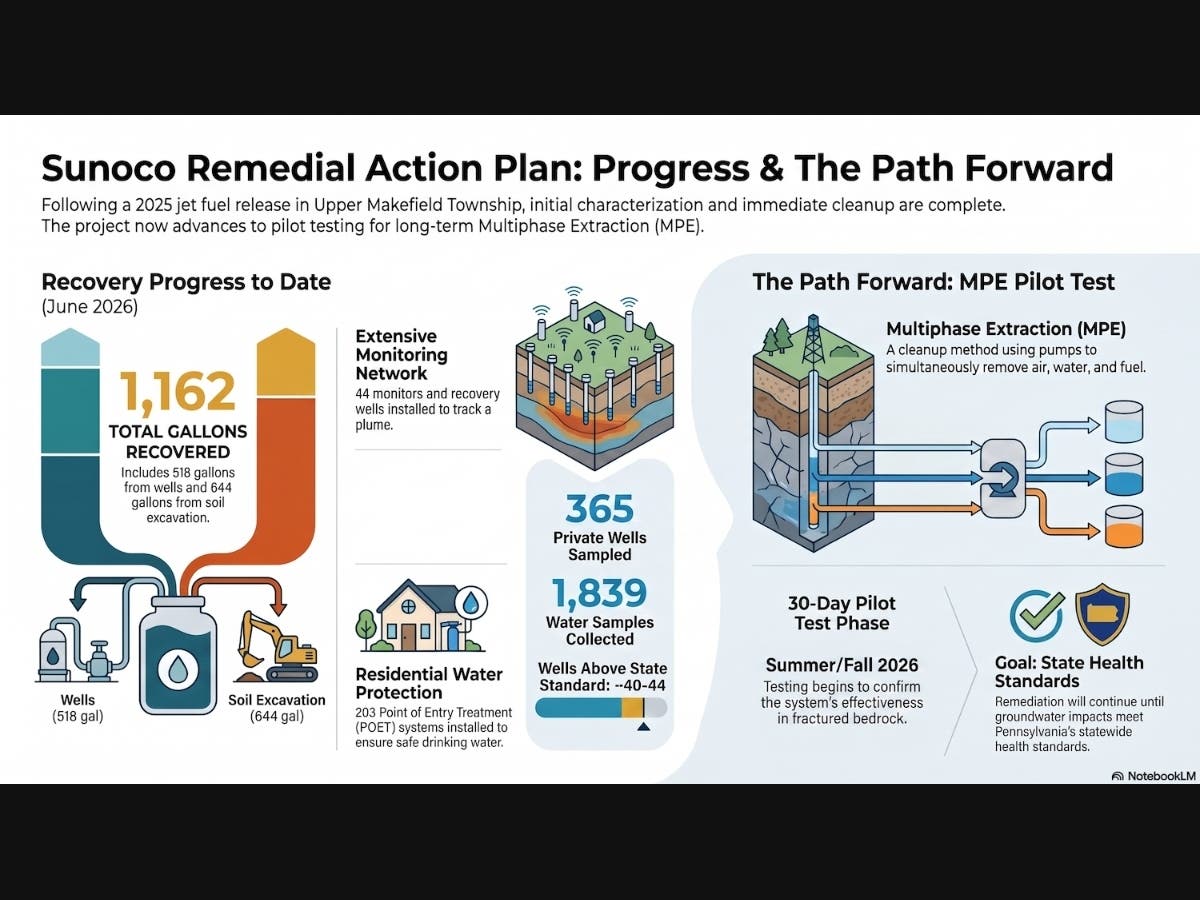
Despite ongoing recovery efforts that have reclaimed approximately 1,162 gallons of fuel to date, the meeting revealed significant friction.

Executive Summary
On July 8, 2026, Sunoco Pipeline LP (SPLP), an Energy Transfer partnership, held a public meeting to present its Remedial Action Plan (RAP) concerning a jet fuel leak in the Mt. Eyre Manor neighborhood of Upper Makefield Township, Pennsylvania (for background, read “Sunoco Submits Plan for Jet Fuel Pipeline Leak”). The leak, discovered in February 2025 from the Twin Oaks-Newark 14-inch diameter pipeline, resulted in an estimated release of 6,500 gallons of jet fuel into the local soil and fractured bedrock. The leak was from a 2.5-inch crack in the pipeline under a Glenwood Drive property, described as a 'slow drip' by pipeline company officials (read “Can UM Sunoco Fuel Pipeline Leak Flow to #NewtownPA Artesian Water Wells?”).
The primary objective of the RAP is to achieve Pennsylvania’s “Statewide Health Standard” for groundwater. The proposed strategy centers on Multiphase Extraction (MPE), a technology selected after an evaluation of 16 potential methods. A 30-day pilot test of the MPE system is scheduled for late summer or fall 2026 to determine the feasibility of a full-scale rollout.
Despite ongoing recovery efforts that have reclaimed approximately 1,162 gallons of fuel to date, the meeting revealed significant friction between SPLP and the community. Residents and local officials criticized the “slow drip” pace of remediation, the heavy redaction of public documents — approximately 40% of the RAP — and the lack of a permanent clean water solution, such as a public water interconnection.
Find out what's happening in Newtownfor free with the latest updates from Patch.
Overview of the Remedial Action Plan (RAP)
The RAP was prepared by environmental consultants Verdantas LLC to satisfy a PADEP administrative order. It serves as a roadmap for transitioning from interim emergency responses to long-term cleanup.
Cleanup Objectives
The plan identifies two categories of objectives:
Find out what's happening in Newtownfor free with the latest updates from Patch.
- Interim Objectives: Immediate protection of human health and the environment while characterization is ongoing.
- Attainment Objectives: Meeting specific regulatory criteria under the Pennsylvania Land Recycling Act (Act 2) to demonstrate the selected standards have been achieved.
In layman’s terms, SPLP defines success as removing as much jet fuel as possible, preventing further migration, reducing groundwater contamination to state standards, and ensuring a continuous supply of safe drinking water to residents.
Regulatory Standard
SPLP has selected the Statewide Health Standard rather than a site-specific standard. This requires groundwater concentrations to fall below a “bright line” limit and necessitates a two-year — eight-quarter — period of post-remediation monitoring to ensure stability.
Site Characterization and Findings
The investigation into the release has established several key geological and hydrological facts about the affected area:
- Geology: The site sits on fractured bedrock that behaves similarly to granite. It has “limited matrix storage,” meaning the fuel primarily resides in the cracks of the rock rather than soaking into the rock itself.
- Flow Direction: Groundwater and contaminant migration follow the dominant fracture orientation of the bedrock, moving in a southwest to northeast trend.
- Contaminant State: The fuel exists as Light Non-Aqueous Phase Liquid (LNAPL) — a floating layer on the water table — and as dissolved Volatile Organic Compounds (VOCs) in the groundwater.
- Delineation: Characterization is described as “ongoing.” While 44 monitoring and recovery wells are currently in place, newer wells are still being sampled to fully define the vertical and lateral extent of the plume.
Current Recovery and Remediation Efforts
Prior to the implementation of the full RAP, SPLP has engaged in interim recovery activities using pumps, bailers, and absorbent socks.
| Metric | Data Point as of June 16, 2026 |
|---|---|
| Total Estimated Release | 6,500 gallons |
| Fuel Recovered from Wells | 518 gallons |
| Fuel Recovered from Soil Excavation | 644 gallons |
| Total Recovery to Date | 1,162 gallons — approximately 18% of release |
| Monitoring/Recovery Wells | 44 wells |
| Private Wells Sampled | 365 wells |
| Total Water Samples Collected | 1,839 samples |
| POET Systems Installed | 203 systems |
Proposed Remedial Strategy: Multiphase Extraction (MPE)
After screening 16 technologies, MPE was selected as the preferred method because it can simultaneously address air vapor, water, and LNAPL.

MPE is uniquely suited for this cleanup because the site sits on fractured bedrock where the jet fuel exists as both a floating layer on the water table (LNAPL) and as dissolved Volatile Organic Compounds (VOCs) in the groundwater. The system utilizes a dual-pump design:
- Vacuum Pump: Pulls air and fuel vapors out of the ground.
- Submersible Pump: Simultaneously extracts contaminated groundwater and liquid jet fuel.
By addressing air vapor, water, and floating fuel all at once, it maximizes recovery from the cracks in the rock formation.
The Pilot Test
- Duration: Approximately 30 days.
- Target Wells: Four specific wells — Well A, RW3, RW2, and Well C — located primarily along Glenwood Drive.
- Mechanism: A dual-pump design using a vacuum to pull air/vapor while a submersible pump extracts fluids.
- Infrastructure: Above-ground piping will be used to avoid the disruption of trenching through asphalt. Equipment — generators, vacuum pumps, tanks — will be housed in a shipping container or trailer in the Walker Road cul-de-sac.
Logistics and Mitigation
- Timing: Summer/fall is preferred because natural groundwater levels are lower, allowing the vacuum to affect a thicker portion of the rock formation.
- Noise: SPLP is working with acoustical engineers to ensure generators and blowers meet township decibel ordinances.
- Water Supply Concerns: While residents expressed fear that MPE would “suck their wells dry,” SPLP consultants stated that the shallow 35-to-40-foot drawdown is unlikely to affect deeper private wells, though monitoring of adjacent water levels will occur.
MPE Pilot Test Phases
| Phase | Description |
|---|---|
| Summer/Fall 2026: Site Preparation | Equipment — generators, pumps, and tanks — staged at the Walker Road cul-de-sac. |
| 30-Day Window: Active Testing | Individual and combined testing of wells RW3, RW2, A, and C. |
| Post-Test: Data Analysis | Evaluation of vacuum influence, recovery rates, and groundwater chemistry. |
| Year-End 2026: Full System Design | Development of a permanent remediation facility based on pilot results. |
Community and Official Opposition
The meeting highlights a profound lack of trust in the remediation process. Key areas of contention include:
- Transparency and Redaction: Residents and officials, including Sarah Baker and Kyle Mulander, representing Congressman Fitzpatrick, criticized the RAP for being 40% redacted — 65 pages. They demanded unredacted access to data regarding the total volume of fuel released. Brian Fitzpatrick’s office pointed out that 65 pages, or 40%, of the RAP are redacted. SPLP claims this is for personal privacy, such as addresses, but critics argue it hides critical technical data.
- Water Security/Reliability: Residents reported “black and brown water” and sediment-clogged filters despite Point of Entry Treatment systems. Many expressed anxiety that a point-in-time test does not guarantee the safety of the water they drink “five days later.”
- Permanent Water Solution: Township officials and supervisors criticized the RAP for omitting any analysis of a permanent public water supply. Ben Weldon, Upper Makefield Board of Supervisors Chair, and Greg Schuster, Township Manager, argued that the RAP fails to address this issue. They characterized POET systems as “temporary bandages” for a contaminated aquifer.
- Operational Integrity: Critics noted the leak went undetected for up to 16 months before discovery and questioned the accuracy of the 6,500-gallon estimate, suggesting the actual spill could be much larger.
- Operational Nuisance: Neighbors raised concerns about 24/7 generator noise and the physical disruption of equipment in residential cul-de-sacs.
- Aquifer Impact: John Mack, Newtown Township, expressed concern regarding the 70-year-old pipeline’s proximity to Newtown and the potential for the MPE drawdown to pull contamination toward the Artesian water supply.

Notable Quotes
Neil Ketchum, Verdantas President: “We’re reaching or have reached the limits of recovery for the methods that we’re using... MPE was the best score for both LNAPL remediation and for groundwater remediation.”
Ben Weldon, Upper Makefield Board of Supervisors Chair: “These [POET systems] are temporary solutions. They were never supposed to be the permanent clean water solution... there’s not one mention in 197 pages of an alternate water source.”
Sarah Baker, Resident: “Sixty-five pages of the remedial action plan are redacted. It’s about forty percent of it... we receive something that’s publicly released, and forty percent of it is a black blob.”
Kyle Mulander, Representative for Congressman Brian Fitzpatrick: “This plan is completely flawed, evasive, and heavily redacted... Sunoco has not provided a transparent, technically supported estimate of how much fuel was actually released.”
Steve Santarsiero, State Senator: “The reason we’re here eighteen months later... is because Pennsylvania law is inadequate. [We have] introduced the Environmental Responsibility and Cleanup Act... to require cleaning up to a much higher standard.”
Next Steps
- Written Comments: The public comment period remains open until August 3, 2026. Via Email: uppermakefieldact2@energytransfer.com and by Postal Mail: SPLP Office, 525 Fritztown Road, Sinking Spring, PA 19608.
- DEP Review: The Pennsylvania Department of Environmental Protection will serve as the final arbiter on whether the remediation meets Act 2 standards.
- Legislative Action: State Senator Steve Santarsiero noted that current state health standards may be inadequate and highlighted the Environmental Responsibility and Cleanup Act as a potential legislative remedy (read “Hazardous Spill Cleanup Bill Introduced By Bucks Co. State Lawmakers”).