Politics & Government
Former Airman Accuses Commander Of Vindictive Mistreatment
Mario Manago had a meeting with his commander to discuss leadership issues in his unit. He was six minutes late. It cost him his career.


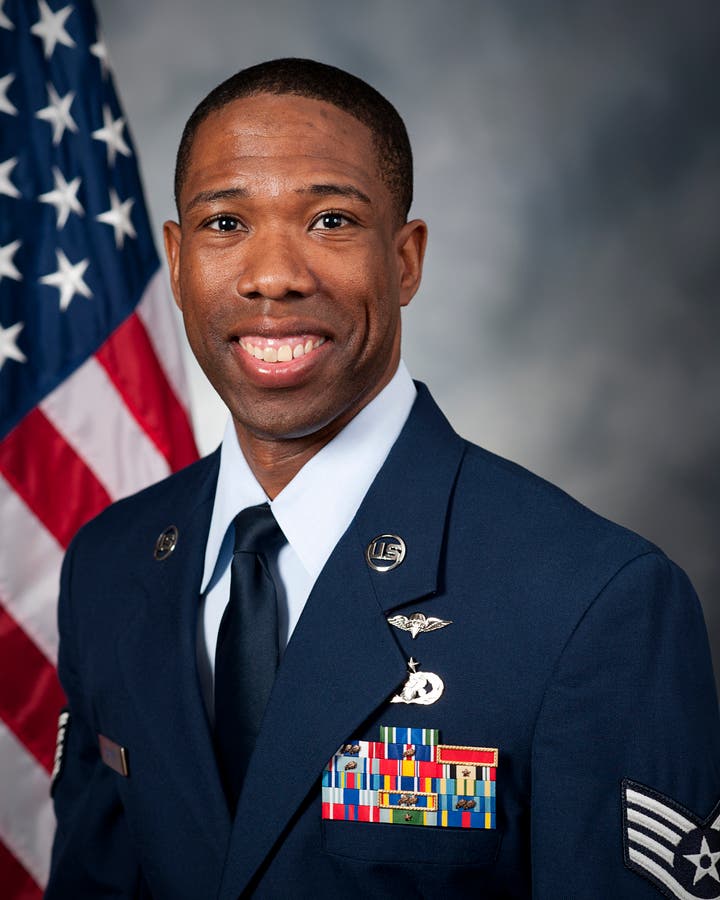
Mario Manago used to be an Airman. There were problems between him and the leadership in his new unit, all of which led to Manago’s forced separation from the Air Force in 2017, ending 13 years of service. The catalyst for the end of his career? Being six minutes late to a meeting.
He was late because he was working a mission. As an air transportation specialist with the 305th Aerial Port Squadron (APS), which is at Joint Base McGuire in New Jersey, it was Manago’s job to coordinate and supervise operations on the flight line — removing and loading cargo, managing air passenger manifests and organizing seating and boarding. Specifically, he was the supervisor of passenger services.
Manago had set up the meeting for Aug. 12, 2016 at 10 a.m, with Lt. Col. Quidley, the commanding officer of his squadron, with the goal of bringing up what he saw as shortcomings among the 305th's leadership like poor organization, failure to adhere to Air Force standards and, eventually, his own treatment which he considered unfair, including a series of unfounded and punitive actions targeted directly at him.
Find out what's happening in Across Americafor free with the latest updates from Patch.
“I requested exercising Lt. Col. Eric Quidley's Open Door Policy to inform my commander what I believed to be deviations of USAF Instructions, regulations, standards and how I had been targeted and mistreated by my immediate leadership,” Manago said in an email.
The morning of the meeting, Manago was concerned with completing the mission correctly. “If I would have left what I was doing to go to the meeting… say something happened, I would have been charged with dereliction of duty,” he told Patch, noting that he was required to supervise the airmen on the mission. Manago saw himself somewhere between a rock and a hard place.
Find out what's happening in Across Americafor free with the latest updates from Patch.
Manago called the squadron office 45 minutes before the meeting, attempting to push it back so he could finish his mission. He was told no, and when the mission was over, he left immediately, he said.
Six minutes late, Manago arrived at Quidley’s office. He says instead of discussing the leadership problems like he had intended, the meeting turned into something of an interrogation as to why he was late. Quidley testified that he wanted to gather “all the facts” about Manago’s tardiness that day.
Quidley decided to issue a non-judicial punishment (NJP) to Manago for his tardiness.
An NJP is basically an in-house punishment with no lasting effects in the civilian world. A unit commander, who is always an officer and in charge of his or her troops’ conduct and well-being, hands down a punishment when one of their troops breaks a rule. This allows for everybody to avoid a court-martial, which is immensely time consuming and has lasting legal effects. Commanders have the authority to demote their troops, restrict them to the barracks, cut their pay and more in an NJP.
Quidley testified that the reason he punished Manago for being late was to uphold an air of authority among his subordinates. “I perceived that there would have been harm for there not to have been any disciplinary action in the face of that lack of punctuality. It could have affected my subordinates’ perceptions of me as a commander for him not to have been disciplined for that,” Quidley testified, according to documents obtained by Patch.
Service members have the right to deny an NJP and take the issue to court-martial, just like civilians can appeal a court’s decision and take the case to a higher court. Manago chose to take it to court-martial.
A History of Reprimands
It would be inaccurate to say that Manago was demoted and kicked out of the Air Force based solely on one incident of tardiness. He had received several official reprimands from his unit throughout his tenure there. According to Manago, many of them were illegitimate. In fact, these reprimands were one reason Manago set up the meeting with Quidley in the first place. He was transferred to the 305th APS in February 2016.
On March 6, 2016, he received a Letter of Counseling about being late on a $20 payment for his government travel credit card, he said. In an official response to the letter, he acknowledged his mistake. “As an NCO [noncommissioned officer] it is my duty to remain aware and fulfill my government obligations without faltering,” he wrote. Manago acknowledged his mistake.
On May 24, he was reprimanded for acting “in a disrespectful manner to a retired Senior Non-Commissioned Officer in the United States Navy,” according to the Letter of Reprimand. This stemmed from a May 19 incident when the retired sailor was taking a flight which Manago’s unit was managing. The sailor didn’t want to wait in a long line, but Manago told him he had to anyway.
Manago thought it was baseless to say he was disrespectful. He says he didn’t raise his voice or act disrespectfully. He admitted there were issues with customer service that day, but says since he was the supervisor, he was the “face” of the terminal, and therefore blamed. Senior Master Sgt. Ronald Ahlstrom, the superintendent of Manago’s work section, acknowledged in testimony that Manago was “not subject to [the sailor’s] authority.” Ahlstrom wasn't there that day, but testified after investigating that nobody he questioned confirmed what the retired sailor had claimed, according to documents.
On June 28, Manago got a Letter of Reprimand for being late twice earlier that month. He did write a memorandum claiming there were extenuating circumstances, but ultimately accepted responsibility.
On Sept. 28, he was reprimanded for “leaving a 10K Standard forklift running that was not double chocked,” according to the Letter of Reprimand. The rule says that if an airman leaves a vehicle unattended, they must put blocks in front of, and behind, a tire to prevent it from moving.
Manago refuted this. He says he was just removing a dunnage from in front of his forklift and did not leave it unattended. “I was within three feet of the forklift… at no time did I leave the vicinity of the forklift,” he said in a response to the Letter of Reprimand, adding that he lowered the tines, put the forklift in neutral and pulled the hand brake "as trained."
On Dec. 21, Manago was reprimanded for being late twice. On Nov. 25, he was an hour-and-a-half late to work and on Nov. 30 he was a half-hour late. Manago acknowledged this, but said his superiors had explicitly given permission to arrive when he did.
In his rebuttal to this reprimand, Manago claims that Ahlstrom had instructed Tech Sgt. Callahan, Manago’s direct superior, to keep memoranda on his infractions and forward them to him, which led Manago to feel disrespected, stating; “I respectfully submit that I am not being treated as a non-commissioned officer, but instead operating in an environment where I am constantly under a microscope by senior leadership that appears to be intent only upon building a case against me”
What was particularly confusing to Manago regarding Ahlstrom's actions was that, he claims, Ahlstrom said in a July 8, 2016 meeting that he “wasn’t given a fair shot” and was a “scapegoat” in the unit. Manago also alleged that Ahlstrom had said the problems he was being blamed for “still existed with other supervisors on shift.”
Senior Master Sgt. Ahlstrom was not available for comment.
On Feb. 24, 2017, Manago was administratively demoted from staff sergeant to senior airman, based on the recommendation of Lt. Col. Quidley. The demotion paperwork cites the reason as four Letters of Reprimand and one Letter of Counseling received by Manago. He was no longer a noncommissioned officer. Manago appealed the decision, but was denied. He said the decision was made “arbitrarily” and “without cause or specifics.”
The denial of Manago’s appeal meant he would be forcibly removed from the Air Force. In an attempt to cut down troop numbers, the Air Force kicks out senior airmen who have been in the service for eight years, according to Stars and Stripes. At this point, Manago was a senior airman with 13 years in service.
The Court-Martial
From March 13-17, 2017, Manago’s case was tried. He was charged with two counts of being absent without leave, one count of insubordinate conduct towards a noncommissioned officer and two counts of making false official statements, according to Tech Sgt. Austin Knox, a public affairs airman at Joint Base McGuire.
Before the trial, Manago’s defense asked the judge to dismiss the charges “on grounds that the prosecution was motivated by vindictiveness.” The judge denied that request. Manago was “ably and zealously represented” by a civilian attorney he hired at his own expense and had a military defense counsel appointed to his case, according to Knox.
During the trial, Manago and his defense tried to establish that he was not at fault for being late. “The evidence established no legal justification or excuse for his tardiness,” Knox said, and the judge sentenced Manago to be reprimanded.
Of the five charges against him, Manago was found guilty only of being absent without leave for six minutes from the meeting that he had requested with Quidley.
Manago now has a federal conviction on his record. The offense, according to Knox, “would be most appropriately characterized as a misdemeanor” in the civilian world.
NJ.com reported Manago, a black man, as saying he doesn't think race played a large role in his treatment. However, a study conducted by Protect Our Defenders, a nonprofit fighting misogyny and sexual harassment in the military, concluded that black airmen are 71 percent more likely than their white counterparts to go through an NJP or court-martial. This disparity is the widest among the U.S. military branches.
Manago grew up around the Air Force. Born in Germany where his father was stationed, he became fascinated with aircraft, he told Patch. He met with military recruiters for the Marine Corps, Army and Navy, but ultimately landed on the Air Force.
Through his 13 years, Manago deployed to Qatar and served in Iraq at Al-Taqaddum Air Base and in Baghdad.
It was clear that Manago felt a strong connection to the Air Force. In letters dated May 31, 2017, he requested of the 305th Air Mobility Wing commander Col. Darren Cole, 305th Maintenance Group commander Col. Jonathan Bland and Quidley that he be reinstated as a staff sergeant, moved to a different base, be retrained in a different job field and that his adverse records be expunged. In his eyes, this would have righted the wrong.
He also requested that the command’s inspector general investigate the “health, morale and welfare of 305th Aerial Port Squadron.
Cole, Bland and Quidley all denied his requests because they weren’t filed “within 90 days of [Manago’s] discovery of the alleged wrong” and because, they said, his requests should have been made to the Air Force Board for Corrections of Military Records.
Today, Manago wouldn't rejoin the Air Force if given the chance. Disillusioned, he feels that if he were to do so, he would be targeted again.
(Patch attempted to contact Col. Cole and Lt. Col. Quidley directly, but neither responded. We were referred to the public affairs office.)
Article image provided
Get more local news delivered straight to your inbox. Sign up for free Patch newsletters and alerts.

![Is Trick-Or-Treating Becoming A Zombie? [Block Talk]](https://patch.com/img/cdn20/shutterstock/790386/20261009/104846/styles/patch_image/public/shutterstock-70173520___09104608634.jpg)