Community Corner
In Doggy Greetings, The Slobbery Toy Is Man's Best Compliment
What's behind this common canine greeting behavior?
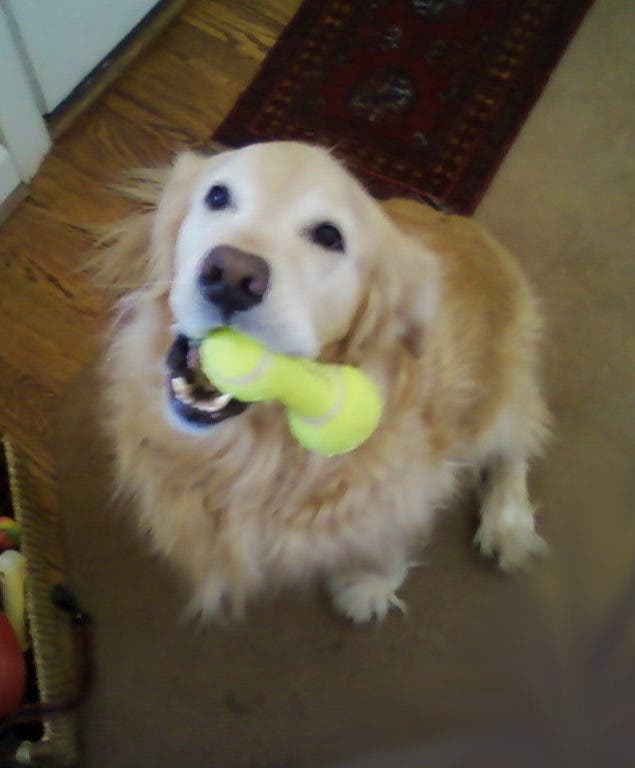


One of the most entertaining parts of my daily dog-walking and pet-sitting visits are enthusiastic greetings I receive from my furry friends upon my arrival. I’m particularly entertained by the fair number of pups who excitedly greet me with their favorite toy or “treasure.”
Everyday a happy-go-lucky middle-aged golden retriever proudly drags his latest stuffed animal victim, sans its stuffing and an arm or leg, to the door where he presents me with it. Another daily dog-walking buddy, an old lab, springs to life, retrieves a giant stuffed purple hippopotamus, and barrels down the hallway, shoving it into my leg as soon as I step through the door. My own dog, a mutt, also displays this same behavior, always finding a toy, a blanket, or anything she can comfortably shove in her mouth to greet her favorite people with.
I used to dismiss these displays simply as an idiosyncratic oral fixation limited to retrievers, but I’ve since come to see it in many a dog, from young to old, across breeds. What, I wondered, explains this common doggy greeting routine?
Find out what's happening in Greater Alexandriafor free with the latest updates from Patch.
I consulted two local experts with whom I’m already familiar – Lisa Colon Tudor, trainer and owner of Kissable Canine, LLC, from whom my dog and I have been getting quite the education –and my boss, Elizabeth Legere, veteran pet professional and owner of Alexandria Pet Care.
I spoke with Tudor first, imagining that as Northern Virginia Magazine’s 2010 “Best Trainer” that she had plenty of experience and insight to share. That said, Tudor reminded me that in many situations, “trainers are really just professional guessers,” who use their background in animal science, their anecdotal experience, and any scientific data to attempt to explain dog’s behavior.
Find out what's happening in Greater Alexandriafor free with the latest updates from Patch.
Tudor explains that a dog excitedly bringing its human its favorite toy is a behavior “based on arousal” and extreme excitement. It is this extra energy that manifests itself is in the retrieval and presentation of toys and treasures. Tudor explains that such behavior not only provides an outlet for overflowing excitement, but as a form of communication from pet to person that can carry multiple messages. On a physical level, approaching with a toy can serve as a means to diffuse tension. Rather than charging the door and greeting with direct eye contact, which in dog speak can be interpreted as rude or threatening, the dog diverts focus to the object. This indirect interaction sends a clear, non-threatening message and helps direct subsequent interaction in a positive, often playful, direction.
Elizabeth Legere of Alexandria Pet Care, believes that our “great praise and happy body language” when dogs bring us their favorite toy or treasure is a behavior that owners “reinforce through our reactions.” Additionally, Legere suggests that the practice of bringing a toy or a “prize” to their human stems from a dog’s “primal instinct to bring food or other comfort offerings to the pack leader.” Indeed many of my colleagues in the pet-care world interpret the greeting-with-a-toy-routine as a clear example of dogs’ wanting to please the “alpha.” I’ve heard the same explanation applied to the practice of cats bringing dead prey into the house and while I can’t speak to feline behavior, I suspect there are strong similarities in motive.
While I have no practical use for a tennis ball coated in thick dog slobber, a giant squeaking hippopotamus, or a dead mouse missing a tail, I too tend to believe that these behaviors demonstrate a distinct desire on the part of our pets to share affection and happiness, to please us, and to have such efforts acknowledged – even if we’re not nearly as excited about the object in question as they are. So the next time your overgrown puppy turns into a tail-wagging, slobbery-toy-toting, wiggle worm when you come home from work – just enjoy it!