Schools
Hollin Meadows Garden Thrives On Teacher, Community Efforts
Community donations save school garden; a Hollin Meadows teacher wins accolades
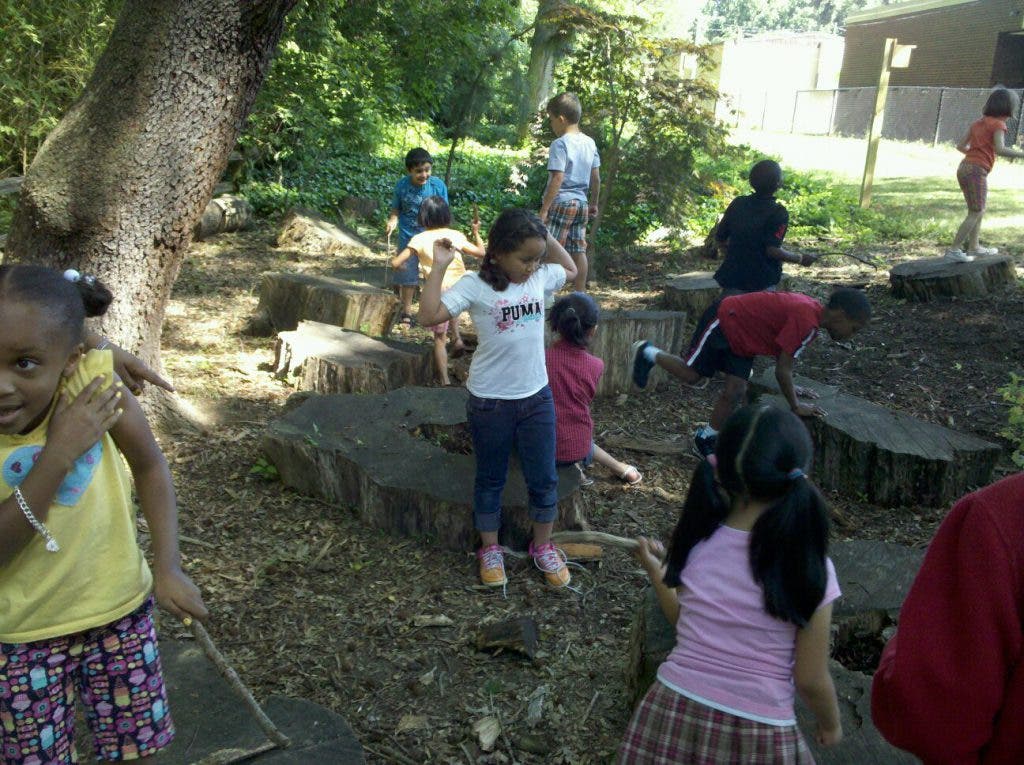


The stillness of a wooded area beside Hollin Meadows Elementary School is broken by a brigade of screaming, giggling first-graders. Science teacher Jason Pittman is showing his rambunctious students how earthworms and fungus make their home inside the rotting, hollowed-out centers of tree trunks.
“As that fungus works, as it gets its food, it turns all of this into new soil,” he tells the children circled around him, with a night crawler in the palm of his hand. “This whole tree stump will be decomposed all into new soil for new plants.
The kids are amazed, and a bit grossed out, that their teacher just picked up an earthworm. Pittman says it beats trying to teach vocabulary from a worksheet in the classroom.
Find out what's happening in Greater Alexandriafor free with the latest updates from Patch.
Parents say Pittman, 36, is the heart of Hollin Meadows’ ambitious outdoor garden curriculum, a program that over six years has terraformed the once-grungy and boring school exterior into 14,000 square feet of garden space. The garden includes five separate areas that boast native vegetation, farmed fruits and vegetables and insect-luring flora.
It’s not just the PTA that’s noticed Pittman’s efforts. In April, he was one of two teachers in the nation awarded the Zula International-National Science Teachers Association Early Science Educator Award, which is given to pre-K through second grade teachers.
Find out what's happening in Greater Alexandriafor free with the latest updates from Patch.
Pittman was recognized for developing a cross-curricular outdoor education program centered on the garden. He invited professional geologists, meteorologists, and professional scientists to visit the school and work with students, according to a news release from Fairfax County Public Schools.
He also was a 2010 recipient of the American Geological Institute’s Edward C. Roy, Jr. Award for leadership and innovation in earth science education as a K-8 classroom teacher. Pittman also was instrumental in landing Hollin Meadows a grant from Intel Corp.
Pittman’s accolades have come in the course of a relatively short teaching career. He was a tech entrepreneur during the dot-com boom, with his own web design firm in Richmond. But after spending a lot of time volunteering with kids, he decided to sell the company and pursue a career in education. He’s now in his eighth year as a teacher.
Pittman didn’t talk much about his awards. He instead directed the spotlight towards the community efforts that have effectively saved the school’s math and science focus program from the chopping block.
The school knew three years ago that its program would be the But Hollin Meadows administrators learned in September that their signature math-science focus program would lose all funding for the next school year. Members of the school community immediately began to plan fundraising efforts.
A non-profit, calling itself , including a that raised about $44,000 dollars, said Chris McNamara, the current president of the school’s parent teacher association.
That money, including a $10,000 dollar contribution from the PTA and a Fairfax County priority schools initiative grant will fund the program for the next school year. Most of the money goes to full-time math teacher, a part-time garden coordinator, and a full-time science teacher.
At a school like Hollin Meadows, where over half of all students are Black or Hispanic and 46 percent receive free or reduced lunch, Pittman said the math and science focus program is crucial for closing the racial-achievement gap.
“It’s not just something we think is working – we can put this in real numbers,” said Pittman. “The interesting thing is about the data, if you compare us to any other school in Fairfax County… we’re closing down these gaps that are historically present.”
In 2010, around 88 percent of Black students and 96 percent of Hispanic students at Hollin Meadows passed Virginia’s SOL math assessment compared to 83 and 82 percent of Blacks and Hispanics county-wide, according to data supplied to the school board by parent advocates.
Shawn Akard, a former parent who’s now employed part-time by Fairfax County Public Schools as Hollin Meadows’ outdoor education coordinator, said the garden is also changing the way kids experience the natural world.
“Giving them an opportunity to experience the natural world in an education setting – I mean, that doesn’t happen that often,” said Akard, a family therapist by trade. “It’s not just pretty. It has nothing to do with that; that’s a bonus. The sole purpose is for educational reasons.”
Every year on to puruse an eviromental project. The garden program features a Native Virginia Wildlife Habitat Garden, which includes hundreds of plants meant to draw pollinating insects, as well as a pile of bowling ball-sized rocks to lure lizards and snakes.
Tree trunks – brought to the school from the remains of a toppled century-old tree – serve as makeshift desks in a woodland classroom. In the school’s courtyard, collaboration between students and teacher and parents transformed an eyesore into a series of murals, a grouping of colorful picnic tables, and more plantings.
On the backside of the school is a long row of planting beds for edible plants and herbs. Seedlings for items such as tomatoes, basil, eggplants, peppers, and squash start in a modest greenhouse and get moved into the garden.
When the students reap what they have sown, they’ll calculate the weight of their harvest by grams – yet another opportunity to bring math into the garden, Akard said.
Science helps to keep the garden grow, too. A pole-mounted wind turbine and solar panel create stored electricity, which powers a pump on a timer, connected to a series of rain barrels. The rig waters the garden in the summer when nobody’s around.
Their green-thumbed efforts drew First Lady Michelle Obama, who made a surprise visit the school in 2009 as she kicked off her “Healthy Schools, Healthy Kids campaign.
For the sixth graders moving onto middle school in the fall – like former PTA president Sue Bernstein’s 11-year-old son – the garden program has been the lynchpin of their elementary school education. That means parents and educators plan to keep a close eye what career paths those students may track toward in the next year, and beyond.
“It’ll be interesting to see what happens long-term,” Akard said. “That’s what we’re going to be tracking because a lot of people are going to be interested in it. We really want to push the idea of [science and technology education methods] occupations.”
Bernstein said if nothing else, the garden is fun.
“Can you imagine growing up, having a little bit of fun while you’re learning? Touching and smelling and eating what you’re planting?” she said. “I really believe that they will remember this education, the process that they’re going through.”
For the kids playing in the woods, hopping from one tree trunk to the next, they couldn’t be having any more fun learning about fungus.
“This is just a way to take our science lessons out of the classroom, to actually have the kids come out here and investigate on their own and develop a foundation of experience,” said Pittman. “We’re learning about ecosystems, living things, how they work together – it’s hard not to get anybody engaged.”