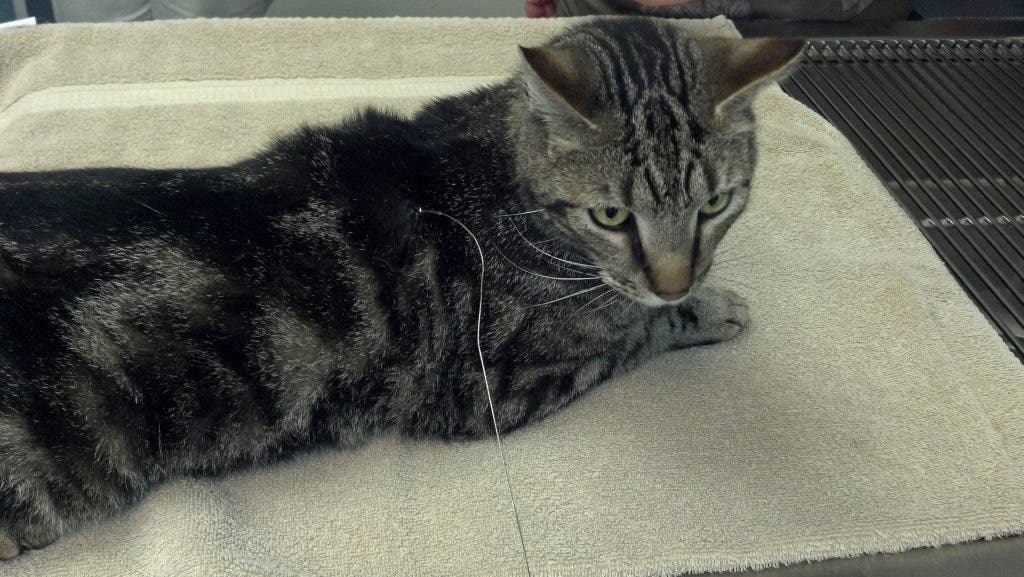

We had a cat's guardian walked in the door saying he'd “been cat fishing,” and look what he'd caught! That's right, his cat Zeus had a large fish hook firmly imbedded in his back. This was not the first fish hook we've seen. It reminded us that even indoor cats can face hazards.
We often get calls about house plants, flowers, and string. These three things seem to make up the bulk of our every day hazards cases. Things like dental floss are enticing for Kitty but easy for care givers to over look. Keep trash cans with lids for bathrooms and make sure to get all the floss inside; or use an old coffee can for the floss. Remove random strings and keep clothing with long ties away from Kitty. Shoe strings are fun toys but can quickly become a hazard. Place all toys with string, such as the ever-fun furry-mouse-on-a-pole, out of Kitty's reach when you are not playing with her. If you do find that Kitty has eaten string of some sort and the end of the string is still visible DO NOT PULL ON IT! The string can easily slice through Kitty's delicate intestinal tract with one pull or tug. Instead, cut the end of the string as close to her mouth as you can and call your veterinarian immediately.
House plant ingestion is another thing we often treat. Some cats will not even touch house plants. Care givers of those cats are lucky. Most cats will take the opportunity to snack on something green and leafy. Cornell Feline Health Center maintains a great resource for owners wanting to research safe indoor homes for cats. Also the ASPCA maintains a nice resource for owners wanting to research toxic and non-toxic houseplants: http://www.aspca.org/pet-care/poison-control/plants/
Find out what's happening in Kingstowne-Rose Hillfor free with the latest updates from Patch.
Some owners simply keep plants in a “no Kitty zone” or use barrier methods such as Scat Mats to deter Kitty from jumping on to a table where plants are kept. In general though, it is best not to keep plants that are highly toxic to Kitty in the house, just in case. If Kitty must snack on something green consider growing some “cat grass” for her. Many pet stores sell trays of safe grass for Kitty that owners can grow indoors. Just keep in mind that cats sometimes vomit even non-toxic plants, like grass.
We all love cut flowers. Who hasn't been happy to receive a bouquet at one time or another? Flower are lovely, but some of them, especially lilies, are highly toxic to cats. When we say lilies, we mean ALL lilies: tiger lilies; day lilies; Easter lilies; Star Gazers; Stella Dora; etc. If it is a lily don't even take a chance. Lily ingestion causes kidney failure in cats. Unfortunately, eating even a tiny amount of lily can kill Kitty in just a matter of days. Some other offenders are tulips, foxglove, and philodendron. Call your veterinarian, local animal emergency hospital or Animal Poison-Control immediately if ingestion is suspected. Immediate treatment is needed to prevent death.
Find out what's happening in Kingstowne-Rose Hillfor free with the latest updates from Patch.
Everyone knows household chemicals can be a hazard. Kitty is unlikely to ingest something like bleach or drain clog dis-solver when left to her own devices. However, if she were to walk through a small spill of chemicals she will probably ingest some as she cleans her fur and feet. Another common household chemical that is very hazardous is antifreeze. Unless it has been flavored to taste bad, it actually tastes sweet and many cats and dogs will readily drink it. Ingestion of antifreeze will cause kidney failure and death if not treated immediately. Clean up chemical spills right away with Kitty in mind and keep all household chemicals in an area where she is unlikely to knock them over during her daily rounds of your house.
Consider keeping the Animal Poison Control Center number handy: 1-888-426-4435. The Center is staffed 24/7. For a reasonable fee, the Center will advise both immediate and follow up treatment for Kitty, allowing both you and your veterinarian to use their resources in order to help Kitty recover.
Lastly, about those fish hooks: they are a huge problem in vacation spots such as the Outer Banks, where vacationing fisherman often leave their fishing poles outdoors with bait still on them. The fishing pole poses a double threat as it has both string and a hook for Kitty to ingest. We hope the message gets out to all fisher (men and women): Please put your poles away where both outdoor and indoor cats won't find them.
For those wondering about Zeus: We took an x-ray of his back to help us determine whether the hook was lodged in bone or not. After sedating him, Dr Gulledge was able to remove the fish hook leaving only two small wounds. We asked the owner to move his fishing poles to a location where the cat was unlikely to go, something he readily agreed to. A happy ending for the owner and his “cat fish.”