Politics & Government
Donald Trump Defeats Hillary Clinton After Rewriting the Rules of Politics in Landmark Election
Hillary Clinton conceded to Donald Trump after a tight presidential race.

Donald John Trump, the billionaire New York developer whose pugnacious and insulting political style obscured a hidden ability to tap into — and stoke — the anger and political disillusionment of huge swaths of Americans, ended his unlikely string of campaign successes Tuesday by defeating Democrat Hillary Clinton to become president-elect of the United States.
Clinton conceded the race to Trump in a phone call, as the Republican broke the 270 electoral college threshold with a Wisconsin win, CNN reported.
Trump’s path to victory, almost unthinkable when he opened his campaign with a barrage of insults against the increasingly powerful bloc of Latino immigrants, was cleared with exceptionally strong support from white, working-class voters in the growing exurbs and rural farm towns in most every region of the nation.
Find out what's happening in Across Americafor free with the latest updates from Patch.
The outcome was more than a win for the GOP or a defeat of Clinton.
His win was a sharp rebuke of the U.S. political establishment and even Trump's own Republican party, much of which abandoned him after he seemed incapable of stopping himself from insulting women, blacks, Latinos and even the handicapped. Some, such as Speaker of the House Paul Ryan, couldn’t even bring themselves to utter Trump’s name, referring to him instead as “our party’s nominee.”
Find out what's happening in Across Americafor free with the latest updates from Patch.
Come January, Trump will have to find a way to govern after having spent 18 months insulting most of Washington. Perhaps easing tensions and striking deals will come easier after the Republican Party also scored enough victories to maintain control of both the House and Senate.
But in his victory speech, Trump struck an inclusive tone, saying, “I’ve just received a call from Secretary Clinton. She congratulated us; it’s about us, on our victory." The country, Trump added, owed Clinton a debt of gratitude for her public service.
He also added that Republicans and Democrats must come together "as one united people."
SEE ALSO: Full Text Of Donald Trump's Victory Speech On Election Night 2016
Voter breakdown exposed the rawness of U.S. race relations and a polarizing divide between whites and virtually every other segment of American society — something to which Trump was sensitive and knew how to exploit.
He ended his speech with a forward looking note, saying that, “While the campaign is over, our work on this movement is just beginning.” He added: "I love this country."
As results started rolling in Tuesday night, Trump shot to a stronger than expected start against Clinton Tuesday night in a nail-biter of a contest for the White House that left Democrats stunned, while Trump supporters were increasingly invigorated with each state he won.
With more than half of the states calling their results, Trump showed surprising strength in several battleground states, winning the key states of Florida, Ohio, North Carolina and Pennsylvania. Clinton rallied back with a win in California, which added 55 electoral college votes to her total and several more states to follow for each of the candidates.
In an odd move at 2 a.m., Clinton campaign chairman John Podesta said several states were too close to call and the Democratic nominee would not speak to her supporters at the Javits Center as planned. He encouraged supporters to go home, saying, “We’ll have more to say tomorrow."
Within 20 minutes, the situation drastically changed as Trump's motorcade roared up to the New York Hilton Midtown.
At that hour, Clinton was projected to win Colorado, Connecticut, the District of Columbia, Delaware, Hawaii, Illinois, Massachusetts, Maine, Maryland, New Jersey, Nevada, New York, Oregon, Rhode Island, Vermont, Virginia and Washington, giving her 218 electoral votes, according to the Associated Press.
Trump also sealed Alabama, Alaska, Arkansas, Georgia, Idaho, Indiana, Iowa, Kansas, Kentucky, Louisiana, Mississippi, Montana, Nebraska, North Dakota, Oklahoma, South Carolina, South Dakota, Tennessee, Texas, Utah, West Virginia and Wyoming, tallying 265 electoral votes.
The uncertainty of the election also had a global economic effect, as U.S. stock futures plunged with Dow futures down 623 points, or 3.38 percent, just after 10 p.m. EST, setting up a potential disastrous Wednesday morning for the market.
Voters in several states had to put in some extra work to help decide whether Clinton or Trump would be president, with broken voting machines in several jurisdictions and long lines reported in multiple critical swing states.
Problems popped up in Florida, North Carolina, Pennsylvania, Virginia and other key swing states that could have made the difference between a Clinton or Trump win. Although most cases involved election administration issues that have afflicted the polls for decades, the problems only fueled Trump's ongoing warnings of a "rigged" election.
As recently as Tuesday morning, when asked on Fox News if he would accept Tuesday's results, Trump continued to give a noncommittal response, saying, "We're going to see how things play out today and hopefully they will play out well and hopefully we won't have to worry about it." He added: "It's largely a rigged system."
Follow along with live 2016 presidential election results here:
In New York City, voters complained about waits that lasted more than two hours. Although Clinton would win the state handily, Mayor Bill Di Blasio took the opportunity to call out state legislators for action, posting on Twitter, “Has it ever been clearer that we need voting reform? We need action here in New York State.”
A Clinton win would have made for the first woman president in American history. The Trump victory was a massive turn in political history, with the election of a man who had never held public office, made numerous mistakes that would have sunk past candidacies and told outright lies time and again on the campaign trails and in interviews with reporters he scorned. Evidence also surfaced during his campaign of suspicious ties to Russia, and yet that had no impact on his support.
The tenor of the race played a role in a sharply divided election season in which Democrats warned that Trump's rhetoric on gender, immigration and race represented a flat rejection of core American values. At the same time, Trump insisted that his outsider, anti-establishment campaign was the country's last shot at ending Washington corruption that has cheated the American worker.
That did not sit will with the establishment and political professionals Trump defeated. George W. Bush and his wife Laura Bush declined to pick a president, a Bush spokesperson confirmed to CBS news. It was previously reported that his father, George H.W. Bush, would vote for Clinton.
Republican Sen. John McCain of Arizona, who was in his own Senate battle, declined to say how he cast his ballot. But his colleague, Sen. Lindsey Graham of South Carolina, took to Twitter to say that he voted for independent candidate Evan McMullin, noting that Clinton "was always a non-starter" and that he "couldn't go where Trump wanted to take" the country and the GOP.
Republican Massachusetts Gov. Charlie Baker faced a different kind of problem as he sought to cast his vote Tuesday: a blank ballot. He opted not to vote for either Trump or Clinton, telling reporters, "First time in my life I haven't voted for the president, and I'm obviously disappointed by that."
When Trump showed up to cast his ballot (presumably for himself) at his polling place in Manhattan, he was met with boos from voters standing line along the street and scattered cheers from beyond.
On Monday night, Clinton made her case one final time before a crowd of more than 30,000 people at Independence Mall in Philadelphia on a stage that she shared with President Barack Obama, First Lady Michelle Obama and husband and former President Bill Clinton.
"Years from today, when your kids and grandkids ask what you did in 2016, when everything was on the line, I want you to be able to say that you did vote," said Clinton. "You voted for an inclusive, big-hearted, open-minded country — a future that will make sure that we all keep moving together. Because I do believe we are stronger together. And you voted for an America where we build bridges not walls."
For some women voters, that message could not come soon enough.
Graca Clifford, a naturalized American citizen from Brazil, said she voted in Union Square, Manhattan, for Clinton because she is a "nasty woman," like Clinton is. To Clifford, being a "nasty woman" means "not being afraid to take challenges and try something new without fear."
While Clinton was delivering a message about empowerment Monday night, Donald Trump, appeared on stage 140 miles north of Philadelphia in Scranton, Pennsylvania, delivering a message that resonated with a much different audience.
"Hillary is the face of failure," Trump said. "She's the face of failed foreign policy. Look at what she's done with emails. Look at the mess. Look at the mess and the corruption."
To the very end, Trump crisscrossed the country, drawing audiences of tens of thousands of supporters to as many as four or five rallies a day, but struggled with a lack of discipline and campaign infrastructure, a dearth of cohesive policies and a string of personal and political scandals.
While most political pundits harangued over a so-called voter enthusiasm gap for the two candidates because of their historically low popularity numbers, early voting indicates quite the opposite. More people voted early in the 2016 election than the 2012 election. At last count, 46.26 million people participated in early voting — a number that doesn't even capture states that do not report or have incomplete tallies.
Despite that enthusiasm, Americans still took to the polls stressed by the election. According to an annual poll on the stress levels of the country by the American Psychological Association, 52 percent of adults were “somewhat” or “very” stressed over the 2016 White House race. That anxiety was felt almost equally across party lines, with 59 percent of Republicans and 55 percent of Democrats registering as stressed. Gender also made no difference, with 52 percent of women and 51 percent of men saying they consider themselves stressed this election cycle.
Also on Patch: Voters Declare Their Disgust, Disdain and Dismay as They Choose Their President
No doubt that stress was caused in part by an election season marked by some of the most acrimonious rhetoric, almost entirely by Trump. His personal style of heaping insults on his opponents and attacking entire groups of people in his speeches and via social media was simultaneously off-putting to many Americans and invigorating to his supporters.
Trump's attacks on minorities began with the first words of his candidacy, saying, as he announced his White House bid in June 2015, "When Mexico sends its people, they're not sending their best. They're not sending you. They're not sending you. They're sending people that have lots of problems, and they're bringing those problems with us. They're bringing drugs. They're bringing crime. They're rapists. And some, I assume, are good people."
He later expanded his xenophobic comments to Muslims when he proposed banning their entrance to the United States. He referred to African-Americans as “the blacks.” He once asked at a rally, “Where’s my African American?”
In August, speaking before an all-white audience, Trump made his first appeal to black voters: “You’re living in poverty, your schools are no good, you have no jobs, 58 percent of your youth is unemployed — what the hell do you have to lose?”
Last month, The New York Times devoted two pages of print to the "282 People, Places and Things" Trump has insulted — just on Twitter.
For some Americans, Trump's bombastic behavior was enough to show he wanted to shake up Washington and the status quo. However, most voters were looking for more.
"He never got past the initial shock value of his inflammatory rhetoric," said Anna O. Law, professor of political science and Herb Kurz Chair in Constitutional Rights at Brooklyn College. "Supporters might think he's telling it like it is, but the larger populations never saw the meat of his proposals."
“I was going to vote for Hillary, regardless," said Shon Hayes, a 42 year-old school bus driver from San Diego. "As far as Mr. Trump, I don’t know nothing about him except that he’s a rich man.”
Trump's language often created a violent atmosphere at his rallies in which peaceful protesters against the New York businessman were harassed, spat upon, kicked and sucker-punched. He also created a toxic environment against the media, in which he turned thousands of protesters against reporters, sometimes calling them out by name. In some cases, the Secret Service had to protect journalists.
In the final wave of national polls released just ahead of Election Day, most gave Clinton a 2- to 4-percentage point advantage over Trump. Battleground states such as North Carolina, Florida and Nevada all remained within the margin of error, if not tied outright. Trump took nearly every state in contention.
When Trump announced his candidacy on June 16, 2015, few took his presidential aspirations seriously. The Huffington Post relegated coverage of his early days on the campaign trail to celebrity news, where he would appear alongside Tom Cruise, not Ted Cruz.
Although HuffPost editors later acknowledged their error, they subsequently appended an editors' note to every story on Trump stating, "Donald Trump regularly incites political violence and is a serial liar, rampant xenophobe, racist, misogynist and birther who has repeatedly pledged to ban all Muslims ― 1.6 billion members of an entire religion ― from entering the U.S."
However, it wasn't just the media. A Republican primary field that put up 16 rivals against Trump were whittled away, in part, because the GOP establishment did not take seriously Trump's appeal.
Jeb Bush, Marco Rubio and Ted Cruz, among other seasoned politicians, had no game plan to take on the first-time office seeker, often dismissing him as an unserious "reality television star." That turned out to be a miscalculation of Trump who often left his opponents slack-jawed with cutting criticism and insults.
That unpreparedness exposed a weakness in the GOP as well as the Democratic party.
"The fact that this non-serious demagogue could just waltz through the primary season without a challenge is not just an indictment of the Republican party," said Law. "Neither party is taking seriously very important issues about class. Both parties are to blame for that."
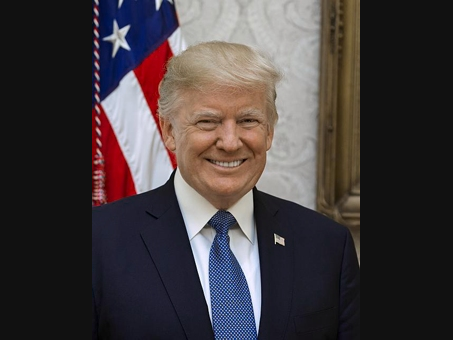
Photo credit: Gage Skidmore via Flickr Commons
Get more local news delivered straight to your inbox. Sign up for free Patch newsletters and alerts.