Politics & Government
From 'Party Zero' To 7.6K Deaths & New Hope: Coronavirus Timeline
The past year has been a whirlwind for Connecticut after life was upended by the pandemic. Here's a summary of some major events.


CONNECTICUT — It's hard to imagine, but life was mostly normal in Connecticut a year ago when the state announced its first coronavirus case. Grandkids hugged their grandparents without a second thought and masks were a rarity in public. Metro-North trains were packed with commuters every morning and evening Monday through Friday. Tolls were a hot-button issue in the state.
Then a once-in-a-century pandemic started to spread quickly through the Nutmeg State and daily life dramatically changed. Fast forward a year and the state has mourned more than 7,600 coronavirus-related deaths — more than the number of residents who died in World War II, the Korean War and the Vietnam War combined.
Connecticut was among the first states to get hammered by the pandemic when little was known about the virus and personal protective equipment was the most sought-after commodity on the planet.
Find out what's happening in Across Connecticutfor free with the latest updates from Patch.
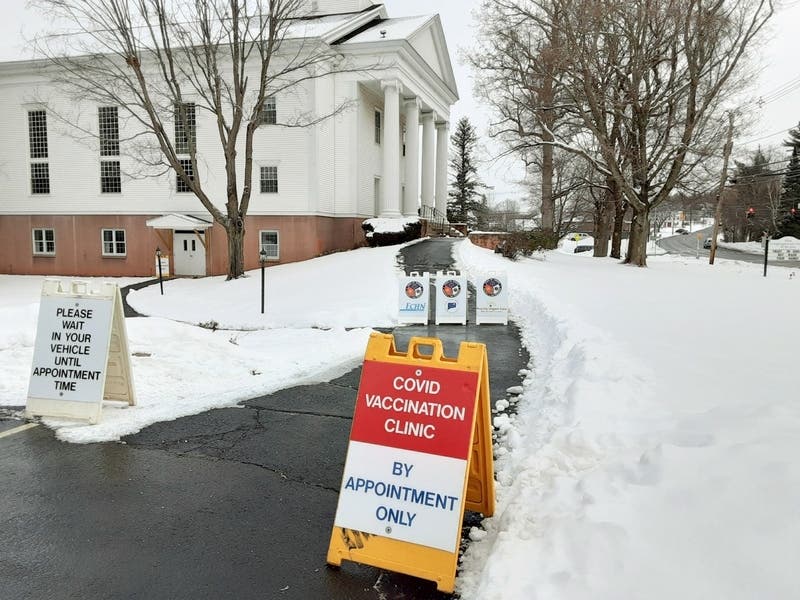
March 2021 is much different than March 2020 as Gov. Ned Lamont announced plans to end coronavirus capacity limits as most businesses throughout the state. Connecticut is also on the offensive when it comes to vaccines and has administered more than 1 million doses — something that would have been virtually unimaginable just a year ago.
Below is a timeline of some of the major coronavirus developments over the past year in Connecticut.
Find out what's happening in Across Connecticutfor free with the latest updates from Patch.
March
March 1: New York State announces its first coronavirus case.
March 5: A private party attended by at least 40 people later becomes a "super-spreader" hotspot and Westport goes on to become one of the earliest hardest-hit towns in Connecticut.
March 6: A New York State resident who worked at Danbury and Norwalk hospitals tested positive for the coronavirus. At this point 21 people in Connecticut had been tested for the virus.
March 7: A physician who worked at Bridgeport Hospital tested positive for the virus. The physician was a New York State resident.
March 8: Connecticut's first residential positive coronavirus case is announced. A Wilton man was treated at Danbury Hospital. He likely became infected during a trip to California. He spent 10 days in a medically induced coma.
March 9: State restricts visits to nursing homes.
March 10: A second state resident tested positive for the virus. Gov. Lamont signs a public health and civil preparedness declaration.
March 11: Connecticut announces its third coronavirus case, which is the first assumed community transmission infection.
March 12: Lamont signs his first coronavirus-related executive order. It limits the size of gatherings to 250 people, waives the 180-day school year requirement, and authorizes the DMV to extend renewal deadlines.
March 13: Connecticut has a total of 11 positive cases. Utility shut-offs are suspended during the crisis. Around this time the state starts to see a massive increase in unemployment claims.
March 15: Lamont signs an executive order that cancels classes at all public schools.
March 16: An executive order limits social and recreational gatherings to 50 people. It also closes dine-in restaurant service, gyms, and movie theaters.
March 18: A Ridgefield man in his 80s becomes the first state resident to die from coronavirus complications. He was an assisted living resident. Indoor shopping malls are closed by executive order.
March 19: Presidential primary is pushed back to June 2. Non-critical state court operations are suspended.
March 20: "Stay Safe, Stay Home" executive order signed, which closed non-essential in-person business.
March 23: Connecticut has 10 coronavirus deaths and 415 positive cases.
March 26: Lamont signs an executive order that limits social and recreational gatherings to five or fewer people. Connecticut has more than 1,000 coronavirus cases and 21 deaths.
March 28: Connecticut has more than 1,500 confirmed cases and 33 deaths. Hospitalizations pass 200 cases. President Donald Trump makes off-the-cuff remarks that Connecticut, New Jersey and New York could be placed under federal quarantine, but by the end of the day it doesn't happen.
March 31: State nearly doubles deaths in one day, reaches total of 69 deaths and more than 3,100 confirmed cases.
April
April 2: Lamont bans non-essential lodging. Coronavirus deaths pass 100.
April 4: Confirmed cases pass 5,000 and state has 165 deaths.
April 7: Lamont signs executive order that allows certain health care professions to practice before licensure.
April 10: Executive order protects renters impacted by coronavirus. School cancellation extended to May 20. Other closures and social distancing mandates are extended to May 20 as well. Connecticut passes 10,000 confirmed cases and has 448 deaths. Hospitalizations pass 1,500.
April 11: Nursing home surge plan announced.
April 12: Total of 554 deaths and more than 12,000 confirmed cases.
April 13: Connecticut joins a regional seven-state reopening council to coordinate reopening businesses and testing strategy. Connecticut is hit by a strong windstorm that knocks power out to more than 100,000 electric customers.
April 17: Lamont executive order signed that mandates face coverings in public when social distancing becomes impossible. Deaths in Connecticut surpass 1,000.
April 18: Connecticut sees its first daily net hospitalization drop.
April 20: Connecticut sees its largest single-day death toll reporting at 204, however, the large increase was due to a change in how deaths were classified and included deaths that occurred several days prior. Protesters hold a drive-by rally near the capitol urging Lamont to reopen the state.
April 27: Coronavirus-related deaths in Connecticut surpass 2,000.
April 30: The state announces its reopening plan, which is scheduled to go into effect May 20 if current trends continue.
May
May 5: Lamont announces that schools will remain closed through therest of the school year. Plans are laid out for summer camps.
May 6: The state releases some information about the college reopening plan, which calls for the gradual return of non-residential students over the summer and residential students in the fall.
May 11: Lamont announces that three children are being treated for a suspected coronavirus-related inflammatory illness. The number later increases to six.
May 12: State Department of Health Commissioner Renee Coleman-Mitchellis ousted by Lamont. She had largely been out of the public view during the pandemic response.
Deaths exceed 3,000.
May 13: Lamont releases some parts of the phase two and three reopening plans.
May 15: Unemployment in Connecticut is around Great Depression levels.
May 18: Lamont pushed back reopening of hair salons and barbershops to June 1 after originally being scheduled to start May 20. The move drew some criticism as it came two days before the reopening date.
May 20: Connecticut enters thefirst phase of its reopening plan, which sees the return of outdoor dining, the rest of retail and office spaces. Lamont also offers a preliminary look at what phase 2 and 3 will look like.
Not everyone is happy with the speed at which businesses are being allowed to reopen and the Cromwell Town Council votes to draft a declaration in defiance of Lamont's executive orders.
May 25: George Floyd, a black man, dies after a white police officer in Minnesota kneeled on his neck for nearly nine minutes. The killing set off numerous protests across the country, including some in Connecticut, calling for an end to police brutality and systemic racism. Lamont supports peaceful protests, but asks protesters to stay off highways. Lamont also worries that the large gatherings of protesters could cause coronavirus infections to rise.
May 29: Lamont announces that larger social gatheringsindoors and outdoors will be permitted as well as an expansion on the number of people allowed at one time for houses of worship.
May 30: Many colleges release their plans for the fall semester around this time.
June
June 3: Lamont announces small-scale in-person graduations would be allowed July 6.
June 5: Lamont moves up second reopening phase date to June 17 instead of June 20 in order to give restaurants the full Father's Day weekend.
June 12: Hospitalizations are down 75 percent from the state's peak.
June 16: Lamont expands social gathering limits to 25 indoors and 100 outdoors for private events. Up to 500 people will be allowed starting July 3 at open organized events like fireworks shows.
June 17: Phase two reopening day brings the return of amusement parks, indoor entertainment like bowling and limited capacity indoor restaurant service.
June 19: Connecticut has the lowest rate of coronavirus transmission in the country.
June 23: The Department of Motor Vehicles partially reopens. A massive backlog of vehicle registration and driver tests must be dealt with.
June 24: The governors of Connecticut, New York and New Jersey announce a 14-day quarantine for travelers from some states that are experiencing high levels of coronavirus infections. Connecticut's quarantine doesn't have enforcement action, but Lamont said that could change if he finds out people aren't heeding the mandate.
June 25: Connecticut unveils its preliminary fall back-to-school plan, which calls for mask use and a full five-day week for students. The plan is criticized by teacher unions who say that it should include things like class size limits.
June 28: The U.S. sets five consecutive days of single-day highs for coronavirus cases. Connecticut continues to keep its daily positive test rate around one or two percent with it dipping below one percent on some days. Connecticut and Rhode Island are the only states in the country where coronavirus cases are declining.
Coronavirus hospitalizations drop below 100 patients for the first time in months. The hospitalization figures are 95 percent less than the peak.
July
July 6: Lamont hits pause of the state’s third reopening phase that was originally scheduled for mid-July— it would have brought back bars. The decision came after several southern states saw coronavirus clusters linked to bars.
July 21: The state’s largest teacher union calls for less classroom density when schools reopen.
July 27: State officials announcelocal school districts will ultimately get to decide what learning model to use in the new school year.
July 28: Connecticut announces a plan to buy 50,000 laptops and provide at-home internet access to more than 60,000 students in an effort to close the digital learning gap. The plan builds upon earlier philanthropic efforts to purchase laptops for students.
August
Aug. 3: Dr. Anthony Fauci says Connecticut is in a good place in the battle against the coronavirus. At the time Connecticut’s infection rate and positive test rates are very low.
Aug. 4: Tropical Storm Isaias causes widespread electrical grid damage in Connecticut. Evesource peaked at more than 632,000 customers without power — more than 8,900 trees had to be cleared from Eversource’s territory alone and more than 500 miles of downed power lines were repaired. Thousands of customers lose their refrigerated food supply and some go without power for a week or more.
September
Sept. 4: A legislative committee votes to allow Lamont to extend his emergency powers.
Sept. 16: State officials close the Three Rivers Nursing Home in Norwich after a coronavirus outbreak.
Sept. 18: Lamont allows authorities to issue coronavirus-related fines for violating the state’s mask and social gathering size orders.
Sept. 21: Mask use is mandated for children over the age of 3 in childcare settings.
October
Oct. 8: Connecticut moves to reopening phase 3. Indoor restaurant and personal service capacity is increased to 75 percent. White House coronavirus task force coordinator Dr. Deborah Birx warns that infection rates seem to be gaining ground in the northeast after several months of low activity.
November
Nov. 6: Connecticut moves to reopening phase 2.1. Indoor restaurant capacity is reduced from 75 percent to 50 percent and event venue capacity is reduced.
Nov. 19: Lamont orders school and club sports to stop after 17 high schools were closed due to sport-related coronavirus clusters.
Nov. 24: Lamont allows fines up to $10,000 for businesses that violate coronavirus rules.
December
Dec. 12: Onlythree of Connecticut’s 169 towns aren’t in the state’s highest warning level for coronavirus infections
Dec. 14: Hartford Healthcare receives its first shipment of coronavirus vaccines and the first vaccine is administered. Connecticut follows CDC guidelines and focuses vaccination efforts on front-line health care workers and long-term care facility residents and staff.
Dec. 21: A $35 million small business grant program is announced for struggling small and mid-size businesses.
Dec. 30: Connecticut gets off to a good start with its vaccination administration and is among the top states per capita for shots given.
January
Jan. 2: Connecticut exceeds 6,000 coronavirus deaths.
Jan. 7: The U.K. coronavirus variant is spotted in Connecticut for the first time.
Jan. 12: Connecticut’s positive test rate and other coronavirus metrics reach disturbing levels weeks after holiday gatherings.
Jan. 14: Connecticut opens up vaccination appointments for people 75 and older.
Jan. 26: Lamont extends his emergency powers until April 20. It’s the second time he extended his emergency powers.
Jan. 28- 29: Connecticut surpasses 250,000 total coronavirus cases and 7,000 deaths.
February
Feb. 4: Lamont eliminates a 100-person cap on religious gatherings and extends restaurant curfew by an hour.
Feb. 8: Lamont extends eviction moratorium.
Feb. 11: Connecticut opens up coronavirus vaccine appointments for people between the ages of 65 and 74.
Feb. 15: The South African coronavirus variant is spotted in Connecticut for the first time.
Feb. 18: Around this date Connecticut seesa sustained drop in the coronavirus infection rate and other key metrics. Much of the country sees the same thing.
Feb. 22: Lamont breaks with CDC recommendations and announces that Connecticut will shift to an age-based vaccine eligibility system for the future roll-out. He cites efficiency and simplicity as the factors leading to his decision. The decision angered many front-line essential workers and people with comorbidities who thought they were next in line.
Feb. 25: Lamont announces that Connecticut is scheduled to receive 30,000 initial doses of the Johnson & Johnson coronavirus vaccine. The vaccine candidate got emergency use authorization from the U.S. Food and Drug Administration at the end of the month.
March 2021
March 1: Vaccine appointments open up for people between the ages of 55 and 64 as well as in-person preK-12 educators, school bus drivers and child care employees. Lamont ends legal immunity for nursing homes and hospitals
March 4: Lamont announces that coronavirus capacity limits will be lifted at nearly all businesses throughout the state later in the month.
See also: A Year Into Pandemic, CT Businesses Still Riding Roller Coaster
Get more local news delivered straight to your inbox. Sign up for free Patch newsletters and alerts.