Politics & Government
‘Endemic Mismanagement of HUD Manufactured Housing Program’ Nom Turner
'Restoring and Expanding Affordable Housing Role of Manufactured Homes'–MHARR Letter Cites 2000 Reform Act, "Enhanced Preemption" Much More

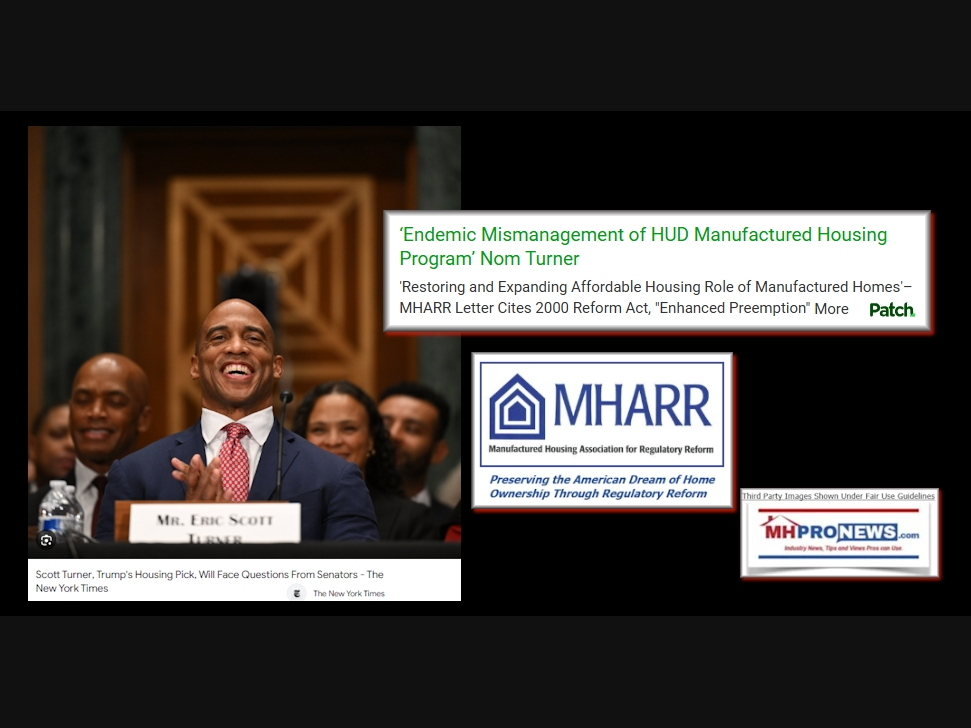
According to a reply to an inquiry from MHProNews, the Manufactured Housing Association for Regulatory Reform (MHARR) President and CEO Mark Weiss, J.D., said in part: “We (i.e.: MHARR) look forward to working with him (i.e.: President-elect Donald J. Trump HUD Secretary nominee Eric Scott Turner) to fully implement ALL reforms of the 2000 Act.” The letter that follows in Part I was obtained by MHProNews and this Patch writer and will be bolstered by additional insights provided in Part II.
Part I
January 30, 2025
Find out what's happening in Lakelandfor free with the latest updates from Patch.
VIA FEDERAL EXPRESS
Hon. Scott Turner Secretary-Designate
U.S. Department of Housing and Urban Development
Suite 10000
451 Seventh Street,
S.W. Washington, D.C. 20410
Re: Restoring and Expanding the Affordable Housing Role of Manufactured Homes
Find out what's happening in Lakelandfor free with the latest updates from Patch.
Dear Secretary-Designate Turner:I am writing as a follow-up to my previous communications of November 25, 2024, January 22, 2025 and January 23, 2025 (see, Attachment 1).
The Manufactured Housing Association for Regulatory Reform (MHARR), as noted in those prior communications, is a Washington, D.C.-based national trade organization, established in 1985, representing the views and interests of producers of manufactured housing subject to regulation by the U.S. Department of Housing and Urban Development (HUD) pursuant to the National Manufactured Housing Construction and Safety Standards Act of 1974 (42 U.S.C. 5401, et seq.) as amended by the Manufactured Housing Improvement Act of 2000 (2000 Reform Law). MHARR’s members are primarily smaller and medium-sized independent producers of manufactured housing, located in all regions of the United States.
As the United States faces an unprecedented affordable housing crisis, with the supply of affordable homes and, more particularly, affordable “starter” homes, millions of units below existing (and growing) demand,[1] HUD-regulated manufactured homes offer American families at all income levels (and most especially moderate and lower-income American families), an inherently affordable, non-subsidized source of housing and homeownership. Yet, the availability (and ultimately the utilization) of this crucial affordable housing resource, expressly protected and guaranteed by Congress in federal law,[2] has been undermined across the United States by endemic mismanagement of the HUD manufactured housing program as well as specific bottlenecks that HUD has both the authority and — more importantly – the responsibility to alleviate and remove, but has failed or (even worse), refused to address and remedy, for decades. Our purpose in this communication, accordingly, is to highlight those program defects and bottlenecks, as well as the statutory tools that Congress has provided to HUD (and others) to address such matters and ensure the statutorily-mandated availability of HUD Code manufactured housing.
At the outset, it should be stressed that manufactured housing is, must be – and must remain – federally regulated. Unlike other types of housing, which are either constructed on or constructed for a specific known lot, site or location in a specific known jurisdiction, manufactured homes are assembled in factories and then shipped to purchasers or retailers who site the homes at locations unknown to the manufacturer at the time of construction. As a result, manufactured homes are routinely transported across state lines and may, even after initial siting, be moved to other locations and other jurisdictions. As a result of this production model and enduring transportability (as mandated by applicable federal law), manufactured homes must be regulated pursuant to:
- uniform federal standards; and
- uniform federal enforcement; in conjunction with
- robust federal preemption.
These three pillars of HUD manufactured housing regulation ensure not only that manufactured homes can be sited anywhere in the United States at the time of initial retail sale or thereafter, but also ensure unparalleled construction efficiencies and savings that manufacturers pass to consumers. Consequently, uniform federal standards, uniform federal enforcement and strong federal preemption, are the primary mechanism that ensures the inherent, non-subsidized affordability of today’s mainstream manufactured homes, in accordance with the purposes and objectives of applicable federal law, and also distinguish HUD-regulated manufactured homes from all other types of factory-built dwellings that are not federally regulated.
Consequently, a properly functioning federal program is essential for manufactured housing to reach its full potential. Yet, the HUD manufactured housing program has suffered from both poor management and poor oversight, as the Department has consistently focused more on wasteful public housing programs and related grants and subsidies, rather than the private-sector affordable solution offered by manufactured housing. This failure has been especially damaging for the smaller, independent manufactured housing producers represented in the nation’s capital by MHARR, which have been disproportionately impacted by excessive and unnecessary regulation, including extra-legal mandates imposed by an entrenched HUD program “monitoring contractor,” which (apparently without precedent in Washington, D.C.) has continuously held what amounts to a de facto sole-source contract since the inception of federal regulation fifty years ago. At the same time, as addressed in my previous communication of January 22, 2025, smaller, independent manufacturers have been denied full and equal participation in the HUD Manufactured Housing Consensus Committee (MHCC) – the most significant program reform enacted by the 2000 Reform Law – through their collective representative, MHARR, for nearly two decades. For manufactured housing and the federal manufactured housing program to both meet their full potential, significant program reform to remedy these failures (and other) is essential and must be a priority under the Trump Administration.
Beyond, these major failures of the HUD program, three principal bottlenecks have impaired the availability and utilization of affordable, HUD-regulated manufactured housing, as mandated by federal law. These principal bottlenecks include impending draconian Biden Administration “energy conservation” standards, previously addressed in MHARR’s January 23, 2025 communication to you, and a discriminatory lack of federal support for manufactured home consumer lending (including Federal Housing Administration programs and Ginnie Mae requirements, as well as the nearly two-decade failure of Fannie Mae and Freddie Mac to implement the statutory “Duty to Serve Underserved Markets” directive for the vast bulk of the manufactured housing market), which we will address in greater detail in a future communication to the incoming director of the Federal Housing Finance Agency (FHFA).
The most significant bottleneck, however, as you become HUD Secretary, is the fact that the availability and utilization of affordable, mainstream HUD-regulated manufactured homes – and the growth of manufactured housing as a vital affordable housing resource — has been undermined, subverted and needlessly restricted in vast areas of the United States through discriminatory and exclusionary zoning mandates that bar manufactured homes and manufactured homeowners (including a significant proportion of minority manufactured homeowners[3]) from entire communities.
While the discriminatory targeting of manufactured housing and manufactured homeowners for zoning exclusion by state and local governments is not new,[4] it has become more prevalent, more pronounced and more extreme in recent decades. It is no coincidence that this radical campaign of discriminatory exclusion has corresponded with an unprecedented long-term decline in the production of new manufactured homes. Specifically, prior to 2007, manufactured home production routinely exceeded 100,000 homes per year and reached its all-time maximum level of 373,143 new homes in 1998. Since 2007, however, manufactured home production has exceeded the 100,000 home benchmark only two times (2021 and 2022) and fell to its modern historical low of 49,683 in 2009. This discriminatory targeting is directly and blatantly contrary to the express purpose and letter of the 2000 Reform Law, which was designed and enacted by Congress to complete the transition of manufactured homes to legitimate housing for all purposes and to ensure the parity of HUD-regulated manufactured homes with site-built (and other) homes for all purposes.
Although federal law, since the adoption of the original National Manufactured Housing Construction and Safety Standards Act in 1974, has included a federal preemption provision (see, 42 U.S.C. 5403(d)) prohibiting states and local jurisdictions from maintaining standards pertaining to any aspect of manufactured housing construction and/or safety which differ from a federal standard applicable to the same “aspect of performance,” HUD refused to apply that federal preemption to zoning exclusion, alleging that preemption, under the 1974 Act, was limited solely to state and local construction and/or safety standards. As a result, HUD did nothing while a proliferation of exclusionary zoning measures specifically targeting manufactured housing emerged.
Subsequently, urged by MHARR and an industry coalition, Congress, in 2000, developed and enacted landmark legislation to reform and modernize both the federal manufactured housing program and the legal treatment of manufactured homes for all purposes. Especially significant, among the many program reforms of the 2000 Reform Law, was an amendment to the 1974 Act’s preemption provision, designed to make it more expansive and more robust in protecting and advancing the availability of HUD-regulated manufactured homes.
Specifically, the 2000 Reform Law amended the federal preemption provision of the 1974 Act by adding a statement that “federal preemption under this subsection shall be broadly and liberally construed to ensure that disparate state or local requirements or standards do not affect the uniformity and comprehensiveness of the standards promulgated under this section nor the federal superintendence of the manufactured housing industry as established by this chapter.” (42 U.S.C. 5403(d)) (emphasis added). This “enhanced federal preemption” of the 2000 Reform Law, significantly expanded the scope, extent and reach of preemption to correspond with and effectuate the expansive remedial and beneficial purposes of the 2000 Reform Law more generally.
The enhanced preemption “broadly and liberally construed” mandate, was added by the 2000 Reform Law specifically because MHARR document requests under the Freedom of Information Act (FOIA) showed conclusively that HUD has been interpreting and applying the scope of federal preemption under the original 1974 Act as narrowly and in as limited a fashion as possible, directly contrary to claims it had previously made to Congress and the industry that it was enforcing federal preemption broadly and vigorously.
Similarly, the enhanced preemption term “requirements or” was added to the preemption clause by the 2000 Reform Law to make it unmistakably clear that federal preemption applies not only to conflicting state or local construction and/or safety standards, but also to any state or local “requirement” that impairs HUD’s federal superintendence of the industry. That federal superintendence, as specifically defined by the 2000 Reform Law, expressly includes “facilitat[ing] the availability of affordable manufactured homes….” (42 U.S.C. 5401(b)(2)). Therefore, insofar as discriminatory and exclusionary state and/or local zoning measures barring HUD-regulated manufactured homes undermine, conflict with and defeat the fundamental, essential and core federal purpose of the 1974 Act as amended by the 2000 Reform Law – to facilitate and ensure the availability of affordable manufactured homes – such mandates are, should be, and, in fact, must be federally preempted under the enhanced preemption of the 2000 Reform Law.
There can be no doubt, moreover, that the 2000 Reform Law amendments to the Act’s preemption provision were designed to – and must necessarily have – such an impact and effect. In a November 13, 2003 communication to then-HUD Secretary Mel Martinez, leading congressional proponents of the 2000 Reform Law stated unequivocally that “these combined changes” to the law, “have given HUD the legal authority to preempt local requirements or restrictions which discriminate against the siting of manufactured homes (compared to other single family housing) simply because they are HUD Code homes.”[5]
It is long past time, accordingly, for HUD to take strong action to stop states and/or localities from acting to undermine and negate federal law and the federal affordable housing policies underlying both the 1974 Act and the 2000 Reform Law by discriminatorily excluding HUD-regulated manufactured homes.
In order to accomplish this, HUD should first take immediate action to withdraw and repudiate two preemption “guidance” statements published in 1997.[6] These statements, which continue to be misconstrued, misapplied and misused by courts to the detriment of both the industry and American consumers of affordable housing, do not include, reflect, or consider the substantive changes to federal preemption enacted by Congress in the 2000 Reform Law (i.e., enhanced federal preemption). As a result, they are no longer accurate, legitimate or valid and must be withdrawn.
Second, the withdrawn 1997 preemption “guidance” statements should be replaced as rapidly as possible with new HUD “guidance” based on the purposes and express terms of the 2000 Reform Law as set forth above. Any such guidance should (and must) be developed and proposed by the MHCC in accordance with the 2000 Reform Law and adopted by HUD with all due speed.[7]
Third, HUD should immediately begin to enforce the enhanced federal preemption of the 2000 Reform Law against jurisdictions which discriminatorily exclude affordable, mainstream, HUD-regulated manufactured housing. As needed and, if necessary, this should include legal action (to the highest level necessary) to prevent and/or eliminate such unlawful zoning measures which stand as an obstacle to – and frustrate the achievement of – federal affordable housing policy as enunciated in the 2000 Reform Law.
Insofar as the foregoing matters are of the utmost importance to MHARR’s members, the broader housing industry and American consumers of affordable housing, we will contact your office, upon your confirmation and arrival at HUD, to seek a meeting with you at the earliest opportunity. Again, please accept our congratulations on your nomination and we look forward to meeting with you soon.
Sincerely,
Mark Weiss
President and CEO
cc: Hon. Tim Scott
Hon. Katie Britt
Hon. French Hill
Hon. Mike Flood
Hon. Russell Vought
Hon. Susan Wiles
Mr. Matthew Ammon
[1] See e.g., “The Significant Shortage of Starter Homes,” Freddie Mac Research and Perspectives, S. Khater (April 15, 2021).
[2] The 2000 Reform Law states, in part: “The purposes of this chapter are: *** (2) to facilitate the availability of affordable manufactured homes and to increase homeownership for all Americans.” (42 U.S.C. 5401(b)(2)).
[3] The importance of HUD-regulated manufactured housing as a source of affordable homeownership for minority purchasers was addressed by the Consumer Finance Protection Bureau in a report entitled “Manufactured Housing Finance – New Insights from the Home Mortgage Disclosure Act Data,” (May 27, 2021).
[4] See e.g., “Testimony of the Pennsylvania Manufactured Housing Association – Promoting Housing Affordability Through Land Use Reforms,” (May 3, 2023) at p. 5.
[5] See, Attachment 2 hereto, November 13, 2003 communication to Hon. Mel Martinez from Hon. Barney Frank, Bennie Thompson, Baron P. Hill, Maxine Waters, Ken Lucas and Julia Carson.
[6] See, 62 Federal Register No. 15, “Manufactured Housing Construction and Safety Standards: Notice of Internal Guidance on Preemption” (January 23, 1997) at p.3456, et seq. See also, 62 Federal Register No. 86, “Manufactured Housing: Statement of Policy 1997-1, State and Local Zoning Determinations Involving HUD Code” (May 5, 1997) at p. 24337, et seq.
[7] In this regard, see, Attachment 3, August 22, 2016 communication from the Arkansas Manufactured Housing Association to Edward Golding, HUD Principal Deputy Assistant Secretary, “HUD’s Preemption Policy Regarding Manufactured Housing.”
MHProNews note: A copy of the attachments was requested with the above. It is anticipated that those other items related to this document will be obtained and published later this week.
Part II – Additional Information with More MHProNews Analysis and Commentary in Brief
See the article linked here or below for more.

> Manzanita Miller-by 60% to 37% Americans Say Govt Wasteful-Inefficient
> HUD Sec Nominee E. Scott Turner: ‘HUD Has Failed Its Core Mission’
Trump Nom Turner: 'We’re not building enough housing. We need millions of homes of all kinds, single family, apartments, manufactured homes'
> Pres. Trump Push for Ending Federal Income Tax Using McKinley’s Method
> President Donald J. Trump’s Official 'America First Priorities'
---
> Rubio Senate Replacement Ashley Moody (FL-R) Gets Key Assignments
> Trump Plan: Make America Safe, Affordable, Restore U.S. Values for All
> NPR=87 Registered Democrats in Editorial Positions and No Republicans
---
> Official Manufactured Housing Production from 1995-2023-Why it Matters
> Anna Paulina Luna (FL-R) and Barry Loudermilk (GA-R) MERIT Act Insight
> Executive Orders on Investigating Biden Censorship & Weaponization
> Floridian Dr István Dobozi Strikes at Trump Again in Magyar Article (Another critical analysis - fact check).
---
> Why do Liars Lie? Why do those Engaged in Paltering and Spin Palter?
> Controversy-Manufactured Housing Institute-Lesli Gooch-Mark Bowersox
> ‘Mobile Home Values Rising Faster Than Single-Family’ House-Wow Fact$
> Realtor-What Is a Manufactured Home? The Next Step Beyond Mobile Homes
> Orlando RE Agent Smith-Younger Adults Will Need $8500 Monthly for Rent
---
> Rob Romano-Time To Declassify Everything, Or Another RussiaGate Ahead
> Contemporary Tips from Legend Paul Harvey-Surprising Rest of the Story
> Alert: Is Affordable Housing Linked Scandal at Champion Homes Brewing?
> Report: Biden-Harris Federal Agencies Spent Millions Torturing Cats
> Lesli Gooch Ph.D.-Award, Coverup, Headfake, Scandal? Rest of the Story (Manufactured Housing Institute linked)
---
> ALG Unpacks Trump Pitch to Cut Drug Costs by Cutting PBM Middleman
> Is there Evidence that God Exists? Evolution vs. Intelligent Design
> Democratic Voters-Closer Look at Biden’s Acts Before Biden-Harris Exit
> Christian Leaders-Signs of 4th 'Great Awakening' Millions go to Jesus
> Attorney John Morgan - Democrat Megadonor on Kamala Harris Campaign
---
> USA Today - David Plouffe and Dem Advisers on Kamala Harris Revelation
> Majority OK Trump Transition-Mass Deportations-Tariffs- Is it Hopeful?
> Niskanen Center Praises Manufactured Home ‘Cost Savings’ and ‘Quality’
> Alice Carter-The Northern Forum-Deporting Immigrants & Housing Crisis
> Cartoons-Kamala Day 1, DOGE the Swamp, Brainwashing, & Out In the Cold
---
> The Creepy Line-Peter Schweizer-Dr. Jordan Peterson-Dr. Robert Epstein
> Secret State Miniseries - Fictional TV Series Shed Light on Reality
> Trump Transition Team Asked to Prioritize Affordable Housing Issues
> Top 10 States for Homelessness & Top Cities for Crime=Shocking Lessons
> WashPost-American Dream Fades But Assoc CEO Mark Weiss Shows Solution
---
> Blankley-Goodbye American Dream? Only 10% Polled Can Buy a House; But
> Frank Rolfe-Special Interests ‘Don’t Want to Solve Affordable Housing'
> TARK-‘I’m a Teen and Know the Solution to Affordable Housing Crisis’
---> Renting? Rent too High? Odds Are DOJ Suit vs RealPage Matters to You
> New-Certified “Half Price Homes” - Affordable Housing Solution Redux
---
> Solution: “Would-Be Homebuyers Need 80% More Income Than 4 Years Ago”
L. A. “Tony” Kovach is a publisher who has earned multiple awards in history. He and his family live in a manufactured home on private property in Winter Haven, FL. He is the co-founder of Manufactured Home Living News.com (MHLivingNews.com) and Manufactured Home Pro News.com (MHProNews.com), trade publications serving segments of the manufactured home industry. Having worked in several segments of the manufactured home industry for over 3 decades, Kovach is a widely acknowledged and often praised expert on manufactured housing. ###