Politics & Government
WashPost-American Dream Fades But Assoc CEO Mark Weiss Shows Solution
Interview with Mark Weiss, J.D., President and CEO of MHARR reveals practical solutions to the affordable housing crisis are already law.

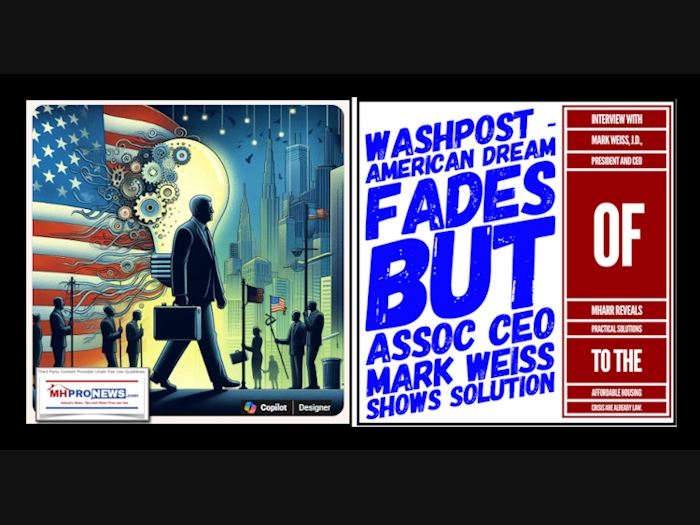
According to the left-leaning Washington Post “I hear it from both sides,” said Tara English, a Wilmington [NC] real estate agent and coffee shop owner. “Whether you’re voting for Trump or Harris, it’s people’s top concern: Will their candidate be better for the economy, and the housing market in particular?” The Washington Post (a.k.a.: WashPost or WaPo) said in report dated 10.20.2024: "Americans in swing states are far more likely to live in areas where housing has become disproportionately more costly since 2019, according to a Washington Post analysis of home-price data. Nationally, home prices have grown 48 percent since 2019. But in some counties across the seven most tightly contested swing states — including Arizona, Georgia, North Carolina and Pennsylvania — prices have more than doubled, an analysis of Zillow data shows."
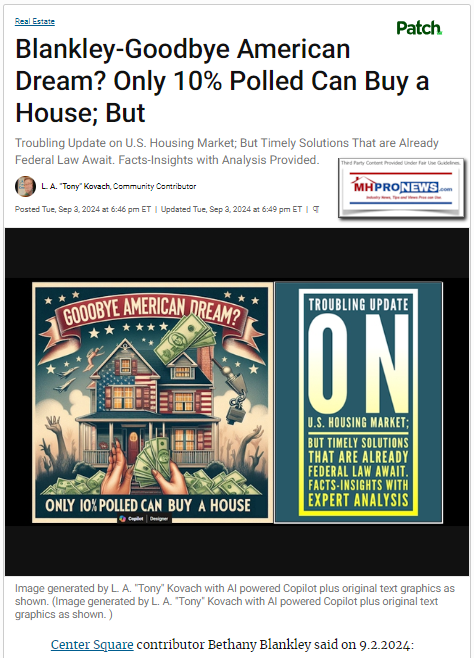
That is similar to the report that this series on the Patch opened with, which said that it now takes 80 percent more income to buy a home under the Biden-Harris (D) economy than it did 4 years ago when Donald J. Trump (R) was still president.
Find out what's happening in Lakelandfor free with the latest updates from Patch.
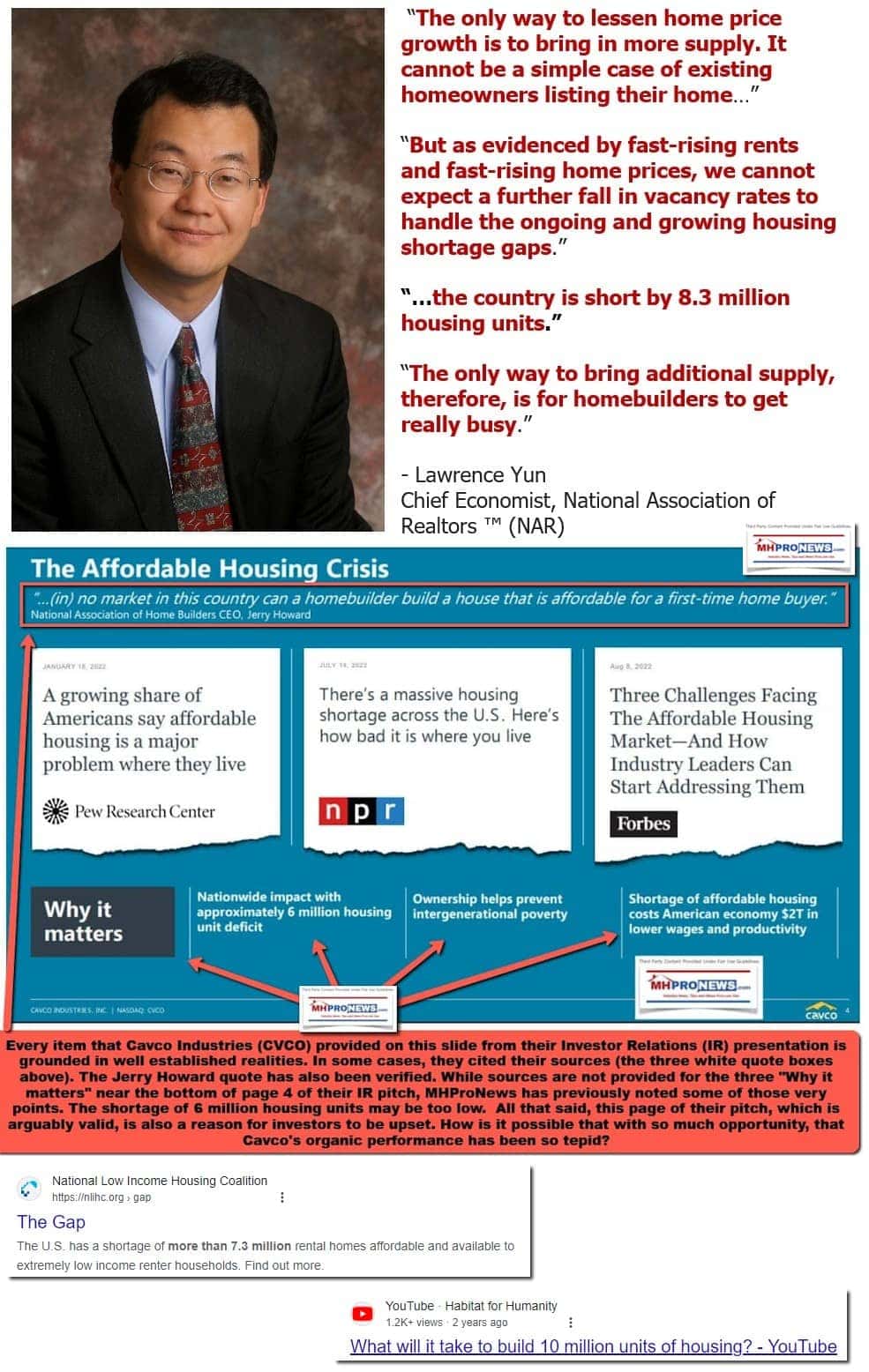
Right-leaning Breitbart reported on the WaPo report and a related editorial. In their analysis Breitbart said the data showed Democratic presidential hopeful Kamala Harris' (D) open borders policies mean her plan to build 3 million more homes won't work. The reason? Because 12 million more immigrants will cross the border illegally, far greater than the number of houses she claims she'll get the Congress to authorize to produce, and there is already a shortage. So, the housing crisis would continue under Harris. There are other factors that those sources didn't mention, illustrated in the graphic below.
Find out what's happening in Lakelandfor free with the latest updates from Patch.
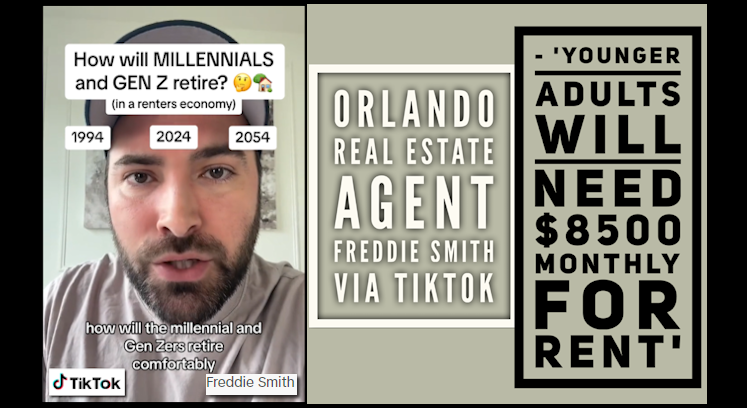
As this series on the Patch has previously reported, unless the trajectory of housing costs is changed, young adults face rents of $8500 monthly by the time they approach retirement.
With that backdrop in mind, Multi-Housing News (MHN), affiliated with Yardi, interviewed Manufactured Housing Institute (MHI) CEO Lesli Gooch, Ph.D. on 9.11.2024.
Per MHN: “Manufactured housing has long been recognized as a vital source of affordable housing, though barriers to wider adoption remain.
“Millions of individuals and families have chosen to live in land-lease manufactured home communities, and demand is growing,” noted Lesli Gooch, CEO of the Manufactured Housing Institute.” As MHProNews pointed out in an analysis, Yardi is linked to MHN, a fact not disclosed in their “interview.” That said, MHN was correct in observing that years of research reveals manufactured housing is a proven solution to affordable housing crisis that is hiding in plain sight.
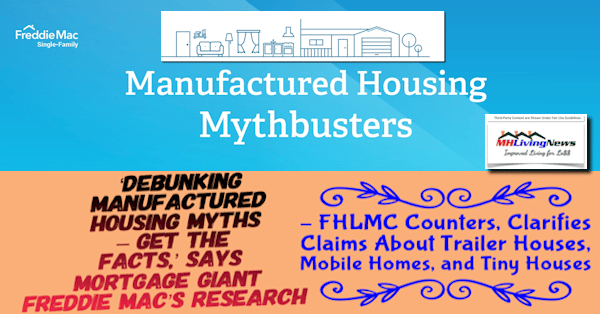
https://www.manufacturedhomeli...
MHProNews reached out to MHN's leadership and asked them to address several factual concerns about their article. While they acknowledged the message, they didn't respond to it the request that MHN clean up apparent errors and apparent omissions by Gooch on behalf of MHI in her interview.
So, because there are two national trade associations serving manufactured housing, MHProNews invited Mark Weiss, J.D., President and CEO of the Manufactured Housing Association for Regulatory Reform (MHARR) to answer a substantial similar set of questions as those posed by MHN to MHI’s CEO Gooch. That interview with Weiss, published by MHProNews at this link here, follows. Note that the MHProNews' initial fact-check of MHI’s responses to MHN are linked here.
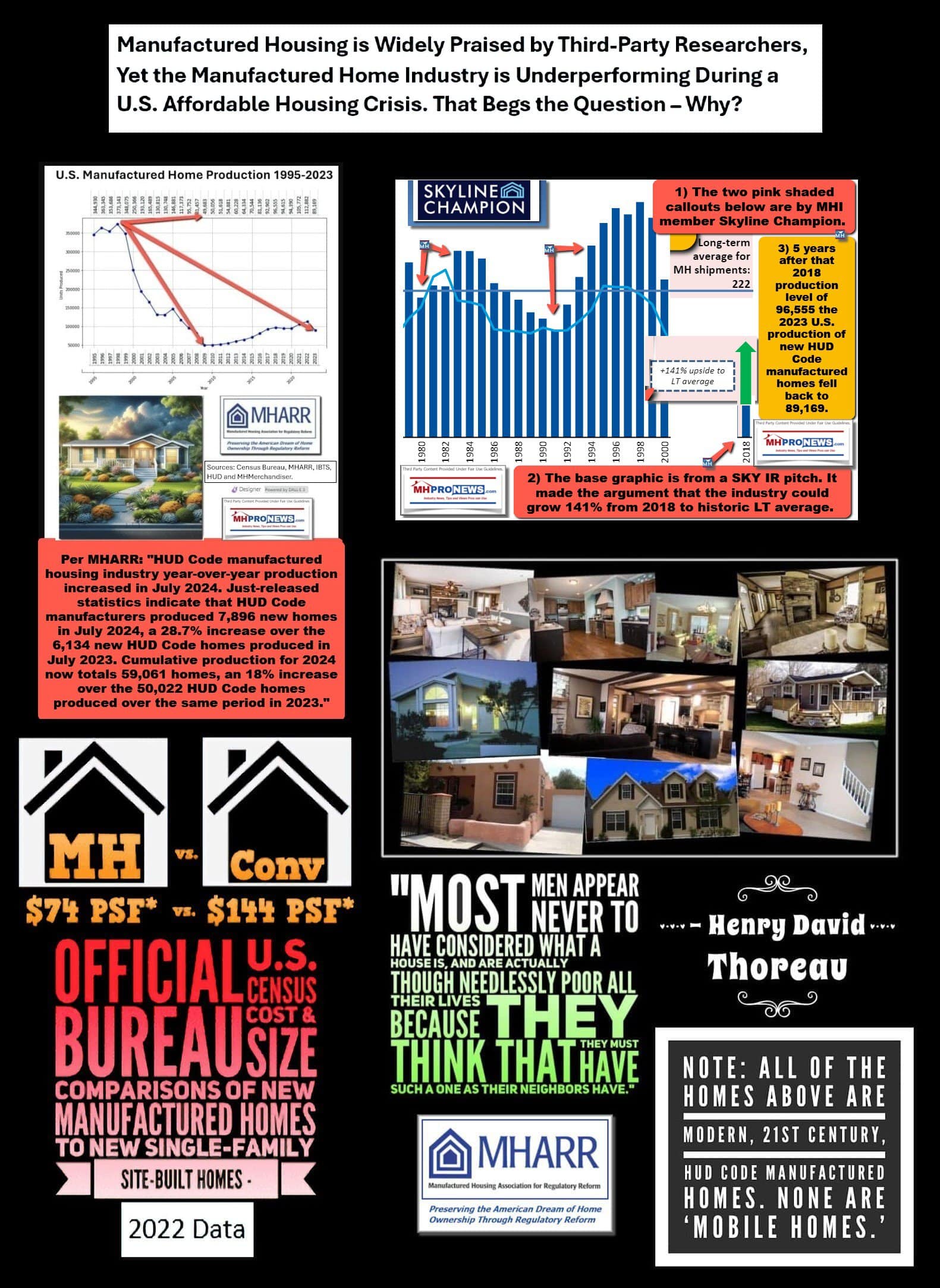
The graphic above was not part of the Weiss interview.
Part I
MHProNews: What stands in the way of developing more manufactured housing communities (MHCs) around the United States?
Mark WEISS: As MHARR has already analyzed in detail – and published in a previous White Paper – there are two principal bottlenecks that continue to restrict the evolution and growth of the HUD Code manufactured housing industry (into annual production levels in the hundreds-of-thousands of homes), both in terms of the development of new MHCs and the placement of individual manufactured homes. Those bottlenecks – both of which reside within the industry’s post-production sector -- are discriminatory/exclusionary zoning laws and constraints on the availability of market-competitive manufactured housing personal property (chattel) loans.
As far as solutions are concerned, Congress has provided the industry and its consumers with two outstanding laws – the Manufactured Housing Improvement Act of 2000 (2000 Reform Law) and the Duty to Serve (DTS) provision of the Housing and Economic Recovery Act of 2008 (HERA) – to address and resolve both such matters.
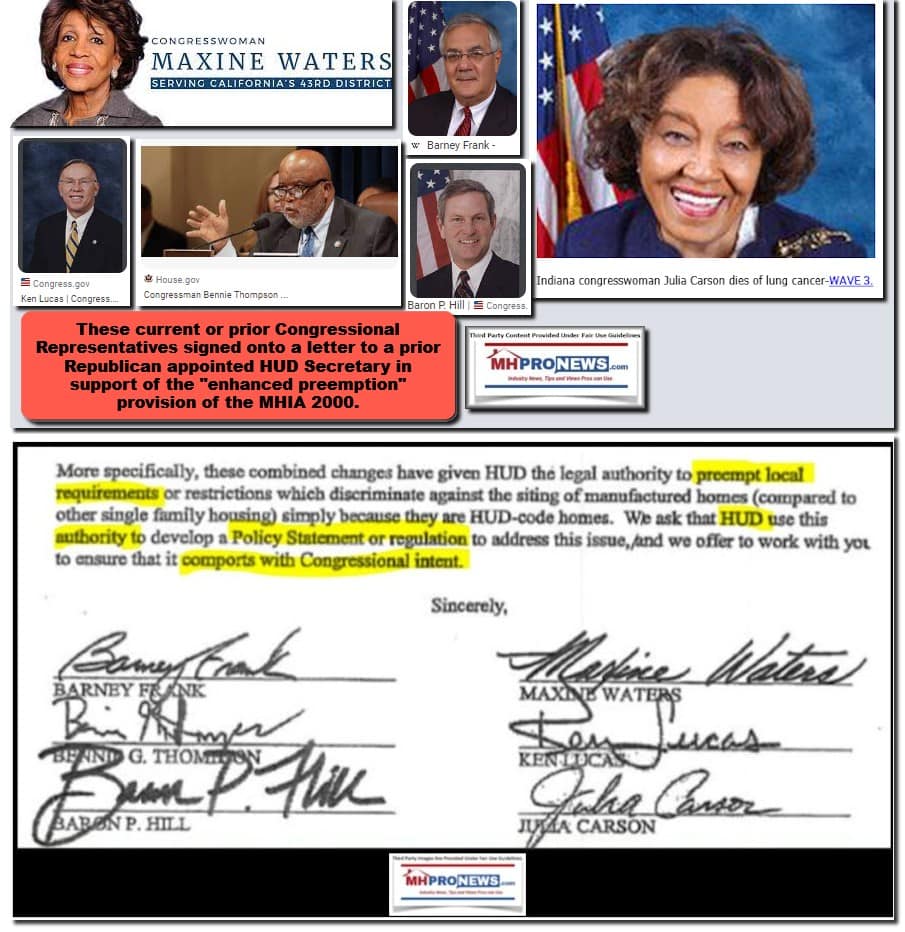
Regarding exclusionary zoning, the 2000 Reform Law specifically enhanced the federal preemption mandate enacted by Congress in the National Manufactured Housing Construction and Safety Standards Act of 1974 to “broadly and liberally” include all state or local “requirements” of any kind that impair the federal superintendence of the manufactured housing industry. And, lest there be any doubt about the meaning of this amendment, subsequent communications from the congressional sponsors of this legislation to HUD make it clear that this change was intended to include within the scope of federal preemption under the Act, zoning laws which exclude manufactured housing.
Similarly, the Duty to Serve mandate directs Fannie Mae and Freddie Mac to provide federal securitization and secondary market support for all types of manufactured home consumer loans, including the nearly 80% of the market represented by personal property loans. Significantly, there is an important interface and connection between the DTS mandate and the discriminatory zoning exclusion that the industry and its consumers face. Specifically, the full, robust and market-significant implementation of DTS would result in many more sales of new manufactured homes. Larger numbers of HUD Code homes entering the market, in turn, would create additional demand for new and expanded communities within which to place such homes. Consequently, as a simple matter of supply and demand, the full implementation of DTS would spur the growth of new, expanded and upgraded MHCs.
Neither of these beneficial laws, however, have been implemented by their relevant government agencies (i.e., HUD and the Federal Housing Finance Agency -- FHFA) to benefit American consumers of affordable housing. Instead, in each case, for two decades (or more), these crucial statutory mandates have been ignored and subverted by HUD and FHFA, to the extreme detriment of American consumers of affordable housing, with little or no effective push-back from the industry’s post-production national representation. The industry’s post-production sector and its national representation, accordingly, have failed – and continue to fail – to aggressively pursue the full, robust and proper implementation of both of these crucial mandates.
Instead, that representation is constantly approaching Congress, seeking – unsuccessfully – new or modified laws that are not needed to resolve these issues and, in fact, are little more than window-dressing because, as noted above, these matters are already addressed by and in existing law. The roadblock facing the industry is not a lack of laws, but rather, a lack of implementation of those existing laws that will not be resolved by adding yet more laws that will similarly be ignored by relevant government agencies. What is needed, is concerted pressure on the agencies involved to fully implement the laws that exist, not more meaningless declarations.
That does not mean, however, that there is no role for Congress or no need to engage with Congress. First, the industry must press for absolute parity for manufactured housing in any and all laws and programs that pertain to housing and consumer home financing. Second, the industry should be seeking hard-hitting and aggressive congressional oversight of HUD, FHFA, Fannie Mae and Freddie Mac for their continuing failure to fully and properly implement all aspects of the 2000 Reform Law and the DTS mandate.
Thus, rather than trying to reinvent the wheel by seeking new and additional laws, the industry should prioritize the full implementation and enforcement of the good laws that are already on the books.
MHProNews: Why is there such a slow pace in achieving zoning changes if affordable housing demand is so great?
WEISS: The slow pace of change is a function of two principal causes. First, zoning policy in any given community is driven by vested interests, not by those seeking access to that community via affordable housing. Multiple studies have shown that over time, zoning policy has been abused to function as a means of exclusion, rather than inclusion, by existing homeowners and related interests.
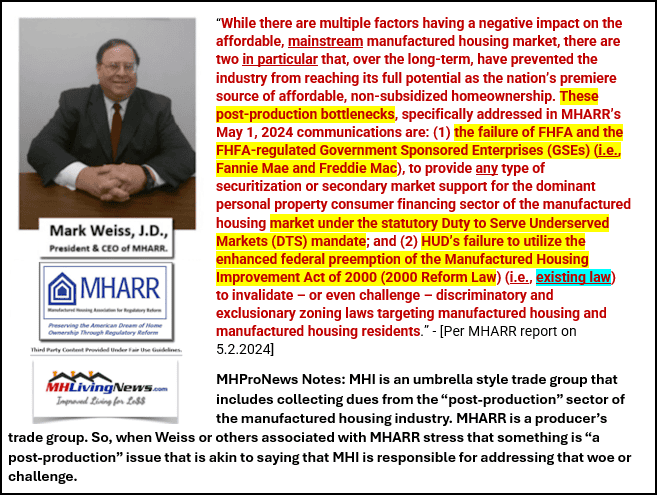
Second, and more significant in the specific case of comprehensively federally-regulated manufactured housing, is the failure of HUD to enforce the enhanced federal preemption of the 2000 Reform Law to prevent communities from excluding mainstream HUD Code homes, and the parallel failure of the industry’s national post-production representation to effectively demand the enforcement of that provision. Instead of joining with MHARR in demanding that HUD fully implement enhanced federal preemption to prevent the exclusion of mainstream manufactured homes that HUD itself comprehensively regulates, the industry’s post-production national representation seems to devote more of its time, effort and resources to developing and promoting more costly hybrid types of so-called “off-site-built” housing in an apparent effort to sidestep – rather than eliminate -- exclusionary zoning targeting HUD Code homes.
While MHARR would rather “fight than switch,” in regard to such blatant and baseless discrimination, others appear all too willing to switch to higher-cost hybrid types of homes, rather than fight for the mainstream HUD Code industry and the consumers who rely upon mainstream, affordable manufactured homes.
MHProNews: Those who oppose having a manufactured home in their neighborhood often claim that having MHCs close-by will lower their property values. Is such a claim valid?
WEISS: Absolutely not.
Just as background, the industry has already dealt with and addressed most of the early reasons (e.g., aesthetics, appearance, quality, durability) cited for discriminatory attitudes and local zoning opposition to manufactured housing. Such early objections, based upon the perception of manufactured homes as “trailers,” were largely resolved as a result of – and in the wake of – the adoption of the original federal manufactured housing law in 1974. These improvements corresponded with sustained production levels of 100,000 homes per year – or more – through 2000. Then, the enactment of the 2000 Reform Law marked the completion of the crucial transition from the ”trailers” of the past to today’s modern, affordable, energy-efficient manufactured homes.
Yet, some negative perceptions persist, despite not only the improvements cited above, but also repeated studies by well-respected organizations, including the Urban Institute, which have concluded that mainstream manufactured homes, while maintaining their inherent, non-subsidized affordability for Americans at every rung of the economic ladder, can and do appreciate over time.
In part, these continued negative perceptions have resulted from the small – and declining number – of communities with older pre-HUD Code models that have been allowed to deteriorate along with the properties themselves. As time progresses, more of today’s modern, attractive manufactured homes are being incorporated within MHCs by both individual homeowners and the MHCs themselves. At the same time, more modern management practices have resulted in more attractive, upgraded communities. This, combined with the amenities offered by today’s modern manufactured housing, have helped to overcome much of the outdated negative perception of MHCs, while offering moderate and lower-income families an attractive, cost-effective homeownership option.
The open and obvious improvements that have been made in the quality and aesthetics of today’s modern manufactured homes, however, are, in too many cases, irrelevant to local zoning officials, who simply do not want affordable manufactured homes and lower/moderate-income people in their communities. For many if not most of these officials, discrimination against manufactured homes and manufactured homeowners is, in reality, grounded in a discriminatory bias against the HUD Code (and homes built to the HUD Code) in relation to other building codes and the homes built to those codes (e.g., site-built homes, apartment buildings, other “factory-built” homes, etc.).
Such bias (disguised or otherwise) should not be occurring and should not be tolerated. Quite simply, the enhanced federal preemption of the 2000 Reform Law gives HUD all the power and authority that it needs to ensure that the manufactured homes it regulates are available to all Americans in all communities. The fact that HUD, for over 20 years, has refused to use this authority – in the face of an admitted affordable housing crisis – represents a crucial failure on its part and on the part of an industry national pos-production representation which has not forced the issue.
MHProNews: How do MHC residents perceive their homes?
WEISS: While subjective opinions are difficult to gauge and can vary, multiple studies have shown that manufactured homeowners, as a whole, view their homes positively and as an essential avenue to homeownership at an affordable price. This is consistent with studies, including a study by HUD itself, showing that mainstream HUD Code manufactured homes are more affordable not only than purchased site-built homes, but also the cost of renting other types of residences.
MHProNews: In June, HUD established a program to allow for the purchase, refinance, or renovation of manufactured housing under a loan program sponsored by the Federal Housing Administration (FHA). What is your take on the program and its potential impact on the manufactured housing sector?
WEISS: With the billions of tax dollars that HUD has shoveled out the door for so-called “housing” programs over the past few years, this is little more than a “throw-away” to mollify the industry and consumers. But it is little more than a token gesture when the industry and consumers need new and expanded communities, and the zoning and consumer financing needed to spur and maintain such growth.
As to individual homebuyers, MHARR took a leading role in encouraging FHA to modernize and upgrade its Title I manufactured housing loan program. That program, which had been a significant source of market-competitive consumer manufactured home lending in the past, had fallen to negligible levels of activity of the past decade, as the manufactured housing consumer lending market has simultaneously become unduly and unhealthfully concentrated in just a few hands, to the ultimate detriment of both the industry and consumers. MHARR, accordingly, pressed FHA to substantially revise and reform its “10-10” rule which, over that same period, had effectively excluded new and other lenders from the FHA Title I market. That pressure has now resulted in significant changes by FHA to relax the “10-10” rule and create the necessary conditions to attract new and additional lenders to the Title I program. If taken-up by industry lenders, the modernization and liberalization of the Title I program should increase the number of participating lenders and increase competition, ultimately benefitting manufactured homebuyers.
MHProNews: How difficult has it been for MHC developers and owners to obtain financial support for their projects in today’s economic environment?
WEISS: The question originally asked by MHN of MHI's CEO Lesli Gooch, in and of itself, misses the point. The main driver underlying the slow or non-existent pace of development of new MHCs (and expansion of existing MHCs), has been – and continues to be – discriminatory zoning and land use opposition. While both Fannie Mae and Freddie Mac have helped to provide financing support for manufactured home communities as an aspect of DTS, the far more significant impediment to the development of new, expanded and upgraded MHCs, has been local opposition through zoning and placement restrictions. This only underscores the need for HUD to assert the enhanced federal preemption of the 2000 Reform Law to ensure that today’s modern and affordable HUD Code homes are not excluded from entire communities. While zoning “research” and databases are all well and good, local land use regulators must be told unequivocally that federal law supports the availability of affordable, mainstream manufactured housing for all Americans, and that land use prohibitions cannot be abused as a subterfuge for excluding affordable housing and homeownership.
MHProNews: Are there particular areas where the demand for affordable housing, particularly manufactured housing, is higher than in other parts of the U.S.?
WEISS: This question only serves to highlight a key aspect of the land use exclusions that the industry and its consumers face.
The short answer is “yes” – of course there are such areas. They are largely in inner cities and close-in suburban areas, where the need for affordable housing is most acute and where, not coincidentally, affordable, mainstream manufactured homes are most often excluded by zoning and/or placement restrictions. The industry’s answer, in such cases, should not be to change the nature of the industry’s product and, thereby, render it less affordable (if not totally inaccessible) to lower and moderate-income homebuyers but, rather, aggressively press for changes to such zoning and placement exclusions. This would necessarily have to include, as explained earlier, demanding that HUD enforce enhanced federal preemption in order to invalidate such laws.
MHProNews: What actions have or should be taken to alter the perception of manufactured housing among the public and policymakers?
WEISS: Lingering negative perceptions of modern HUD Code manufactured homes are not a function of the quality or attractiveness of today’s HUD Code homes but, rather, are a relic of a now bygone era. As such, they are not based on or grounded in current day reality, but are a discriminatory manifestation of outdated and unsupported biases. Like other types of irrational bias and discrimination, they serve no positive purpose, inflict undue harm on those most in need of community support and understanding, and should have no place in America’s hometowns. HUD should be at the forefront of eradicating such discrimination through its broad federal preemption mandate. ##
Part II - Additional Information with Expert Analysis
1) According to her responses to MHN, MHI CEO Gooch said in her interview: "MHI is partnering with HUD on research to assess the specific zoning barriers to manufactured housing. We plan to develop a manufactured housing regulatory index that identifies and evaluates barriers to the placement of manufactured housing.” But that response, as MHARR CEO Weiss explained appears to be absurd on its face. It smacks of posturing rather that an authentic effort toward solutions and actually producing more manufactured homes. How so? Because Gooch herself said in a letter to prior HUD Secretary Ben Carson, M.D., that HUD needed to enforce the enhanced preemption under the Manufactured Housing Improvement Act of 2000 (a.k.a.: 2000 Reform Act, 2000 Reform Law, MHIA, and MHIA 2000).
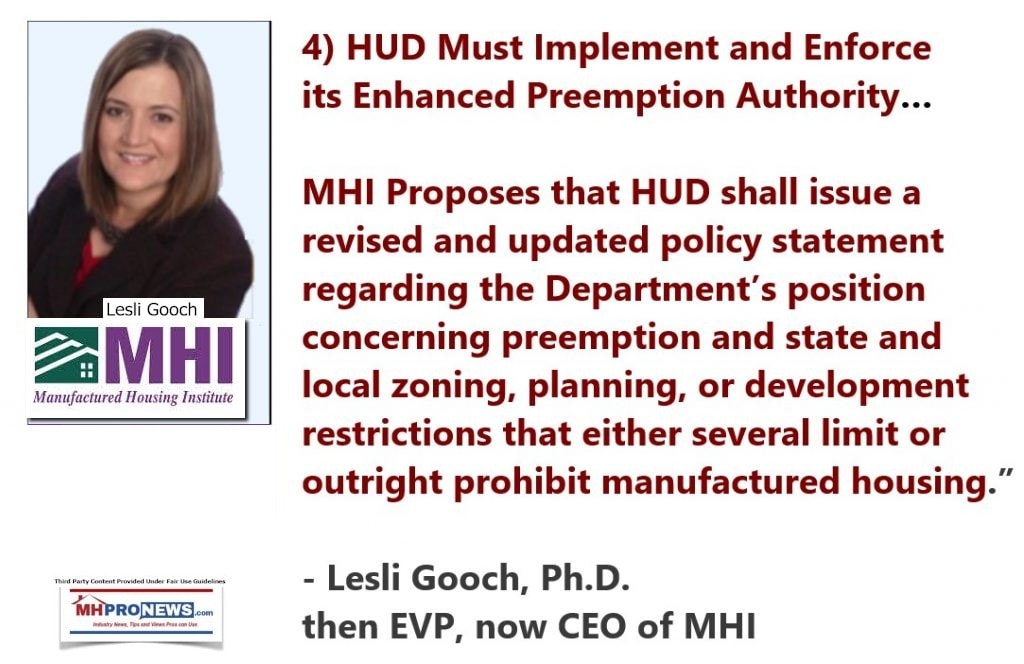
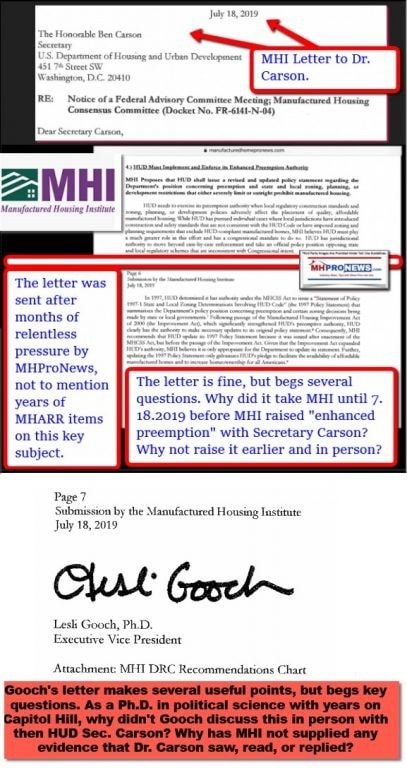
2) MHARR's Weiss noted that lawmakers after the 2000 Reform Law was enacted stated what "enhanced preemption" means. Pull quotes from the letter Weiss referred to are shown below, and that letter from lawmakers is linked here.
3) MHARR's CEO Weiss met again recently with HUD's acting secretary to press her to get enhanced preemption enforced. See that linked below.
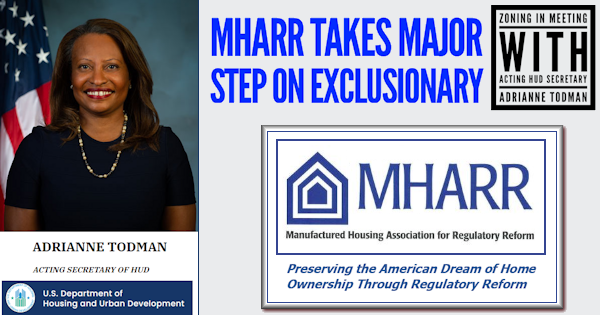
Which begs the question. Why is MHI doing all sorts of seemingly impressive sounding razzle dazzle when all that they should be focused on is to get HUD to enforce existing laws? Why should Gooch talk about "MHI is partnering with HUD on research to assess the specific zoning barriers to manufactured housing," when the obvious next step is to get "enhanced preemption" routinely enforced?
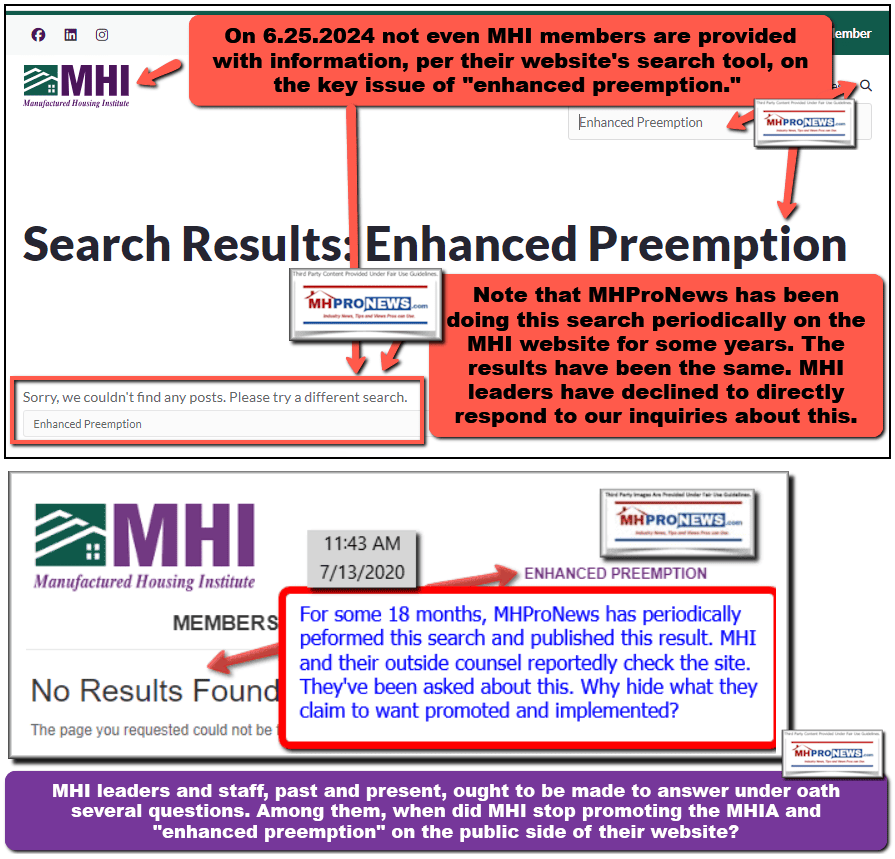
4) This article has documented that MHI CEO Gooch herself said when 45th President Donald J. Trump (R) was in office that she asked then HUD Secretary Ben Carson to enforce enhanced preemption. Did she forget? Why should MHI and Gooch do anything other than press the White House, HUD, and FHFA - as MHARR CEO Weiss has argued - and Congress to get existing law enforced? Unfortunately, as prior reports in this series (linked further below) indicated, MHI appears to be engaged in head fakes and posturing. At least at this time, they don't want enhanced preemption enforced. Otherwise, they would be laser focused on getting existing law enforced. As but one example of apparent duplicity, MHARR has the legally important words "enhanced preemption" on dozens of pages on their website. Meanwhile, in stark contrast, MHI has been missing those words on the public side of their website for years. What they put in a letter to Dr. Carson is not on their own website.
Compared to MHI's obvious disconnects, MHARR and Weiss are consistent. See his remarks from earlier this year in the quote graphic below.
5) Recall the reports earlier in this series where MHI member Frank Rolfe pointedly accused MHI of being a culprit in this problem. Rolfe said, "I blame MHI." Rolfe is understandably seen as notorious, but he nevertheless made a very apt set of observations reported in the linked items.
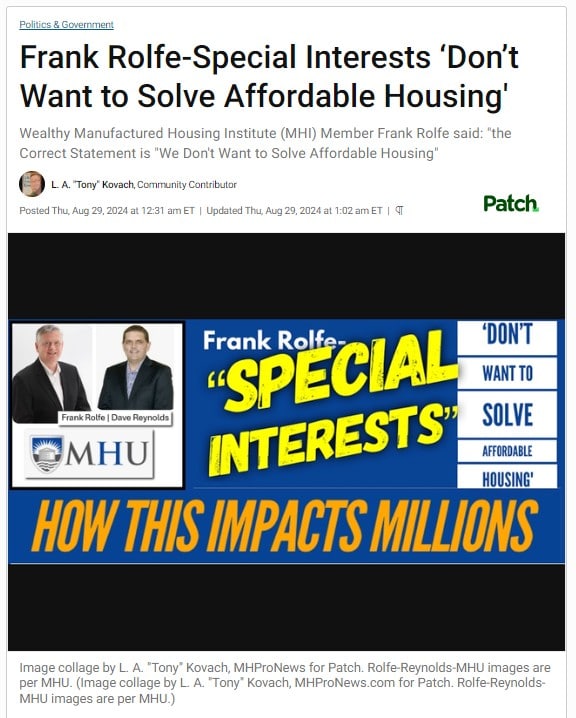
6) The point? Mark Weiss is demonstrably correct. The solution to the affordable housing crisis boils down to enforcing existing laws.
In fact, much of the solution to the problems facing our nation comes down to routinely enforcing existing laws.
If you want more affordable homes, enforce the laws Weiss has stressed. Similarly, if you want fewer illegal immigrants, enforce the border laws and laws that require employers to prove the citizenship status of employees. Per ICE I-9 8/7/2023: "The Immigration Reform and Control Act, enacted on November 6, 1986, requires employers to verify the identity and employment eligibility of their employees and sets forth criminal and civil sanctions for employment-related violations." Biden-Harris (D) declined installing the border wall sections that the Trump Administration (R) had already paid for, which is another way of saying Biden-Harris (D) wanted more illegal migrants. Similarly, Trump has campaigned on law enforcement.
7) There are no new laws needed, as Congress heard in testimony from both MHARR and MHI in 2011 and 2012. But since then, MHI has apparently pivoted to posturing efforts without sincerely desiring enforcement at this time. Why would they do that? While there are many possible reasons, it seems to come down to this. Several of MHI's members believe that limiting development benefits their business model. Two examples from MHI members Equity LifeStyle Properties (ELS) and Sun Communities (SUI) follow. The call out boxes are added by MHProNews.
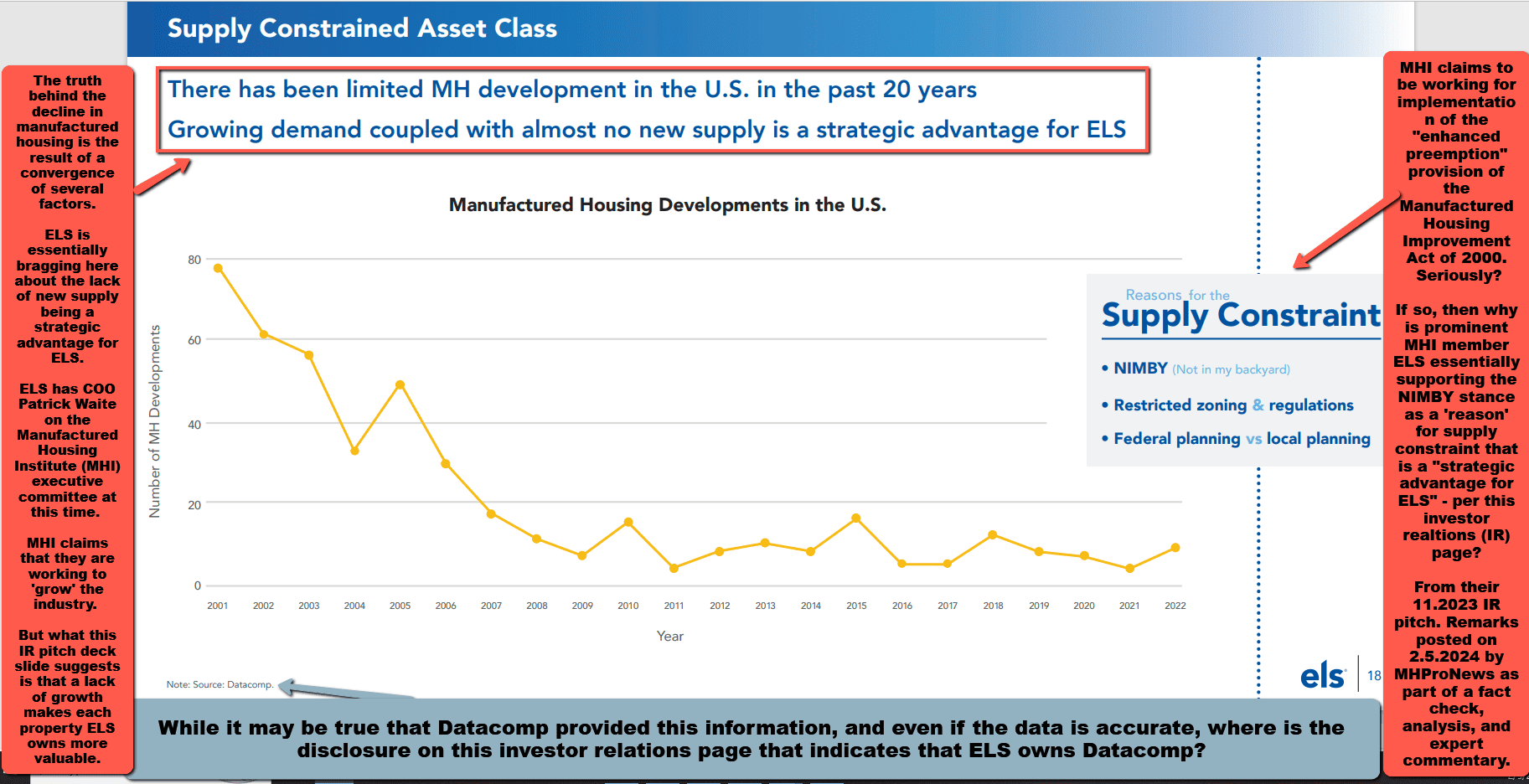
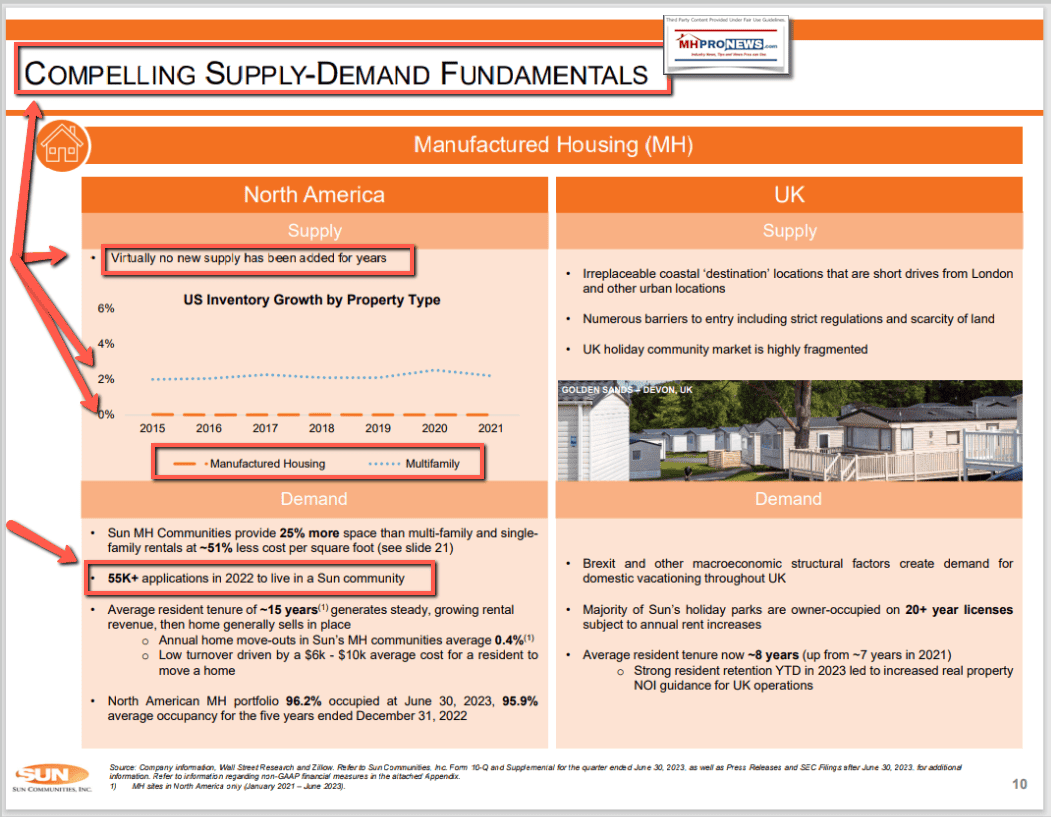
See the prior reports on those two companies and more about MHI linked below.

https://patch.com/florida/lake...
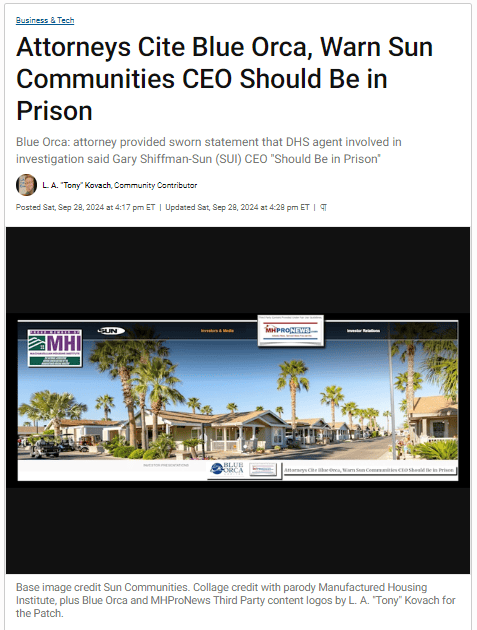
https://patch.com/florida/lake...
https://patch.com/florida/lake...
https://patch.com/florida/lake...
To see our entire series on a range of issues facing Americans, check out the linked results, which include the above but much more. Stay tuned for more on how to fix what's gone wrong for the American Dream. ##
> Controversy-Manufactured Housing Institute-Lesli Gooch-Mark Bowersox
> 34,758 Votes May Decide ‘24 Election & Dr. George Barna@ACU Research
> Other Countries Homeownership Rates vs. U.S. – Fix Affordable Housing
> Visual Capitalist Shows Top 15 Artificial Intelligence-AI-Online Tools
> Burning Bush Cove, Hurricanes Helene and Milton, and Where Is God?
> Magyar Szabadság Kör – Cultural-Culinary Experience in Plant City, FL
> Realtor? Journalist? Affordable Manufactured Home Production Jumps
> Orlando RE Agent Smith-Younger Adults Will Need $8500 Monthly for Rent
> Blankley-Goodbye American Dream? Only 10% Polled Can Buy a House; But
> A Brief History of Labor Day and Modern Insights for Employees and Pay
> New-Certified “Half Price Homes” - Affordable Housing Solution Redux
--
> Solution: “Would-Be Homebuyers Need 80% More Income Than 4 Years Ago”
L. A. “Tony” Kovach and his family live in a manufactured home on private property in Winter Haven, FL. He is the co-founder of ManufacturedHomeLivingNews.com (MHLivingNews.com) and ManufacturedHomeProNews.com (MHProNews.com), trade publications serving segments of the manufactured home industry. Having worked in several segments of the manufactured home industry for over 3 decades, Kovach is a widely acknowledged and often praised expert on manufactured housing.