Politics & Government
No Matter Who Wins NH Primary, U.S. May Still Be A Divided Nation
Analysis: Few presidential candidates have a grasp on how to mend America's longstanding divide — and that doesn't bode well for the future.


CONCORD, NH — Many of the candidates running for president in New Hampshire's first-in-the-nation primary point to the election of President Donald Trump in 2016 as a defining moment of division in the history of the United States. In one form or another, while offering varying levels of fury and awareness about the outcome of that election, they do not believe it was won by a disruptor of the status quo. Instead, they say it was won by an opportunist who fomented detachment to break the country apart for his own benefit — and he must be stopped.
A lot has been written about the last presidential election, but one thing missing from much of the analysis is that America, especially around election times, has been divided for a very long time. And in 2020, it doesn't appear to be changing.
Analysis by Tony Schinella, editor, New Hampshire Patch
Find out what's happening in Concordfor free with the latest updates from Patch.
Generalizing, there is a large chunk of the body politic that supports Democrats and a large chunk that supports Republicans. And then, there is this fickle 5 or 10 percent or so of voters who change their minds every two and four years, as well as third- and fourth-party candidates, throwing the expectations into disarray and, sometimes, chaos. And with the exception of a handful of elections, the electorate has pretty much been this way for more than two generations.
In other words, this is not something Trump wrought.
Find out what's happening in Concordfor free with the latest updates from Patch.
As an example, in the lead-up to the 2016 election, with nearly every pollster showing Hillary Clinton poised to have a grand, sweeping election win nationally, nearly all of her state-by-state polling showed a potential upset: Trump was within the margin of error all the way up until Election Day in every place he needed to win.
While the perception that 2012 was a solid win for incumbent Democratic President Barack Obama over Republican challenger Mitt Romney, by 126 Electoral College votes, the data showed otherwise: A shift of around 400,000 voters in a handful of states and/or Maine's 2nd Congressional District would've given Romney the win. That number of voters is two cities the size of Manchester and two cities the size of Nashua — out of a nation of 321 million.
For these reasons, Trump's victory should have surprised no one because he only needed to boost Romney's 2012 vote totals by a smidgen in a few states — and he did so while also earning more than 2 million votes more than the now-Utah senator nationally. This doesn't take into account Gary Johnson, running as a Libertarian, and Jill Stein, as the Green Party nominee, boosting their overall totals nearly four-fold from 2012 to 2016 (Clinton held Obama's numbers nationally but not in states she needed to win to be elected).
But 2016 and 2012 were not anomalies; they were the norm.
With the exception of 2008, when Obama won decisively, as well as the Reagan-Bush years (1980, 1984, 1988), our presidential elections have been pretty close, with large unpredictability factors such as indie candidates and turnout swings, as well as a level of volatility that random sampling in polling rarely, if ever, reveals or tracks. Before 1976, most presidential elections were decisively won (the most recent exceptions were 1960, where John F. Kennedy won due to two states with tight margins, Woodrow Wilson's 1916 win by eight Electoral College votes, and some of the more contentious elections during the early years of the country).
Mending such a longstanding divide is not an easy task because there are so many subset factors to the division — the country being a federalist republic with specific separation of powers and not a European social democracy; change is slow, as it was intended to be; constant arguments and often hypocrisies on both sides about what the federal government should and shouldn't do, from gun ownership and control to speech regulation and raising children to personal issues such as a citizen's body, wallet and paystubs — and in this cycle, accumulated wealth, too, etc., just to name a few.
No matter where a voter stands on any of these issues, another voter can often be just as vehemently opposed, and vice versa.
From tracking the campaign statements, rhetoric, debates and press coverage, most Democrats (and some Republicans, too) believe that just removing Trump and implementing their own ideas and policies, in whatever way they can, will rectify the situation because the current president will be gone. But if history is any indication, that's not true. The candidates speak of unity, but their positions often seem to be just another form of preserving the division — while just switching the winners and divvying up the spoils for their supporters.
What Democrats Have To Say
During the last two months of New Hampshire's first-in-the-nation presidential primary, Patch set out to see if any of the candidates had an answer as to what they would do, after winning, to bring Americans together.
Surprisingly, or maybe not so — it is an election, and most of the candidates are politicians — only a few offered tangible solutions. Many others either did not want to answer, or their campaign handlers refused to offer time or written commentary on what some believe is one of the most difficult issues facing the United States today.
At the same time, other candidates see the writing on the wall: They know and understand that in order to heal the divide, the winner of the next presidential election has to bring people together — in a big way.
One of those candidates, former Maryland Congressman John Delaney, a Democrat who dropped out just before the Iowa Caucus, said the most important factor was to not "act like half the country is entirely wrong about everything they believe."
Delaney said his first focus would be to find issues and policies on which both political sides agree, especially issues that have been "pushed aside for decades." He also believed the installation and expansion of a national service program would influence young people about their obligation to their nation.
Watch John Delaney's remarks below.
Not surprising to anyone who knows him or has covered him, former Massachusetts Gov. Deval Patrick was thoughtful in his response and focused on some of the same themes Delaney mentioned. He said Democrats don't have to hate Republicans to be good Democrats in the same way they don't have to hate police to think black lives matter.
"You're right that America needs a healing," he said. "And I think people feel that across the spectrum. I think we have a politics today, and we have for some while, that says we have to agree on everything before we work together on anything. But it's not where most people are; it's not how most of life functions."
Patrick said that after elections, leaders needed to shift and govern with the understanding they won and represented everyone. Not ever president led in that way, he said, but he did as governor and in business, and he would if elected.
Watch Deval Patick's remarks below.
Andrew Yang, an entrepreneur whose main plank is a "freedom dividend," said the plan would bring people together because of its support by not only Democrats but independents, Republicans and Libertarians. The "dividend" would be a monthly $1,000 check sent to every American, paid for via a value-added tax of 10 percent on the means of production of all goods and services as well as the elimination and consolidation of welfare programs.
"(Voters) can sense I'm not ideological," he said. "I want to have solutions in place that help improve our lives. As president, I'll be able to bring the country together in a way that none of the other candidates can."
Watch Andrew Yang's remarks below.
Businessman Tom Steyer balked at the concept that the country is divided pretty evenly, because half the nation doesn't even participate in the process — a relevant point. He harkened back to many of the themes of past insurgent Democrat campaigns, including Jerry Brown's 1992 race and Howard Dean in 2004.
"How about, instead, we go and convince (the nonvoters) we are going to tell the truth, we're going to deal with the real issues, we're going to take the country back from the corporations, if they vote?" Steyer said. "That’s my plan."
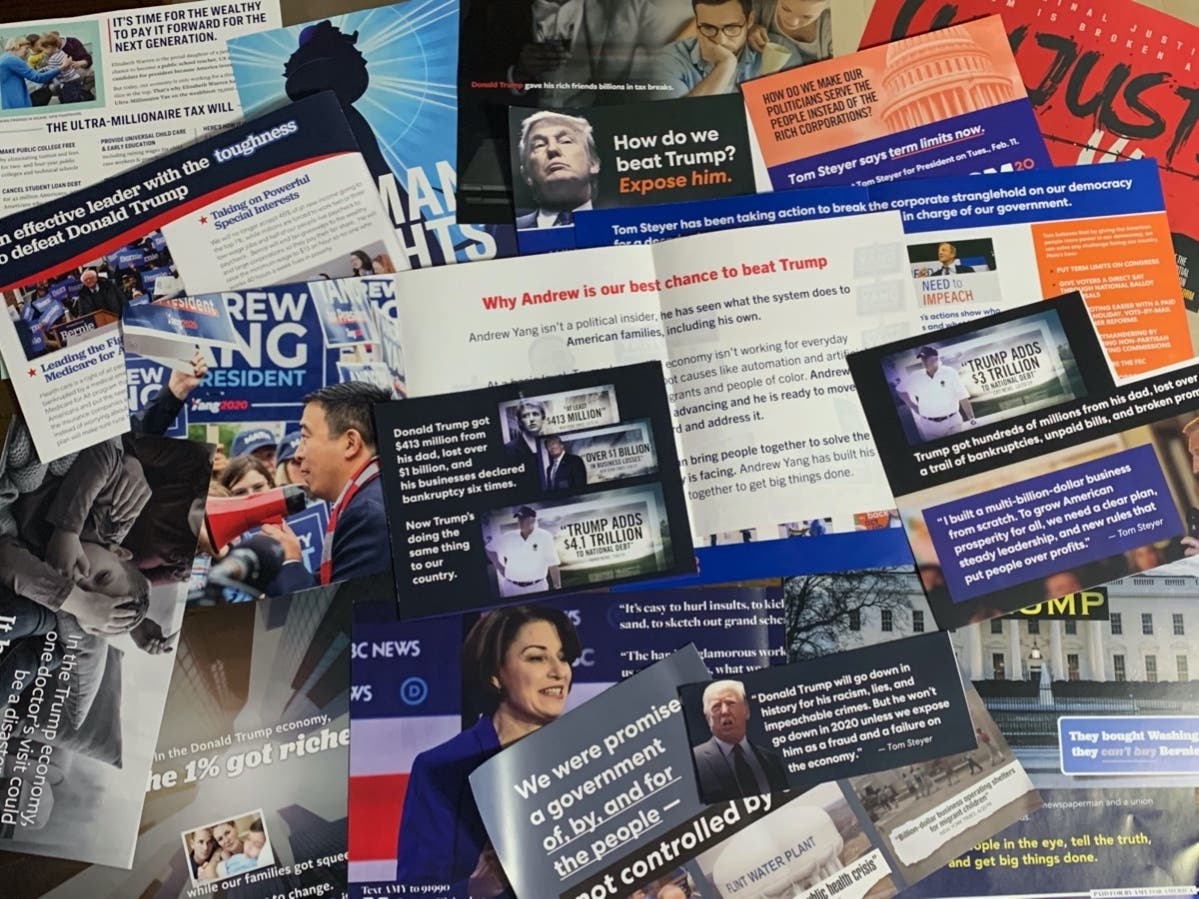
Instead of offering to bring people together, Steyer said he would do whatever he could legally to implement his agenda, which includes massive changes in the energy, farming, manufacturing and transportation sectors, while also implementing a wealth tax. (Due to time constraints, Patch was unable to ask him about the carbon footprint of his bombardment of direct-mail advertising to thousands of New Hampshire voters across many months).
Watch Tom Steyer's remarks below.
U.S. Sen. Michael Bennet (D-CO) said most of the division and polarization was in Washington and part of the campaign process, and was not necessarily the people of America.
"It's the way we raise money; it's the way we get known," he said. "The more negative light we can cast the other side, the more successful we are. The greater the promises we make without being able to keep them, the more successful we are."
Most of the things that elected officials want to do — such as improving education, fixing transportation and building infrastructure, as well as action on climate change — is supported by close to 70 percent of Americans, he said.
But then, Bennet pivoted and said his first act would be to meet with farmers in red states with a calculator, while inviting "the Fox News hosts to come ... I doubt very much they have calculators" to "unpack the lies Trump has told them" about his tax cuts. (Bennet did not acknowledge that the Tax Cuts And Jobs Act Of 2017 delivered a $2,000 direct tax credit to the head of households for every child — something many families had never seen before.)
The polarity, however, is not going to fix itself, Bennet added, and is the job of the president "who sees it as part of their duty to keep the country together."
Watch Michael Bennet's remarks below.
No other Democrats or their campaigns responded to Patch's repeated requests to be interviewed or include a written comment about the subject.
What Republicans Say
Three Republicans also offered commentary about the issue, with varying degrees of solutions, too.
William Weld, another former governor from Massachusetts, agreed that the discord in the country has been around for a while. He also pointed to the electoral process, fundraising, ideological division inside of the two major parties, and gerrymandering of congressional districts as having acerbated the divide. He said that 1994, when Republicans took control of Congress after Bill Clinton was elected president, was a turning point. In the wake of Trump, Weld was astounded how many families he knew who couldn't enjoy Thanksgiving dinners together because of the disagreements about a president.
"Obviously, that's way more divided than we should ever be," he said. "I'm hopeful that, with a new administration, whenever it comes, we can get back to the old-fashioned way of just rolling up our sleeves and getting down to work to help solve people's problems. And there are going to be problems aplenty a few years from now."
Climate change, job automation, and education are just some of the issues that need long-term, viable and bipartisan solutions that will require a lot of work by both parties, Weld said.
Watch William Weld's remarks below.
Matt Matern, an attorney from California who is on the ballot in New Hampshire, Colorado and other states, said a president needs to "bridge builders" and that it starts with eliminating "insulting and demeaning comments" from the national discourse. He said dialogue with all kinds of people, with different ideas, was what the Founders sought for the nation's common good and is needed today, too. Matern pointed to building coalitions among political leaders while also putting the national interest above self — and sending a message to the president that "his divisive conduct" is not acceptable.
"We will heal our national divide by having a dialogue that promotes a meritocracy of ideas," Matern said. "Voters who make up a silent majority in the country are not the hyper-partisans from either the Republican or Democrat parties. The silent majority is made up of citizens who make common-sense decisions every day to run their businesses, engineers engaged in coming up with scientific solutions to real-world problems, parents who balance their family budgets and students who understand they have to study hard to get good grades."
Zoltan Istvan, a futurist also on the GOP ballot in New Hampshire, said voters need to embrace the "radical innovation and technology" changing the course of human history.
"We are entering the transhumanism age, where disease can be cured, robots can do our jobs for free, and we can even soon colonize other planets," he said. "If Americans focused on the future, instead of our differences, we could get over ourselves and really embrace what the new America can look like. It's one that's much more harmonious, much more relaxed, and bound by rational guidance of science, which historically has always made America a very special place to live in."
A Libertarian Candidate Chimes In, Too
Vermin Supreme, who is vying for the Libertarian nomination in 2020, said he is using "satire and humor" to present real issues "with fantastical context, in-depth analysis and a dose of much-needed humor in the political sphere." Liberty, he said, would be the key focus on the world where individuals are sovereign with their own lives and are not forced to sacrifice their values for the benefit of others.
"I will always defend each person’s right to engage in any activity that is peaceful and honest, and welcome the diversity that freedom brings," he said. "The world I seek to build is one where individuals are free to follow their own dreams, in their own ways, without interference from the government or any other authoritarian power."
Previous #FITN2020 Coverage
- Elizabeth Warren's Challenge: Breaking Out Of Murky Middle
- 'He’s The Greatest:' Trump Supporters Camp Out Before President’s Manchester Rally
- Murphy: Former Nurse Says Vote Tulsi, She's The ‘Real Deal’
- Last Call: See Your Favorite Candidate Before FITN 2020 Vote
- NH’s Primary Is Fun, But Local Politics Are Where The Rubber Meets The Road
- Amy Klobuchar Pushes To Defy Expectations In New Hampshire
- N.H. Poses A Last Chance For Some Struggling 2020 Democrats
- Radio Free NH’s Fave NY (Bleep) Reporter: Ready To Rock FITN 2020
- 10 Dems Who Want To Be President Play Nice In Manchester
- Biden Mocks Rival Buttigieg's Record As Small City Mayor
- New Hampshire Kids Pick Trump, Sanders For President: FITN 2020
- Stampede Of Candidates Leading Up To Tuesday's Primary
- VP Pence Rallies 'Cops For Trump' In Portsmouth Monday
- Democrats Clash Over Electability In Struggle To Oust Trump
- N.H. Campaigns Expected To Shift Into Overdrive After Debate
- Kohrman-Glaser: Why I Switched My Support From Warren To Bernie
- Democrats Prepare For New Hampshire Debate As Urgency Rises
- Data Says, Yes, New Hampshire Does Resemble The Nation: FITN 2020
- New Hampshire Officials Confident They'll Avoid Iowa Chaos
- NextGen NH To Run Get Out The Youth Vote Primary Campaigns
- Klobuchar Comes Out Swinging In NH Primary's Home Stretch
- The Truth About NH's Primary Through The Eyes Of Reporter Chloe Schlagobers
- The Tulsi Vibe In Rochester: 'Dark, Quiet, Hushed'
- Caroline Kennedy Backs Biden, Calls Him Democrats' Best Bet
- Tulsi Gabbard In Concord: Marijuana Legalization Will Save Lives
- Deval Patrick's Vibe Of Fresh, Fresh Air In Somersworth
- Rayno: The Presidential Primary Party Is Starting in Earnest
- Longshots, Safe Bets, The Bern Surge? All Eyes Are On NH Primary
- In New Hampshire, Democratic Contenders Spend Big On TV Ads
- Patrick Says Pollsters Don't Tell Us The Outcome, 'We Decide'
- Soldati: Why I'm Backing Mayor Pete For President
- Amid Impeachment And Iowa, 2020 Top Tier Jilts New Hampshire
- Gabbard To Speak At Great Bay Community College Thursday
- Deval Patrick Launches 'Meet The Moment' 6-Day NH Bus Tour
- Delaney At NHTI: 'The Future Is About Skills, Not Degrees'
- It's Official: Trump Will Rally On Eve Of New Hampshire Primary
- Impeachment Leads To New Hampshire Surrogate Invasion: FITN 2020
- Decoding The Vibe: 'Anyone But Trump' At Portsmouth Women's March
- Weld's Wildcard: Iowa, NH, Senate Removes Trump, GOP Nomination
- Warren Vows To Cancel College Debt Without Awaiting Congress
- 2020 Watch: Will The Democratic Debate Provide Any Clarity?
- Cory Booker Ends Presidential Bid After Polling, Money Struggles
- Bernie Sanders Wins Major New Hampshire Union Endorsement
- Librarians Cancel Presidential Forum, The Next Debate: FITN 2020
- Yang Warns Of Coming 'Fourth Industrial Revolution'
- Watch: Man Screams At Elizabeth Warren In NH Town Hall
- Ranked Choice Voting At Convention Picks Trump, Warren, Klobuchar
- Dixville Notch Finds Enough People To Retain Claim To Fame
- Jill Biden Tours Riverbend In Concord; Talks Grief, Mental Health
- Former Republican Humphrey Joins Other NH Indies In Backing Biden
- Bevy Of Candidates To Attend NEC College Convention: FITN 2020
- NH Dems Predict Big Primary Turnout, Unified Party To Dump Trump
- Marianne Williamson Lays Off 2020 Campaign Staff Nationwide
- Andrew Yang: 'We're Going To Shock The World In February'
- Bernie Sanders Says He'll Enact National Drinking Water Standards
- Yang's Math: Each NH Voter Is Worth 1,000 Californians
- Joe Biden Questioned About Sharing 2020 Ticket With Republican
- 6 Magic Words Decoding Bernie's Vibe In Dover
- 2020 Watch: Messy Primary Finally Meets Election Year
- The First Primary: Why New Hampshire?
- Tiny Dixville Notch May Have To Forfeit Midnight Voting
- New Hampshire DNC Debate Announced, Meet-And-Greets: FITN 2020
- New Hampshire's 2020 Primary: Sleepier Than Elections Of The Past
- New Hampshire Voting Law On Trial, Just Weeks Before Primary
- Warren's 'Boots' Are Made For Running For President
- NH Presidential Primary Date Set – With A History Lesson, Too
- Presidential Primary Candidates Return To Press Flesh: FITN 2020
- Buttigieg Surges Ahead Of Warren, Biden In Latest N.H. Poll
- Got Those New Hampshire Primary Blues Again: Distant Dome
- 50 Hopefuls File For New Hampshire's First-In-The-Nation Primary
- Deval Patrick: 'I'm Excited. I'm Humbled. I'm Fired Up'
- In Concord, Warren Says Trump Operates Outside The Law
- Bill Weld Files To Challenge Trump In New Hampshire Primary
- Biden Makes it Official in Concord, Says He Will Take on the NRA
- Mike Pence To File President Trump's Paperwork For N.H. Primary
- Peter Grote Drove From Franconia To Back Klobuchar Filing In Concord
- 99 Days Until NH's Primary And Who's Counting
- Elizabeth Warren's Manchester, N.H. Campaign HQ Broken Into
- Primary Election Chief Back In Spotlight After Near-Ouster
- With A Special Hug And Hundreds Of Friends, Mayor Pete Files For The NH Primary
- Yoga With Marianne, 50+ Educators For Biden: FITN 2020 Roundup
- Watch: Tulsi Talks Up Presidential Campaign In Bow
- Trump Critics Struggle To Raise Money For Primary Challenge
- Joe Biden In Lead, But Does Campaign Have Enthusiasm To Keep It?
- In New Hampshire, 2020 Dems Urge Voters To Not Play It Safe
- New Hampshire Primary Candidates Descend On Convention: FITN 2020
- Buttigieg, Klobuchar Are In New Hampshire This Weekend: FITN 2020
- President Trump Called Woburn Supporter He Fat-Shamed At NH Rally
- Trump's New Hampshire Struggle: Voters Feeling 'Trumpgret'
- Trump To NH Voters: 'You Have To Vote For Me'
- President Trump Rallies With Thousands Of Supporters In NH: Watch
Got a news tip? Send it to me at tony.schinella@patch.com.
View videos at https://www.youtube.com/user/tonyschinella.
Follow the New Hampshire Patch Politics Twitter account @NHPatchPolitics for all our campaign coverage.
Get more local news delivered straight to your inbox. Sign up for free Patch newsletters and alerts.