Politics & Government
MHARR Provides Washington D.C. Updates on Affordable Manufactured Housing Bills-Challenges-Enforcement Woes
Manufactured Housing Institute Publicly Mute on Key Subjects Manufactured Housing Association for Regulatory Reform Spotlighted in Analysis


HUD has published several research reports in recent years that flatly stated that they have been dealing with regulatory barriers to more affordable housing for some 50 years. Let that sink in and then see exactly what HUD's own researchers have said in their own reports unpacked at in articles linked here and here, among others. Besides other affordable housing programs, HUD is the primary federal regulator of HUD Code manufactured housing.
For nearly 50 years, HUD has been directly involved in regulating what was once the trailer house and mobile home industries from half-a-century or more ago which evolved into the manufactured housing industry of today. Modern manufactured homes routinely defy the sterotypes many have about manufactured homes, according to an array of third-party researchers.
Find out what's happening in Lakelandfor free with the latest updates from Patch.

https://www.manufacturedhomeli...
More on these topics, including insights from the Manufactured Housing Institute (MHI) in their own words, are found in Part II.
Find out what's happening in Lakelandfor free with the latest updates from Patch.
Part I provides MHARR's press release as shown below.
Part I
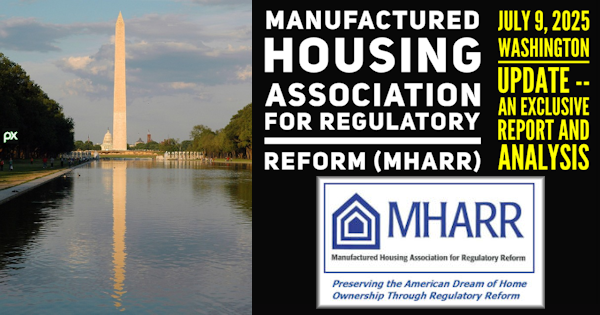
REPORT AND ANALYSIS
IN THIS REPORT: JULY 9, 2025
- MHARR ADDRESSES DEFICIENCIES IN PENDING AND DRAFT MH BILLS
- DOE DELAYS MH ENERGY RULE IMPLEMENTATION DATE
- MHARR PRESSES DOE FOR REVOCATION OF MH ENERGY RULE
- MHARR FILES FOIA ON LEADERSHIP CHANGE AT HUD MH PROGRAM
- MHCC RECOMMENDS NO CHASSIS FOR MULTI-STORY UPPER LEVELS
- HUD RECONSIDERING COST-BENEFIT DETERMINATION ON 2021 IECC
- HUD HEADQUARTERS MOVING TO NEW HOME
MHARR URGES CONGRESS TO FIX PROBLEMS WITH MH-RELATED BILLS
As MHARR reported previously, bi-partisan legislation entitled “The Housing Supply Frameworks Act of 2025” (HSFA), has been introduced in both the House of Representatives (H.R. 2840) and the U.S. Senate (S. 1299). At their core, these bills would establish a federal mechanism to, within three years of enactment, “develop frameworks for best practices on zoning and land-use policies” at both the state and local level. Among other things, the bills specifically reference a “reduction of obstacles to a range of housing types at all levels of affordability, including manufactured and modular housing.” In addition, the legislation would provide state and local governments with resources to confront barriers to affordable housing development and construction.
While MHARR supports the purposes and objectives of these HSFA bills, it nevertheless has serious concerns with certain aspects of the language used in the bills, which – like two draft bills currently before the House of Representatives Subcommittee on Housing and Insurance, addressed in detail in an MHARR memorandum and package dated June 11, 2025 entitled “Pending and Potential Legislation Impacting Manufactured Housing”) – could have significant unintended negative effects for the manufactured housing industry and American consumers of affordable housing if not addressed and corrected during the legislative process.
Consequently, MHARR, in a June 16, 2025 communication to both houses of Congress, has indicated the sections of the HSFA bills that pose the greatest concern, and has offered suggested changes to the bill language that would address those concerns. In general, the matters addressed by MHARR fall into four broad categories:
- MHARR proposed changes seek to specifically define “manufactured home” by referencing the definition contained in the National Manufactured Housing Construction and Safety Standards Act of 1974, as amended;
- MHARR proposed changes seek to include “manufactured housing producers” as a distinct membership category for the committee that would be established by the bill;
- MHARR proposed changes would separate references to the regulation and exclusion of federally-regulated HUD Code manufactured homes from references to “modular” or other types of homes built to state or local building codes; and
- MHARR proposed changes would replace references to “attainable” housing with references to “affordable” housing.
Most importantly, the proposed changes seek to identify HUD Code manufactured homes as a distinct category of affordable housing (indeed, the most affordable housing) which faces discrimination and exclusion through zoning and placement mandates precisely because it is regulated pursuant to a federal building code (with performance-based federal standards, uniform federal enforcement and federal preemption), rather than state or local codes (most typically the International Residential Code – IRC). In order to make this distinction clear and unequivocal in the proposed legislation, it is necessary that manufactured homes, as a housing category, be specifically identified and defined in the bill language. Moreover, and consistent with the HSFA’s specific identification and definition of “affordability,” it is essential that HSFA avoid references to the meaningless term “attainable” housing and instead refer in all instances to “affordable” homeownership, which is the centerpiece of President Trump’s and HUD Secretary Scott Turner’s goal to increase housing supply and the availability of homeownership throughout the United States.
MHARR will continue to monitor these bills and will take any and all actions needed to protect the rights and interests of smaller HUD Code industry businesses and the lower and moderate-income American homebuyers who rely on affordable manufactured housing, while simultaneously working to ensure that full and fair competition within the industry is maintained and protected.
DOE DELAYS EFFECTIVE DATE FOR “TIER 2” ENERGY STANDARDS
The U.S. Department of Energy (DOE), in a final rule published in the Federal Register on July 2, 2025, has delayed the compliance date for so-called “Tier 2” manufactured home “energy conservation” standards until 180 days after the publication of “enforcement procedures” related to those standards. Previously, the compliance date for Tier 2 homes had been July 1, 2025. As published, the delay is effective immediately.
Publication of the Federal Register notice effectively renders moot a Temporary Restraining Order (TRO) on enforcement of the DOE standards issued on June 30, 2025 by the court hearing the federal challenge to the validity of those standards. The TRO had provided that it would “expire of its own force upon … publication [i]n the Federal Register of the Department of Energy’s [final] delay rule….”
While MHARR supports the extension of the compliance date for “Tier 2” standards, a mere delay is not sufficient in itself. Rather, the destructive DOE energy standards must be eliminated. As a result, MHARR has aggressively sought – and continues to aggressively seek (see article below) -- the complete withdrawal and revocation of the manufactured housing energy standards “final” rule published by DOE on May 31, 2022. Indeed, MHARR’s consistent opposition to the DOE manufactured housing energy standards is duly noted in the DOE July 2, 2025 Federal Register final extension rule notice. In that document, DOE states:
“While MHARR commented it supports extending and delaying manufactured housing energy standards implementation, they also maintain the May 2022 Final Rule standards are fundamentally flawed and should be completely withdrawn, not just postponed. They argue that these standards are detrimental to the manufactured housing industry and hinder affordable homeownership for lower and moderate-income Americans. MHARR advocates for crafting a new, cost-effective rule in collaboration with [the] U.S. Department of Housing and Urban Development and its Manufactured Housing Consensus Committee, encompassing both the standards and regulatory compliance procedures.
Response: DOE agrees with the commenter that it is necessary to amend the compliance date for Tier 2 homes.”
See, 90 Federal Register No. 125, July 2, 2025 “Energy Conservation Standards for Manufactured Homes,” at pp. 28875-28876. As to MHARR’s broader objection to the standards, DOE maintains that such objections are beyond the scope of the extension rulemaking, per se, but indicates in its notice that such organic opposition points may be considered in a further rulemaking re-visiting the substance of the energy standards – a further action that MHARR will continue to demand.
It must be reiterated that MHARR is the only national industry trade organization to consistently oppose every iteration of the DOE energy standards proposal since the baseless and corrupted DOE “negotiated rulemaking” scheme. MHARR cast the only “no” vote against the proposed standard “term sheet” developed through that process, while MHI supported both the negotiated rulemaking procedure and the resulting negotiated rulemaking “term sheet.” If MHI had joined with MHARR in opposition to this illegitimate process and destructive “term sheet” recommendation, and had worked to present a united industry position and view to DOE, it could have helped to encourage DOE to fully comply with all aspects of the underlying enabling legislation. It did not, however, ultimately leading to decade-long (and continuing) regulatory cloud hanging over the industry.
Nevertheless, during the entire rulemaking process, as reflected in DOE’s Federal Register recitation above, MHARR has consistently maintained:
(1) That manufactured homes are already cost-effective with respect to energy under existing HUD standards as shown by Census Bureau data;
(2) That draconian DOE regulation is unnecessary and will result in exclusionary price increases that will worsen homelessness;
(3) That the contrary claims of “climate” extremists in support of the DOE rule are utterly baseless; and most importantly,
(4) That DOE, in developing the energy standards rule, failed to comply with the affirmative requirement of section 413 of the Energy Independence and Security Act of 2007 (EISA), that it substantively consult with, obtain and consider the input of both HUD and the statutory Manufactured Housing Consensus Committee (MHCC), including with respect to the purchase price cost-benefit of the proposed standards.
With the expected re-opening of the DOE standards rulemaking itself, MHARR will continue to press for the total repeal of the DOE energy standards and for both HUD and the MHCC to be substantively involved and engaged in further activity – if any -- regrding manufactured housing energy standards.
MHARR’s position on DOE manufactured housing energy standards has been clear and consistent from the very outset. This was expressed, in part, in an August 2022 MHARR Issues and Perspectives article (written six months before the pending federal court action was filed), entitled “The DOE Energy Rule Should be DOA,” which made the case for legal action against the standards. With the Trump Administration now in office, the opportunity to eliminate these baseless and illegitimate standards once and for all now exists, and the industry must fully commit itself to that end.
MHARR MEETS TOP DOE OFFICIALS – SEEKS REVOCATION OF ENERGY RULE
MHARR officials reiterated the Association’s call for the complete and total revocation of the U.S. Department of Energy’s (DOE) baseless and destructive May 31, 2022 manufactured housing “energy conservation” standards in a July 1, 2025 meeting with DOE Principal Deputy Assistant Secretary Lou Hrkman. Mr. Hrkman is responsible for the manufactured housing energy standards and enforcement procedures rulemaking in his capacity as the top official of DOE’s Office of Energy Efficiency and Renewable Energy.
At the meeting, MHARR stressed its documented findings that the May 31, 2022 DOE manufactured housing energy standards would:
- Result in much greater purchase price increases for both Tier 1 and Tier 2 homes than projected by the Biden Administration;
- That the inflationary impact and related aspects of the standards were grossly underestimated by the Biden Administration;
- That the purchase price increases resulting from the standards would exclude millions of Americans from all the benefits of homeownership while expanding homelessness; and
- That the destructive impacts of the May 31, 2022 standards would have a disproportionately negative impact on smaller HUD Code manufacturers and smaller industry businesses in general.
MHARR also stressed that the DOE manufactured housing energy standards were not the result of any organic clamor for such mandates by actual (or prospective) manufactured homeowners, but were instead an ideological project of “climate change” extremists seeking to worm their way into the lucrative site-built residential housing market through the smaller HUD Code sector.
Based on all of these factors, MHARR stressed that a mere delay in the compliance date for the DOE standards would not be sufficient and that leaving those standards intact would be totally inconsistent with the policies and priorities of the Trump Administration to both promote American small business and manufacturing, and to alleviate the nation’s affordable housing crisis.
In response, Secretary Hrkman indicated (consistent with an acknowledgement offered by the Department of Justice in the federal court litigation) that the May 31, 2022 final rule could be reopened by DOE for further substantive comment and rulemaking. That possibility was also indicated by DOE’s final rule extending the Tier 2 compliance date, which acknowledged the receipt of comments attacking the substance of the standards themselves (as contrasted with their implementation date) and stated that “the issues presented may be appropriate for future updates to DOE’s energy conservation standards for manufactured housing.”
Accordingly, MHARR will continue to press for the full revocation of the May 31, 2022 DOE manufactured housing energy standards and – only if proven to be warranted – a return “to the drawing board” for the development of any manufactured housing energy standards led by HUD and, most importantly, by the statutory Manufactured Housing Consensus Committee (MHCC).
MHARR FILES FOIA ON DEPARTURE OF HUD PROGRAM ADMINISTRATOR
Following the abrupt departure of HUD Office of Manufactured Housing Programs (OMHP) Administrator, Teresa Payne, and her nearly simultaneous installation as Policy Vice President at the Manufactured Housing Institute (MHI), MHARR has filed a sweeping Freedom of Information Act (FOIA) request relating to the circumstances of her departure.
Among other things, the MHARR request seeks copies of all communications between Ms. Payne and persons outside HUD since November 1, 2024, all communications, questions or guidance provided to Ms. Payne by the Office of Government Ethics (OGE), the Office of Management and Budget (OMB), the Office of Personnel Management (OPM), or the HUD Office of General Counsel regarding the post-employment ethics obligations of federal officials, and all OMHP enforcement matters under Ms. Payne’s direction, authority or purview, from November 1, 2024 to the present.
MHARR’s concern is – and continues to be – that insider HUD enforcement information (or other non-public regulatory information), uniquely known to Ms. Payne as the immediate-past HUD program administrator, if conveyed or made known to others within the industry, could be misused, manipulated, or weaponized against non-favored competitors or potential corporate acquisition targets, particularly in light of extensive industry consolidation in recent years. The same information could also shed light on the endemic mismanagement of the HUD program and the potential intersection of that mismanagement with developments and activity within the industry.
Meanwhile, Ms. Payne has been replaced as OMHP Administrator by Ms. Mary Jo Houton. MHARR will be meeting with Ms. Houton (and other top-level HUD officials) imminently. In these meetings, MHARR will stress the need to address and correct the endemic mismanagement and dysfunction of OMHP. It will also emphasize the need to re-direct the program toward full compliance with all reform elements of the Manufactured Housing Improvement Act of 2000 (2000 Reform Law) including, most particularly, its enhanced federal preemption, in order to eliminate – to the greatest degree possible – the exclusionary zoning discrimination (one of the two main policy bottlenecks) that has suppressed industry growth and the availability of genuinely affordable mainstream manufactured homeownership for far too long.
Given the stated commitment of both President Trump and HUD Secretary Scott Turner to alleviate the nation’s affordable housing crisis, it is essential that the full and proper operation of the HUD manufactured housing program be prioritized and the integrity of that program, beyond any question, be fully secured.
MHCC RECOMMENDS NO CHASSIS FOR UPPER FLOORS OF MULTI-STORY MH
The statutory Manufactured Housing Consensus Committee (MHCC), at a conference call meeting on June 24, 2025, recommended the adoption, with slight modifications and additions, of a HUD-proposed amendment that would eliminate the regulatory “permanent chassis” requirement for the upper stories of multi-story HUD-Code manufactured homes. The requirement for a “permanent chassis” affixed to the ground floor, or lowest level of a multi-story manufactured home – being, at present, a statutory requirement contained in the language of the National Manufactured Housing Construction and Safety Standards Act of 1974, as amended -- would remain under the HUD proposal considered by the MHCC,
As is normal practice in regulatory activity since the enactment of the Manufactured Housing Improvement Act of 2000 (2000 Reform Law), the MHCC-recommended proposal will now go back to HUD for further administrative action, including publication of a Notice of Proposed Rulemaking (NPR) in the future.
As MHARR made clear during introductory remarks, the Association, since its inception in 1985, has historically supported regulatory modifications that provide homebuyers with greater freedom of choice, more living options, and greater flexibility, while simultaneously reducing regulatory burdens on regulated industry members including, especially, smaller businesses that are disproportionately impacted by excessive regulation.
MHARR cautioned, however, against the adoption of any standards or requirement based upon or driven by the proprietary designs or unique proprietary interests of any one manufacturer or group of manufacturers, an action that would be inherently prejudicial to other – and particularly smaller, independent – manufacturers. As was the case with so-called “Cross-Mod” homes, federal manufactured home construction and safety standards should not incorporate or be tailored to align with designs that are proprietary and not generically available to or accessible to all HUD Code manufacturers.
MHARR further asked if a study of the cost-benefit impacts of the proposed rule – specifically including free market competition impacts, in the event that the proposal does track with existing proprietary designs -- has been performed by HUD (or submitted to HUD by the actual proponent of the multi-story proposal) in full compliance with the 2000 Reform Law, which requires both the MHCC and HUD to consider the cost-benefit impacts of any proposed rule, regulation or interpretation. HUD responded that it had not done (or presumably received) such a cost-benefit analysis of the proposed rule, thus exposing a major rulemaking deficiency in relation to the multi-story proposal. MHARR, therefore, will closely monitor all further rulemaking proceedings related to this proposal to determine if this deficiency is remedied by HUD during the regulatory process.
Accordingly, while the proposal considered by the MHCC may ultimately prove to be beneficial for the industry and consumers, it still does not address – and will not remedy – the principal bottlenecks, i.e., discriminatory zoning exclusion and the lack of available, competitive-rate consumer financing within the mainstream manufactured home consumer financing market, that have suppressed the production of mainstream HUD Code manufactured homes (which should be in the hundreds of thousands of homes annually) for decades.
Rather than tinkering “around the edges” of the manufactured housing market and mainstream manufactured housing availability, then, HUD, under the Trump Administration, should go straight to the root of the industry’s production and availability stagnation since 2000, and use the authority it already has under the 2000 Reform Law (i.e., enhanced federal preemption under 42 U.S.C. 5403(d)), to federally preempt discriminatory and exclusionary zoning edicts grounded in the refusal of local authorities to accept manufactured homes built to federal standards and the unique HUD federal building code (rather than state and/or local codes). It should also expressly support – and join – efforts to advance the availability of Duty to Serve (DTS) support, by Fannie Mae and Freddie Mac, for consumer financing loans within the mainstream manufactured housing market.
Overcoming these two crucial bottlenecks will spur production and the availability of mainstream manufactured homes (into levels in the hundreds of thousands of homes per year) as a key remedy for the nation’s affordable housing crisis – a principal objective of housing policy under both President Trump and HUD Secretary Turner, with which MHARR policies and actions continue to align. (See, March 31, 2025 MHARR News Release – “MHARR Aligns MH Industry Goals with President Trump’s and HUD Secretary Turner’s Affordable Homeownership Vision.”)
HUD RE-OPENS RULEMAKING ON COST-BENEFIT OF 2021 IECC CODE
In yet another Trump Administration (de)-regulatory action, the U.S. Department of Housing and Urban Development (HUD) and the U.S. Department of Agriculture (USDA), in a Federal Register announcement published on July 7, 2025, have re-opened for public comment, a 2024 determination adopting the energy efficiency criteria of the 2021 International Energy Conservation Code (IECC) and 90.1-2019 American Society of Heating, Refrigeration and Air Conditioning Engineers (ASHRAE) code as “minimum energy standards for certain categories of newly constructed housing financed by HUD and USDA.”
Specifically, on April 26, 2024, during the waning days of the Biden Administration, HUD and USDA issued a “Final Determination” finding that the adoption of those standards would “not negatively impact the affordability and availability of such covered housing.” Significantly, the IECC is the same code mandated by section 413 of the Energy Independence and Security Act of 2007 (EISA) to be the basis for U.S. Department of Energy (DOE) manufactured housing “energy conservation” standards and the 2021 IECC, specifically, was used as the basis for the May 31, 2022 “final” DOE Tier 1 and Tier 2 manufactured housing standards.
With the July 7, 2025 Federal Register announcement, however, HUD and USDA state that they are “considering reexamining the analysis” contained in the April 26, 2024 Final Determination, and are seeking public comment “to inform a potential review” of that analysis, and specifically, its cost-benefit components, “consistent with the [Trump Administration] Executive Action, ‘Delivering Emergency Price Relief for American Families and Defeating the Cost-of-Living Crisis.” (Emphasis added).
While the HUD and USDA programs affected by this rulemaking activity are distinct and separate from the EISA mandate for DOE manufactured housing energy conservation standards, it is nevertheless necessary, in MHARR’s view, to consider comments in this rulemaking:
- To demonstrate the lack of any cost-benefit flowing to homeowners and purchasers as a result of the 2021 IECC code, due primarily to its extreme purchase price impacts and the corresponding/resulting exclusion of millions of lower and moderate-income homebuyers from the housing market, particularly within the extremely price-sensitive manufactured housing sector;
- To illustrate, again, that the IECC (in any iteration) is not an appropriate code or baseline standard for affordable manufactured homes; and, most importantly,
- As a predicate for further urging DOE – and demonstrating to DOE the basis and need for – reopening and reconsidering the substance of the May 31, 2022 “final” DOE manufactured housing energy standards based on the 2021 IECC.
Consistent with these objectives, MHARR expects to submit comments to HUD in advance of the August 6, 2025 comment deadline and, as always, will make its comments available to industry members who may wish to submit their own input.
HUD MOVING TO NEW HOME
The U.S. Department of Housing and Urban Development (HUD) has announced that it will be leaving its current headquarters building in Washington, D.C. and relocating to an existing federal building several miles away in Alexandria, Virginia. In a News Release issued on June 25, 2025, HUD Secretary Scott Turner stated:
For decades, the Robert C. Weaver [HUD headquarters] Building has been plagued by severe long-term infrastructure, safety, health, and operational challenges. It has deteriorated well beyond the point of cost-effective repair, creating significant financial obligations for the federal government if occupancy is maintained. Building conditions and financial liabilities for the Robert C. Weaver Building include outdated core infrastructure, ongoing structural issues, environmental and health risks, safety failures, and security and compliance deficiencies. The building would require nearly half a billion dollars over the next four years to meet minimum federal standards.
According to the HUD News Release, the Department will begin to implement a “staggered employee relocation plan,” in coordination with the federal General Services Administration (GSA).
At present, there has been no public announcement as to when employees within the HUD Office of Manufactured Housing Programs (OMHP) will be relocated to the new agency headquarters building.
---
MHARR is a Washington, D.C.-based national trade organization representing the views and interests of independent producers of federally-regulated manufactured housing.
The “MHARR Washington Update” is available for re-publication in full or in part (without alteration or substantive modification) without further permission and with proper attribution to MHARR.
---
Part II - Additional Facts, Evidence, Analysis plus other topics
In no particular order of importance are the following.
1) On the date and time shown, MHI has no apparent remarks on the items that are covered by the MHARR press release in MHI’s own ‘news’ section.

More details on the above are unpacked in the report linked here.
2) One of several useful ways to see the differences between MHI and MHARR is to visit both websites. Unlike the National Association of Realtors (NAR), the National Association of Home Builders (NAHB), the Recreational Vehicle Industry Association (RVIA), or MHARR, MHI does not provide a monthly report to the public about production activity. MHARR has provided monthly reports for years at this link here.
3) For more details on MHI, MHARR, NAHB, and others involved in these issues, see the reports linked below.

https://www.manufacturedhomepr...

https://www.manufacturedhomepr...
Other topics follow.
Lakeland|Neighbor News|2d
GIGO-Important for Understanding Computers, Search Results, AI, plus Human Understanding and Behavior too
'Garbage In, Garbage out' (GIGO) is Principle in Computer Programming and Mathematics Quality of Output is Directly Linked to Quality Input
Is Tech Advancing Living Standards? How Govt Can Boost Incomes, Conv. and Manufactured Home Affordardability
Alexander Frei - 'Tech Is Advancing. Your Standard of Living Isn’t. Here’s Why': Govt Regs, DOE Energy Rule, Impacts Income-Housing-More
MHARR: DOE Issues Final Rule Delaying Energy Rule Compliance Date for “Tier 2” Manufactured Homes
MHARR Cited by Federal Register in Delay and Push to Kill 'Flawed' DOE Manufactured Housing Energy Rule-MHI called out in 'corrupt' process
Antitrust, Affordable Housing, and Manufactured Home Paradox: What Big/Organized Money's Matt Stoller Missed
Matt Stoller-author of Goliath and Big newsletter-built a reputation as a critic of monopoly power. Why duck Buffett-Clayton Evidence?
Still more topics follow. Thanks for checking in to this installment of the "Reality Check" series for this Patch.

Big Tech Accused of Crime of Illegally Hiring Immigrants vs. Americans
Pope Francis dies at 88 - What is next for the global Catholic Church?
Get Real Evidence for Jesus Christ, Easter & the Resurrection Miracle.
Dealmaker-In-Chief: Trump Given Room for Tariffs As Negotiation Tactic
This Day in History per Britannica-Why Do We Call this Friday "Good?"
---
American Dream of Homeownership is Slipping Away-Association Spotlight
Presidential Message on Holy Week for 2025
Manufactured Home Groups Split in Transparency Amidst Housing Crisis
Congressional Lawmakers "Monopoly Busters Caucus" to Fight High Costs
Young Leaders' Faith Behrens on Gov. Ron DeSantis and Florida's Future
---
Congress Must Now Cut Taxes and Regulations plus Trump Tariff Insights
Manufactured Housing Misses-Experts and Insiders Critique MHI Failures
Wilson: Did former Clinton-era VP Al Gore Commit Climate Change Fraud?
"Tesla Protesters Paid up to $200 by Indivisible" Paid Protest Theater
---
Hanne Nabintu Herland-2025: The Fall of Globalism-The Rise of Trumpism
Josh Hammer-'The Dismal Science and Trumpian Tariff the Hullabaloo'
Homeownership Raises Wealth-Lowers Poverty-Reasons Cavco Study Matters
Manufactured Housing Institute says HUD Sec E. Scott Turner will Speak
---
Romano: Interest Rates-Prices Fall After Trump Tariffs. Facts-Insight$
'Get Busy!' Rob Romano Sounds Alarm on U.S.A.'s 'Population Collapse'
Only Florida had Fewer HUD Code Manufactured Homes Shipped in Feb 2025
---
Department of Government Efficiency (DOGE): Biden-Harris (D) Era Shock
Problems and Solutions: Illegal Immigration and Housing Construction
---
Real Reason Behind Left’s Freak-Out About the Department of Education?
ESG Ruling Puts New Pressure on Public Pension Funds and BlackRock
Trump Team Secures Southwest Land Border-Lowest Encounters Since 2000
Under Kash Patel Leadership FBI Finally Releases Docs on 2017 Shooting
Mark Weiss, JD-“The Good, The Bad And The Ugly” in Affordable Housing
Mark Weiss, J.D., is President/CEO of the Manufactured Housing Association for Regulatory Reform (MHARR) on MHI, HUD, and MH Industry Woes
Is There a Recession Ahead? John Carney's Fact-Packed Insight & Answer
---
Americans Mostly Support Trump On Deportation vs Activists Fighting it
Manzanita Miller unpacks new survey insight most 'Americans Side With Trump On Deportation—Not w/Activists Fighting For Illegals and Gangs.'
Lakeland Study Test Frank Rolfe Claim "Mobile Homes" Lower Prop Values
Hybrid Expert Human Study Combined with Multiple AI Powered Fact Checks plus 3rd Party Research Expose Disputed Claims in Critical Reporting
Manzanita Miller-Trump Tax Cut Helped Middle Class-Extension Welcomed
According to Manzanita Miller, the "Trump’s Tax Cuts Benefited The Middle-Class And That Is Why Extending Them Is Wildly Popular" LATK FEA--
New Manufactured Home Production Trend UP But Research Raises Concerns
Manufactured Housing Association for Regulatory Reform (MHARR) Released Jan 2025 data that reflects continued improvements since 2023 but...
VP Vance-Illegal Immigrants Squeeze U.S. Citizens from Home Ownership
Is There a Recession Ahead? John Carney's Fact-Packed Insight & Answer
---
Americans Mostly Support Trump On Deportation vs Activists Fighting it
Manzanita Miller unpacks new survey insight most 'Americans Side With Trump On Deportation—Not w/Activists Fighting For Illegals and Gangs.'
VP Vance-Illegal Immigrants Squeeze U.S. Citizens from Home Ownership
Bill Wilson - "A Mistake From The Past That Can Be Avoided"
GROK Affordable Housing Crisis Thesis-‘This Ain’t Theory—it’s a Heist’
Fact Checks by Grok-Copilot-Gemini Point to Problems at Manufactured Housing Institute that help Explain 21st Century Manufactured Home Sales
---
Is Decline in Christianity in U.S. Over? Pew Research Suggests It Is
Numbers of Those Praying and Attending Religious Services or Mass Have Stabilized According to Recent Findings Including a Big New Pew Study
Feb 2025 sees Lowest Number of Border Crossings in Modern USA History
HUD Sec Scott Turner Tension with HUD Research v Local Zoning Barriers
GROK reports on "Most Comprehensive" article on Sec Turner's recent remarks to WMAL, CPAC, and on challenges to solve affordable housing.
Dems Fretting Over Billionaires Are on Billionaire Dole for Years
Audrey Streb-for DCNF and via Daily Signal: Democratic Officials that Criticized Wealthy Despite Taking Funding from Billionaires (Ouch!)
Rob Romano-Who Controls Foreign Policy? President Or District Courts?
'Sexual Deviants' in Federal Service to be Fired-per DNI Tulsi Gabbard
More on those and other topics in this eclectic "Reality Check" series here on this Patch.
Big Majority Approve DOGE-Plus Political Cartoons to Muse and Amuse
THE Reality Check-All of Us Have Been Manipulated & Lied to-E. Nickson
Dan Bongino to FBI - 'We’re About to See it All. It’s All Coming Out.'
Larry Elder on 'Supercharging the U.S. Economy' Using a Proven Method
---
Democrats and GOP both 'Underwater' in New Poll-But Guess Which Leads?
By the Numbers - Evidence of Discrimination Against Believers in God
Employees! It is ‘Not Free Market Capitalism It’s Corporate Feudalism’
HUD Sec Turner-'Corporate Takeover of Housing—A Manufactured Crisis'
'Trump Is Leading a Historic Counterrevolution Against the Deep State'
Federal Racket-Follow the Money-Tammany Hall 2.0 and Big U.S. Media
U.S. Manufactured Home Industry Production 2024 Total Up per MHARR
(Note MHARR is short for the Manufactured Housing Association for Regulatory Reform.)
‘Endemic Mismanagement of HUD Manufactured Housing Program’ Nom Turner
'Restoring and Expanding Affordable Housing Role of Manufactured Homes'–MHARR Letter Cites 2000 Reform Act, "Enhanced Preemption" Much More
Scott Turner Confirmed Secretary of Housing and Urban Development-Official HUD+Manufactured Housing Association for Regulatory Reform (MHARR) News Releases; Manufactured Home Generational Wealth
> ‘Endemic Mismanagement of HUD Manufactured Housing Program’ Nom Turner
'Restoring and Expanding Affordable Housing Role of Manufactured Homes'–MHARR Letter Cites 2000 Reform Act, "Enhanced Preemption" Much More...https://patch.com/florida/lake...
> Big Govt, Big Pharma, Big Food made Americans Overweight and Unhealthy
> Virginia Bishop for ‘Well-Regulated Borders’ Amid VP J.D. Vance Rumble
> Romano-Trump Bans DEI In Federal Govt—States And Corporations Are Next
> How Republicans Should Follow Through on Tough Talk on Immigration
> NPR=87 Registered Democrats in Editorial Positions and No Republicans
> President Donald J. Trump’s Official 'America First Priorities'
---
> Rubio Senate Replacement Ashley Moody (FL-R) Gets Key Assignments
> Trump Plan: Make America Safe, Affordable, Restore U.S. Values for All
---
> Official Manufactured Housing Production from 1995-2023-Why it Matters
> Anna Paulina Luna (FL-R) and Barry Loudermilk (GA-R) MERIT Act Insight
> Executive Orders on Investigating Biden Censorship & Weaponization
> Floridian Dr István Dobozi Strikes at Trump Again in Magyar Article (Another critical analysis - fact check).
---
> Why do Liars Lie? Why do those Engaged in Paltering and Spin Palter?
> Controversy-Manufactured Housing Institute-Lesli Gooch-Mark Bowersox
> ‘Mobile Home Values Rising Faster Than Single-Family’ House-Wow Fact$
> Realtor-What Is a Manufactured Home? The Next Step Beyond Mobile Homes
> Orlando RE Agent Smith-Younger Adults Will Need $8500 Monthly for Rent
---
> Rob Romano-Time To Declassify Everything, Or Another RussiaGate Ahead
> Contemporary Tips from Legend Paul Harvey-Surprising Rest of the Story
> Alert: Is Affordable Housing Linked Scandal at Champion Homes Brewing?
> Report: Biden-Harris Federal Agencies Spent Millions Torturing Cats
> Lesli Gooch Ph.D.-Award, Coverup, Headfake, Scandal? Rest of the Story (Manufactured Housing Institute linked)
---
> ALG Unpacks Trump Pitch to Cut Drug Costs by Cutting PBM Middleman
> Is there Evidence that God Exists? Evolution vs. Intelligent Design
> Democratic Voters-Closer Look at Biden’s Acts Before Biden-Harris Exit
> Christian Leaders-Signs of 4th 'Great Awakening' Millions go to Jesus
> Attorney John Morgan - Democrat Megadonor on Kamala Harris Campaign
---
> USA Today - David Plouffe and Dem Advisers on Kamala Harris Revelation
> Majority OK Trump Transition-Mass Deportations-Tariffs- Is it Hopeful?
> Niskanen Center Praises Manufactured Home ‘Cost Savings’ and ‘Quality’
> Alice Carter-The Northern Forum-Deporting Immigrants & Housing Crisis
> Cartoons-Kamala Day 1, DOGE the Swamp, Brainwashing, & Out In the Cold
---
> The Creepy Line-Peter Schweizer-Dr. Jordan Peterson-Dr. Robert Epstein
> Secret State Miniseries - Fictional TV Series Shed Light on Reality
> Trump Transition Team Asked to Prioritize Affordable Housing Issues
> Top 10 States for Homelessness & Top Cities for Crime=Shocking Lessons
> WashPost-American Dream Fades But Assoc CEO Mark Weiss Shows Solution
---
> Blankley-Goodbye American Dream? Only 10% Polled Can Buy a House; But
> Frank Rolfe-Special Interests ‘Don’t Want to Solve Affordable Housing'
> TARK-‘I’m a Teen and Know the Solution to Affordable Housing Crisis’
---> Renting? Rent too High? Odds Are DOJ Suit vs RealPage Matters to You
> New-Certified “Half Price Homes” - Affordable Housing Solution Redux
---
> Solution: “Would-Be Homebuyers Need 80% More Income Than 4 Years Ago”
L. A. “Tony” Kovach is a publisher who has earned multiple awards in history. He and his family live in a manufactured home on private property in Winter Haven, FL. He is the co-founder of Manufactured Home Living News.com (MHLivingNews.com) and Manufactured Home Pro News.com (MHProNews.com), trade publications serving segments of the manufactured home industry. Having worked in several segments of the manufactured home industry for over 3 decades, Kovach is a widely acknowledged and often praised expert on manufactured housing. ###
Share